Mongol Empire · 1224
Why did the Rus learn nothing from defeat at the Kalka?
The seminar question: “Why did Europe and the Rus learn nothing from 1223, when the Mongols learned everything?”
Pursuing the defeated shah of Khwarazm, Jebe and Subötai led roughly 20,000 riders around the Caspian and through the Caucasus, splitting the Alans and Qipchaqs by diplomacy. At the Kalka River on 31 May 1223 a feigned retreat pulled a Rus and Qipchaq army apart before it was crushed, and the Mongols rode home with intelligence.
Chapter 5 is part of membership. WW2 is free — every chapter. Try chapters 1–2 of any 2 other atlases (3 with a free account). Opening a new atlas uses one of them. Membership opens all 21 — Join.
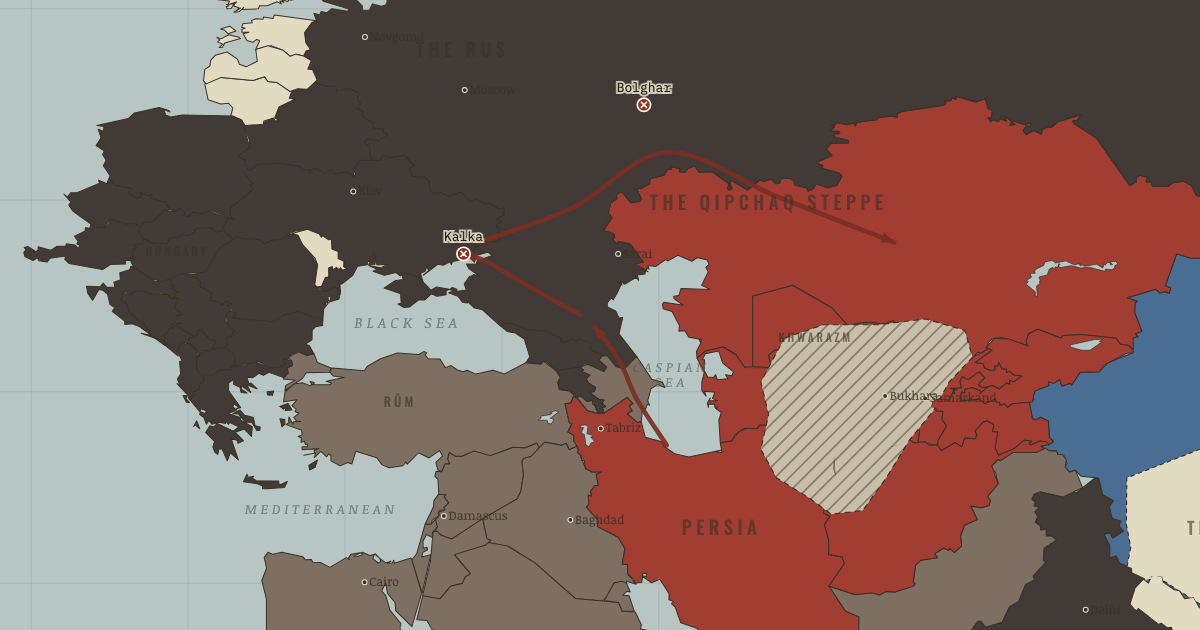
The expedition began as a pursuit and became a reconnaissance in force, meaning an operation that gathers intelligence while remaining strong enough to fight. Sent after Shah Muhammad, Jebe and Subötai pressed on past his death, crossing the Caucasus, defeating Georgian forces, and meeting the Alans and Qipchaqs on the open steppe. A Mongol offer persuaded the Qipchaqs to abandon their Alan allies, and the Mongols destroyed the isolated Alans before turning on the Qipchaqs in their turn. Diplomacy separated the opponents before a single major battle was fought.
The short answer
- Reconnaissance in force, as institution. Calling the raid a raid undersells the doctrine: the Mongols institutionalized deep reconnaissance in a way no contemporary did — years-long expeditions producing route surveys, political intelligence and client contacts, stored in a command culture (and in Subötai personally) that could act on them a decade later. The 1236 invasion (Ch. 6) follows this expedition’s map almost turn by turn. No European or Islamic power possessed anything comparable; most could not have named the Mongols’ ruler.
- The steppe road runs both ways. Geography that had always funneled nomads west — Huns, Avars, Magyars, Qipchaqs — was now organized under one command for the first time. The raid proved the corridor was open at will: from the Caucasus to the Dnieper, the horsemen never left grass. Remember Chapter 1: pasture is logistics, and the corridor is paved with it.
- A coalition of the mutually suspicious. The Rus response previewed every failure to come: three princes named Mstislav, jealous of each other, no unified command, the vanguard racing ahead for glory while rivals dawdled. At the Kalka one contingent watched from a fortified camp as the others died. The princes had spent the previous decades fighting each other — and the Mongols, at Otrar as at the Kalka, had a genius for arriving where politics had already done half their work.
THE TURNING POINT
The Kalka, 31 May 1223 — and the morning after. The battle is the hinge less than the response to it. A shattering defeat by an unknown enemy was, on the evidence, survivable — if it triggered intelligence-gathering, watch on the steppe frontier, defensive union. It triggered nothing: the raiders vanished, the princes resumed their feuds, and the chronicles filed the Tatars under divine punishment rather than military problem. Thirteen years of warning were available and none was used. The hinge of 1237–40 is here, in the not-learning.
What it changed
Europe’s file stays empty; the Mongol file fills. Asymmetric information becomes the campaign plan: when Batu and Subötai return in 1236, they know the fords, the winter conditions, the Bulgar defenses and which princes hate which. Their victims still know “only God.” Weigh how much of Chapter 6’s speed is bought in Chapter 5.
The Qipchaq steppe changes owners in advance. The raid broke Qipchaq power a decade before the conquest confirmed it; the survivors’ flight west in the 1230s — forty thousand tents seeking asylum in Hungary — will drag Hungary itself into the storm’s path. On this map, refugee movements are load-bearing events.
A legend with consequences. Reports of a mysterious eastern power smashing Muslims briefly convinced crusading Europe that “Prester John” or King David had come — some historians link the Fifth Crusade’s fatal optimism at Damietta to these rumors. When the truth arrived two decades later, it arrived at Legnica. Bad intelligence, note, can be worse than none.
The full answer, argued
The Mongols had experienced commanders whose job included gathering and preserving operational knowledge. Subötai could use what the expedition learned when he returned more than a decade later. Rus rulers lacked a shared institution for frontier planning, and the Mongol withdrawal made the danger seem temporary. Religious interpretation was not simple ignorance, but it did not supply routes, scouts or unified command. One side converted a rare encounter into doctrine; the other returned to immediate local rivalries.
An interesting fact
Measure the raid and it stands alone: the first recorded circumnavigation of the Caspian Sea by an army — some 8,000 kilometers by most modern reckonings, a dozen battles, three years, no resupply and no reinforcement from home. Military historians from Basil Liddell Hart onward have treated it as a benchmark of operational art, and Subötai as one of the great commanders of any century. Jebe never filed his report — the sources simply lose him on the road home, most likely to illness in 1224 or 1225.
This is the study layer of Jebe and Subutai’s great raid, chapter 5 of The Mongol Empire, 1206–1294; the full index of the atlas is here.
Related questions
THE FREE PRINTABLE STUDY GUIDE
Join the Dispatch — a short welcome series, then a letter when a new atlas opens — and the printable study guide for The Mongol Empire is yours now, free.
NO TRACKING · YOUR ADDRESS IS USED FOR THE DISPATCH AND NOTHING ELSE · UNSUBSCRIBE ANYTIME