Mongol Empire · 1206
Why could steppe nomads beat richer settled empires?
The seminar question: “Settled empires were richer, more populous and technologically ahead. Why did the steppe repeatedly produce armies they could not match?”
Before 1206 a grassland corridor from Mongolia toward Hungary supported mobile herding, so steppe peoples could raise skilled mounted archers quickly and cheaply. Their weakness was disunity: Tatars, Kereyids, Naimans, Merkits and Mongols feuded endlessly, while the Jin dynasty of north China backed one group against another.
WW2 is free — every chapter. Try chapters 1–2 of any 2 other atlases (3 with a free account). Opening a new atlas uses one of them. Membership opens all 21 — Join.
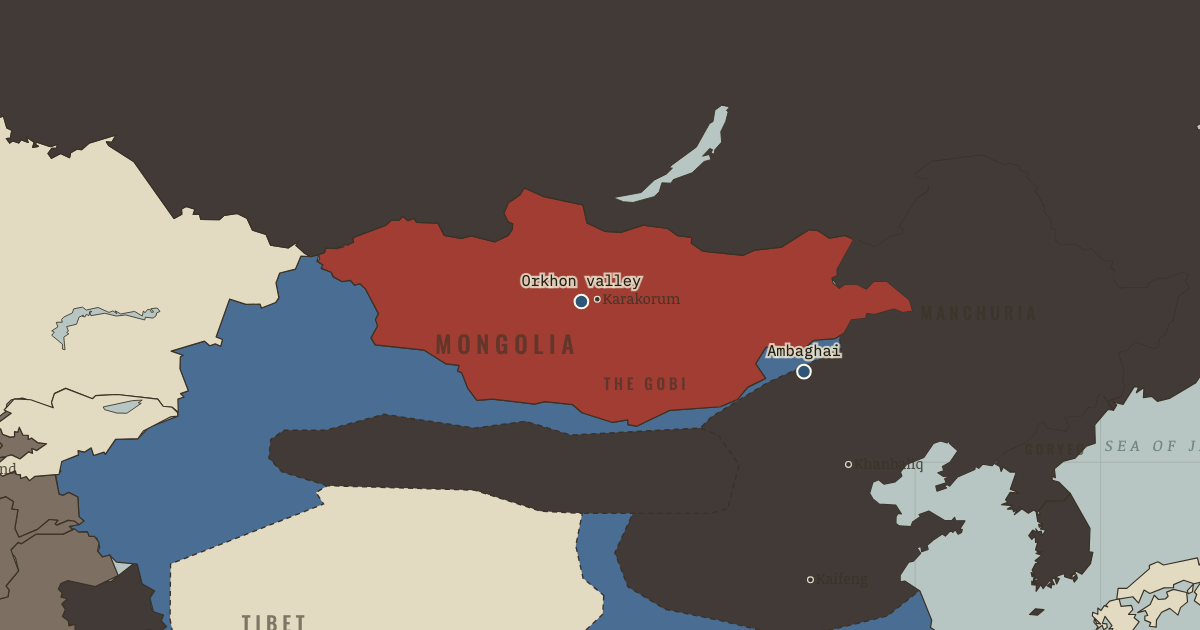
The steppe’s military advantage began with grass, which functioned as a supply system. Herding families moved with animals that carried them and fed them, so an army drawn from those households needed little of the wagoned grain that tied settled forces to roads and depots. Children learned to ride and shoot early, and the great communal hunts trained thousands of riders to encircle prey, follow signals and hold formation. The composite bow, built from wood, horn and sinew, was short enough to draw from horseback yet powerful at a distance. Together these habits gave the plateau a standing reservoir of skilled cavalry at a cost no farming state could match.
The short answer
- An ecology that manufactures cavalry. The steppe cannot feed dense populations, so it selects for mobility: five horses per rider, herds as rations on the hoof (mare’s milk, blood, dried curd), felt tents struck in an hour. A nomad army needs no supply train — its logistics graze. That single fact explains half of what follows: campaigns in winter, across deserts, at distances no settled army could contemplate.
- The composite bow and the decimal habit. The recurved composite bow packed a longbow’s power into a weapon usable at full gallop, and steppe hunts — the great ring-drives called nerge — rehearsed thousands of riders in encirclement, signaling and timed movement. What Temüjin will add is organization: units of 10, 100, 1,000 and 10,000 that deliberately mix tribes, so a soldier’s loyalty runs to his unit and his khan, not his clan.
- Divide-and-rule from the settled south. Jin policy treated the steppe as a fire to be managed: pay the Tatars to destroy the Mongols’ khan (see the Ambaghai marker), then arm others against the Tatars when they grew strong. It worked for a century — and it taught every steppe leader that the settled world was not a neighbor but a predator. The system’s one failure mode: a unifier it couldn’t divide.
- A crisis generation. Twelfth-century chronicles describe worsening feuds and, some historians argue from tree-ring data, a cooling, drying spell squeezing the pastures. Whether or not climate lit the fuse, the social material was explosive: too many armed young men, too little order, and a code — revenge as sacred duty — that kept every wound open.
THE TURNING POINT
A khan nailed to a wooden mule, c. 1156. The Jin’s execution of Ambaghai Khan, delivered to them by Tatar treachery, is the wound the Mongol world organizes itself around for fifty years. It fixes two convictions in the steppe mind: the tribes betray each other, and the settled empire pays them to do it. Temüjin’s answer to both — dissolve the tribes, then destroy the empire — is this atlas’s whole plot.
What it changed
A military revolution waiting for a manager. All the components of the world-conquering army — bow, remounts, hunt-discipline, hardiness — already exist in 1206. Nothing on this map changes technologically in the next twenty years. What changes is organization and command, which is worth reflecting on: the deadliest weapon of the thirteenth century was a personnel system.
The steppe corridor as a strategic fact. Because grass runs unbroken from Mongolia to Hungary, a power that controls pasture can project force along the whole corridor at horse-speed. Every westward arrow you will see on this map — 1223, 1237, 1241 — travels that green highway. Where the grass ends, as you will see, so does the tide.
The Jin’s playbook expires. Divide-and-rule dies the moment the steppe has one ruler; then the subsidies stop, the ledger of grievances comes due, and the wall-builders discover walls have gates and gates have traitors. Chapter 3 is that discovery.
The full answer, argued
Settled states had more people and wealth, but converting those resources into mobile armies took time, taxes and supply lines. Steppe households already possessed horses, riding skill and portable food. That gave a united confederation a high rate of mobilization at relatively low cost. The advantage was conditional, however. It depended on political unity and access to pasture. Temüjin removed the first limit in 1206; forests, wet farmland, deserts without grazing and open sea continued to impose the second.
An interesting fact
The bow itself was slow manufacture: horn, sinew and birch laminated with fish glue and cured for a year or more, so every rider carried a small workshop’s patience on his back. Fittingly, the oldest surviving monument in the Mongolian script — the “Genghis Stone,” carved around 1225 and kept today in the Hermitage — commemorates not a conquest but a shot: the khan’s nephew Yisüngge putting an arrow out to 335 alds, roughly half a kilometer. The distance may be flattered; the priorities are not — a world empire’s first stone inscription is an archery scorecard.
This is the study layer of Mongolia before Genghis Khan, chapter 1 of The Mongol Empire, 1206–1294; the full index of the atlas is here.
Related questions
THE FREE PRINTABLE STUDY GUIDE
Join the Dispatch — a short welcome series, then a letter when a new atlas opens — and the printable study guide for The Mongol Empire is yours now, free.
NO TRACKING · YOUR ADDRESS IS USED FOR THE DISPATCH AND NOTHING ELSE · UNSUBSCRIBE ANYTIME