Mongol Empire · 1216
Did captured siege engineers win the Mongols north China?
The seminar question: ““The Mongols won because captured engineers gave them siege engines.” What does this popular explanation get right — and what does it miss?”
Between 1209 and 1234 the Mongols learned siege warfare by recruiting engineers and administrators from conquered peoples, first against Xi Xia and then against the Jin dynasty of north China. After the Jin field army was destroyed at Yehuling, Zhongdu fell in 1215; the Jin were finished in 1234 with Song help.
Chapter 3 is part of membership. WW2 is free — every chapter. Try chapters 1–2 of any 2 other atlases (3 with a free account). Opening a new atlas uses one of them. Membership opens all 21 — Join.
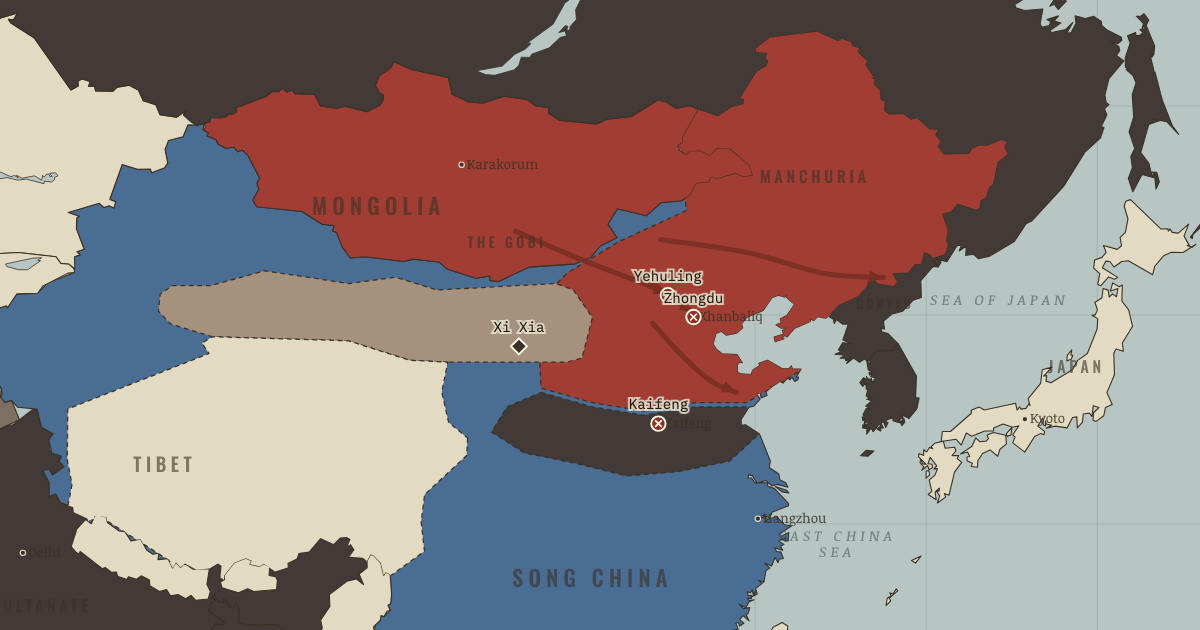
The Xi Xia campaign exposed the central problem plainly, because horse archers could surround a city but could not force its walls, and the early Mongol assaults failed, including a scheme to flood a capital that instead drowned the besiegers’ own camp. The response was practical and lasting: captured specialists were pressed into service and moved on to later fronts. By the opening of the Jin war in 1211 the army was becoming a combined force of cavalry, engineers and local infantry rather than a pure cavalry host.
The short answer
- Why the walls failed now. Not because of new weapons — trebuchets and siege towers were ancient — but because of a new employer. Steppe armies had never held engineers, and Chinese ones had never lacked them; the Mongol innovation was systematically transplanting the settled world’s siegecraft into a nomad war machine, with pay, status and their lives as the offer. Within a decade the “barbarians” besieged cities better than the dynasties that invented the tools, because they hired from everyone and answered to no defensive tradition.
- A conquest dynasty’s fatal seams. The Jin were themselves foreign conquerors — a Jurchen minority atop resentful Chinese and displaced Khitans, garrisoned apart, taxed apart. The Mongols didn’t have to defeat one state; they had to pull three peoples apart, and did: Khitan commanders defected early (one, Yelü Chucai, became the empire’s great administrator), Chinese warlords took Mongol titles, and the “Chinese” war was fought substantially by Chinese against the Jin.
- Geography turned inside out. Jin power depended on holding both the steppe frontier and the river plains; the dynasty’s flight to Kaifeng in 1214 surrendered the frontier zone — and with it the horse pastures that mounted its own cavalry. After 1215 the Jin fought horse-archers without horses, behind rivers, with rebellion at their backs: the strategic position of a fish in a draining pond.
- Tribute misread as peace. The Jin paid the 1214 ransom as their ancestors had always paid nomads — buying a raider’s departure. But the yassa state was not a raider: to Genghis, accepted tribute meant accepted submission, and the emperor’s flight afterward was rebellion. Two diplomatic grammars collided; the misunderstanding cost the Jin the north. Hold onto that pattern — Khwarazm is about to repeat it at a larger scale.
THE TURNING POINT
Zhongdu, May 1215. The fall of the Jin capital is the hinge not for what was destroyed but for what was absorbed: archives, clerks, mints, and engineers by the hundred. Here the horde acquires the two capacities that separate world conquerors from raiders — the ability to take any fortification on earth, and the beginnings of an administration that could hold what it took. After 1215, no wall on this map means what it meant before.
What it changed
The siege problem is solved for a century. From here the specialists travel with every army: Chinese engineers batter Samarkand and Baghdad; Muslim engineers’ counterweight trebuchets crack Xiangyang (Ch. 10). Watch technology flow along the arrows for the rest of this atlas — the empire functions as a single labor market for military skill.
A treasury and a bureaucracy. North China’s revenue makes the Mongol state rich enough to wage continuous war, and Yelü Chucai’s census-and-tax system (Ch. 7) proves peasants yield more farmed than massacred — an argument he reportedly won by arithmetic against a proposal to turn the plains to pasture. Millions of lives hung on that memo.
Xi Xia’s lesson in vassalage. When the Tanguts refuse troops for the western war and then defect, the response (1227) is annihilation — see the Zhongxing marker. The message writes the empire’s client-state rulebook: vassalage is not alliance, and it is enforced retroactively. Korea, Rûm and the Rus principalities will all be governed by that precedent.
The Song open the door. By joining the kill at Kaifeng, the Song regain old provinces for one summer and buy a 45-year war for their existence. Their own strategists warned of exactly this — “lips gone, teeth cold,” the old proverb about letting a buffer state die. Chapter 10 collects the debt.
The full answer, argued
Captured engineers were necessary because cavalry alone could not take major fortifications. But the Jin already possessed siege technology, so machines by themselves do not explain the outcome. The larger advantage was the Mongols’ ability to absorb foreign specialists, defecting officers and local soldiers into one expanding command system. Jin ethnic divisions and the capital’s retreat weakened resistance. The conquest was won through personnel, politics and logistics as much as through hardware.
An interesting fact
The Jin went down fighting with weapons Europe would not see for another century. Their own dynastic history describes the defense of Kaifeng in 1232: “heaven-shaking thunder” — cast-iron gunpowder bombs whose blast, the chronicle claims, carried for miles and whose fragments pierced iron armor — and fire-lances jetting flame at the sappers, among the earliest well-documented gunpowder weapons in any war. The conquerors absorbed these too, like everything else: thunder-crash bombs resurface in this atlas at Hakata Bay in 1274, aimed at samurai.
This is the study layer of Mongol conquest of the Jin dynasty, chapter 3 of The Mongol Empire, 1206–1294; the full index of the atlas is here.
Related questions
THE FREE PRINTABLE STUDY GUIDE
Join the Dispatch — a short welcome series, then a letter when a new atlas opens — and the printable study guide for The Mongol Empire is yours now, free.
NO TRACKING · YOUR ADDRESS IS USED FOR THE DISPATCH AND NOTHING ELSE · UNSUBSCRIBE ANYTIME