Road to WW2 · 1935
Were weak sanctions on Italy worse than none at all?
The seminar question: “Britain and France chose not to close the Suez Canal or embargo oil. Was half-hearted sanction worse than none at all?”
Italy turned a clash at Wal Wal, inside Abyssinian territory, into a pretext for war, and in October 1935 its armies advanced from Eritrea and Somaliland. The League named Italy the aggressor but left oil out of its sanctions while Britain kept Suez open. Italian forces used mustard gas and entered Addis Ababa in May 1936.
Chapter 4 is part of membership. WW2 is free — every chapter. Try chapters 1–2 of any 2 other atlases (3 with a free account). Opening a new atlas uses one of them. Membership opens all 21 — Join.
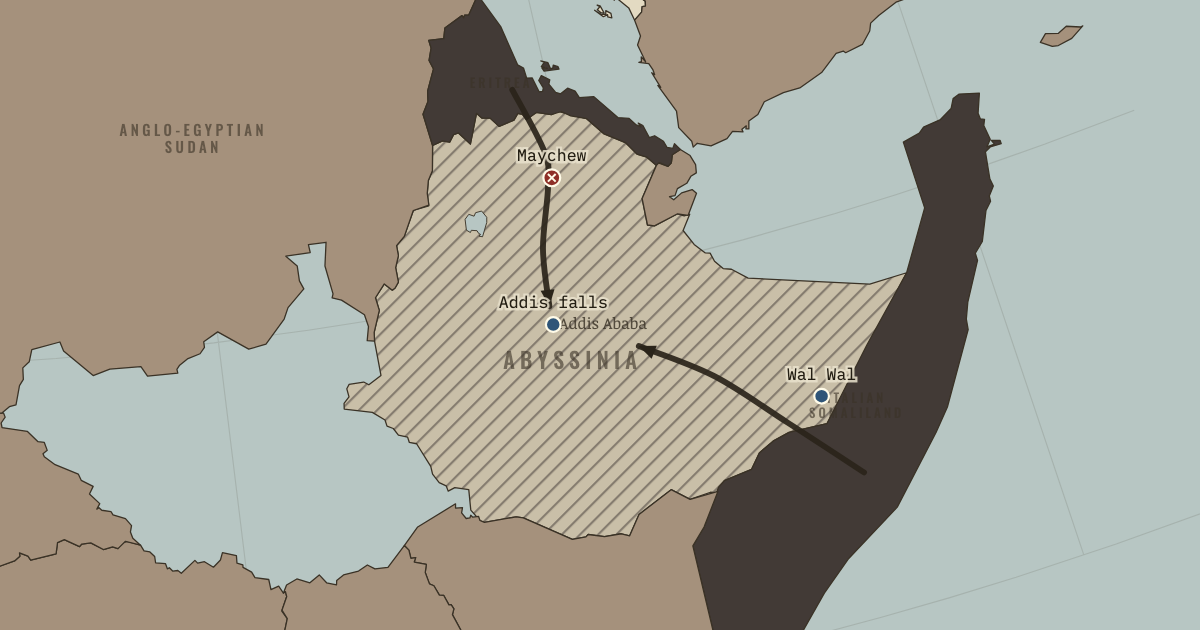
Italy turned the clash at Wal Wal, which occurred well inside Abyssinian territory, into the pretext for a war it had long intended to fight. Haile Selassie appealed to the League while Italian troops and supplies moved openly through the Suez Canal all year, an early sign of how little the machinery of Geneva frightened a determined aggressor. In October 1935 Italian armies advanced from Eritrea and Somaliland against a fellow member state, and the contest was desperately unequal from the start.
The short answer
- A regime that needed a triumph. Fascism sold itself as the antidote to Italy’s “mutilated victory” of 1918, and by 1934 the promised greatness was overdue: the corporate economy was stagnant and the movement middle-aged. A colonial war offered everything at once — revenge for Adwa (1896), employment for restless Blackshirts, and the “place in the sun” Liberal Italy had failed to win. The war was genuinely popular; sanctions made it more so, letting Mussolini cast a colonial land-grab as fifty nations bullying one.
- Britain and France wanted Italy against Hitler. The fatal calculation: after the Stresa conference (Ch. 3), London and Paris valued Mussolini as a counterweight to Germany — he had, after all, rushed troops to the Brenner when Nazis murdered Austria’s chancellor in 1934. Punishing him properly over Africa meant losing him in Europe; so they tried to do both halves of the impossible — sanction him enough to satisfy their publics, gently enough to keep his friendship — and achieved the exact opposite of each aim.
- The victim was inside the system. What made Abyssinia the League’s true test was that every box was ticked: both parties members, aggression documented, arbitration attempted, the Covenant’s Article 16 explicitly requiring sanctions. Manchuria had offered excuses — distance, China’s disorder. Here there were none. That is why contemporaries and historians alike date the League’s death not to Manchuria, which wounded it, but to Abyssinia, which exposed the wound as untreatable.
- Air power and gas against spears and rifles. Italy committed nearly half a million men, tanks and some 400 aircraft against an army largely of riflemen and feudal levies. When the mountains slowed the advance anyway, Badoglio turned to aerial mustard gas — sprayed on troops, villages and Red Cross units in defiance of the 1925 Geneva Protocol Italy had signed. Estimates of Ethiopian deaths in the war and the savage occupation that followed run from the tens of thousands into the hundreds of thousands; the Ethiopian government later claimed some 760,000 in all. The gap in those numbers is itself part of the record.
THE TURNING POINT
Paris, December 1935. The Hoare–Laval pact is the hinge because it revealed the system’s two guarantors negotiating against their own verdict: while the League’s sanctions machinery — built and led by Britain and France — was formally squeezing the aggressor, the British and French foreign ministers were privately offering him most of the prize. The leak cost Hoare and Laval their offices but the damage was structural: every small state in the League drew the conclusion that collective security was a great-power convenience, and began hedging. Belgium returned to neutrality within the year; the states of the Little Entente started making their own arrangements. Deterrence is a reputation, and reputations die of exposure, not of defeat.
What it changed
The Stresa Front becomes the Axis. Sanctioned by his Stresa partners while Germany stayed benevolently neutral (and kept buying Italian goods), Mussolini reversed his alignment inside a year: October 1936 brings the Rome–Berlin “Axis” speech, 1937 Italy’s adhesion to the Anti-Comintern Pact and exit from the League. The man who had guarded Austria’s independence in 1934 sold it in 1938.
Hitler moves while the referee is distracted. With Britain, France and Italy consumed by the African crisis and each other, Germany remilitarized the Rhineland in March 1936 — the subject of the next chapter, and a gamble Hitler explicitly timed to the League’s Abyssinian paralysis.
Collective security is abandoned in practice. Sanctions were lifted in July 1936 — Ethiopia annexed, nothing gained. Small states drew consequences: Belgium abandoned its French alliance for neutrality (removing the planned battlefield of French defense), and the phrase “collective security” disappears from serious planning until it reappears, in 1945, as the UN Charter’s attempt to fix exactly this failure — with great-power enforcement built in.
The full answer, argued
Arguably yes — and this is the enduring policy lesson the episode teaches. Full pressure had a real chance of working: Italy’s war ran on imported oil, Mussolini later admitted an oil embargo would have forced him out “within a week” (self-serving, but the fuel margins were genuinely thin), and the Royal Navy commanded the route his army supplied. No pressure would at least have preserved Italy’s alignment against Hitler — the Stresa logic. The middle course delivered neither: it enraged Italy into Germany’s arms while saving Ethiopia nothing. Defenders of London and Paris answer that publics demanded action, navies feared a Mediterranean war, and the American oil trade (outside the League) would have leaked through any embargo. The debate is the ancestor of every modern sanctions argument; what it settled is that sanctions are a weapon, not a gesture — sized for effect or better sheathed.
An interesting fact
Haile Selassie’s Geneva speech of 30 June 1936 was delivered in Amharic — the first time a head of state had addressed the Assembly in person to plead his own country’s case — and Italian journalists in the gallery blew whistles to drown him out until the Romanian delegate, Nicolae Titulescu, shouted for the ejection of “the savages.” Time magazine had already made the Emperor its 1935 Man of the Year. In 1963, twenty-seven years later, it was Haile Selassie — restored by the war he had prophesied — who hosted the founding of the Organisation of African Unity in the same Addis Ababa the map shows falling.
This is the study layer of Italian invasion of Abyssinia, chapter 4 of The Road to War, 1931–1941; the full index of the atlas is here.
Related questions
THE FREE PRINTABLE STUDY GUIDE
Join the Dispatch — a short welcome series, then a letter when a new atlas opens — and the printable study guide for The Road to War is yours now, free.
NO TRACKING · YOUR ADDRESS IS USED FOR THE DISPATCH AND NOTHING ELSE · UNSUBSCRIBE ANYTIME