Road to WW2 · 1931
How far did economics rather than ideology cause WW2?
The seminar question: “How far was the road to war laid by economics rather than ideology?”
From 1929 the Great Depression cut world trade by roughly a third and discredited governments that defended free trade. Japan’s silk exports roughly halved and its farm villages fell into destitution, while in Germany the slump drove the Nazi vote toward a mass following. Yet many countries weathered it without turning to war.
WW2 is free — every chapter. Try chapters 1–2 of any 2 other atlases (3 with a free account). Opening a new atlas uses one of them. Membership opens all 21 — Join.
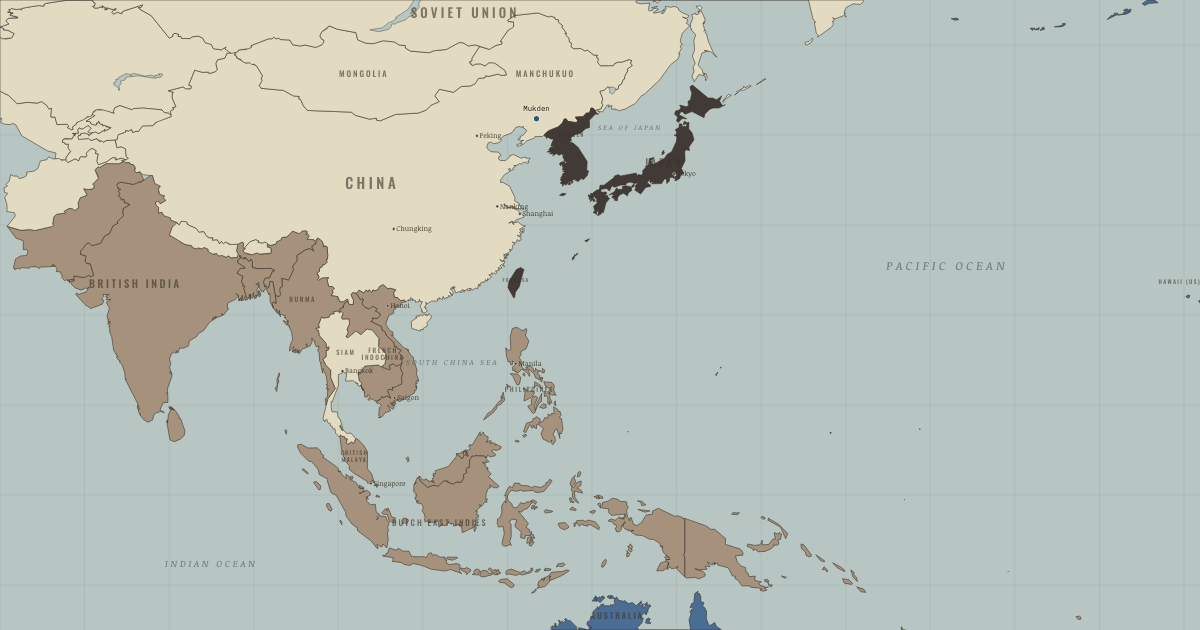
Before any territory changed hands, the Pacific already held the tension that would break it, which is why the map rewards a careful look before it moves. Japan had built a modern empire in two generations, holding Korea, Taiwan and a scatter of Pacific islands, yet it depended on imported oil, metals and markets it could not control. The European powers and the United States held most of Southeast Asia, from the oil of the Dutch East Indies to British Malaya. China, the largest prize of all, was unified only on paper under Chiang Kai-shek and in practice divided among rival warlords and a communist insurgency. The order looked stable, but it rested on the assumption that the have-not powers would go on accepting their place within it.
The short answer
- The Depression discredited the open world. World trade fell by roughly two-thirds in value between 1929 and 1933, and every industrial country retreated behind tariffs — America’s Smoot–Hawley (1930), Britain’s imperial preference (1932). For have-not powers without empires to retreat into, autarky became a strategic argument: if the world is closing into blocs, seize a bloc of your own. Japanese planners called Manchuria a “lifeline”; Hitler would call the east “living space.” Same syllogism, five thousand miles apart.
- The Washington order had no enforcer. The 1920s Pacific ran on the Washington treaties: naval ratios, the Open Door in China, consultation. But the system assumed good faith and provided no policeman — the United States would not commit force, Britain could not afford to, and the League of Nations had no army at all. The order was real enough to constrain governments that believed in it, and invisible to soldiers who did not. In 1931 the Kwantung Army ran the experiment.
- Japan’s army answered to no cabinet. By constitutional custom the Japanese army reported to the Emperor, not the prime minister — and its field commands increasingly reported to no one. Officers of the Kwantung Army, garrisoning Japan’s railway concession in Manchuria, had already assassinated the local warlord Zhang Zuolin in 1928 and gone unpunished. The civilians in Tokyo knew another plot was coming in 1931; the army minister sent a general to restrain it, and he began by telling the plotters he was coming. Insubordination that succeeds becomes policy.
- China looked weak enough to bite. Chiang Kai-shek’s Nationalist government had unified China on paper in 1928, but in 1931 it was fighting communist bases in the south, feuding warlords everywhere, and — that summer — catastrophic Yangtze floods. Tokyo’s radicals judged, correctly in the short run, that Nanking would answer an invasion with lawyers rather than armies. What they misjudged was the long run: humiliation is a renewable resource, and Chinese nationalism fed on every concession.
THE TURNING POINT
Mukden, the night of 18 September 1931. The world this chapter describes ends at the ✕ on the Manchurian railway line. Not because the explosion was large — it barely bent the rails — but because it was the first time a great power’s army simply took what the postwar order said could no longer be taken, and the order did nothing. Every capital on both maps watched the experiment run. The next chapter walks through it hour by hour; this one only asks you to notice how normal the world still looked the evening before.
What it changed
A pretext is prepared. Through the summer of 1931, Kwantung Army staff officers Ishiwara and Itagaki planned their incident down to the placement of the explosive charge. The next chapter opens with the night they lit it.
The weimar center collapses. The same slump plays out on the Europe map: the Weimar Republic’s last majority government fell in 1930, and by late 1932 the Nazis are the largest party in a parliament that can no longer form one. Chapter 3 begins with the handshake that ends the republic.
Rearmament becomes thinkable. The Depression also disarmed the defenders. The democracies cut military budgets to the bone; Britain’s “ten-year rule” assumed no major war. Every aggressor in this atlas therefore begins with a head start that the treasuries of London, Paris and Washington voted for.
The full answer, argued
The correlation is uncomfortable: no Depression, no Nazi majority — the party polled 2.6% in prosperous 1928 and 37% in desperate 1932 — and Japan’s military radicals rode the same wave of rural misery. But economics chose neither the destination nor the methods. Weimar Germany and Japan both had liberal, internationalist options on the ballot; what the slump did was discredit them and hand prestige to men who had always wanted conquest and now had an audience. Most historians therefore treat the Depression as the enabling condition — it opened the door — while ideology and institutions (a Japanese army outside civilian control, a German conservative elite willing to deal) decided who walked through it. The transferable lesson: economic catastrophe does not make aggression, but it dissolves the antibodies against it.
An interesting fact
The Japanese term for the era’s anxiety was “ABCD encirclement” — America, Britain, China, the Dutch — but in 1931 Japan was still, on paper, one of the world’s most respected citizens: a founding member of the League of Nations with a permanent Council seat, and the League’s deputy secretary-general was a Japanese diplomat, Nitobe Inazō, whose face now appears on the 5,000-yen note. The first great power to wreck the League’s authority was one of its architects.
This is the study layer of Great Depression and causes of WW2, chapter 1 of The Road to War, 1931–1941; the full index of the atlas is here.
Related questions
THE FREE PRINTABLE STUDY GUIDE
Join the Dispatch — a short welcome series, then a letter when a new atlas opens — and the printable study guide for The Road to War is yours now, free.
NO TRACKING · YOUR ADDRESS IS USED FOR THE DISPATCH AND NOTHING ELSE · UNSUBSCRIBE ANYTIME