Road to WW2 · 1938
Was Munich a betrayal, a blunder or the best option?
The seminar question: “Was Munich a betrayal, a blunder, or the best of the bad options available to Chamberlain in September 1938?”
Germany annexed Austria in March 1938, leaving Czechoslovakia nearly surrounded. Hitler then used the grievances of the Sudeten Germans to manufacture a crisis, and at Munich on 29–30 September Britain and France agreed to hand the Sudetenland to Germany, while Czechoslovakia and the Soviet Union were excluded from the talks.
Chapter 7 is part of membership. WW2 is free — every chapter. Try chapters 1–2 of any 2 other atlases (3 with a free account). Opening a new atlas uses one of them. Membership opens all 21 — Join.
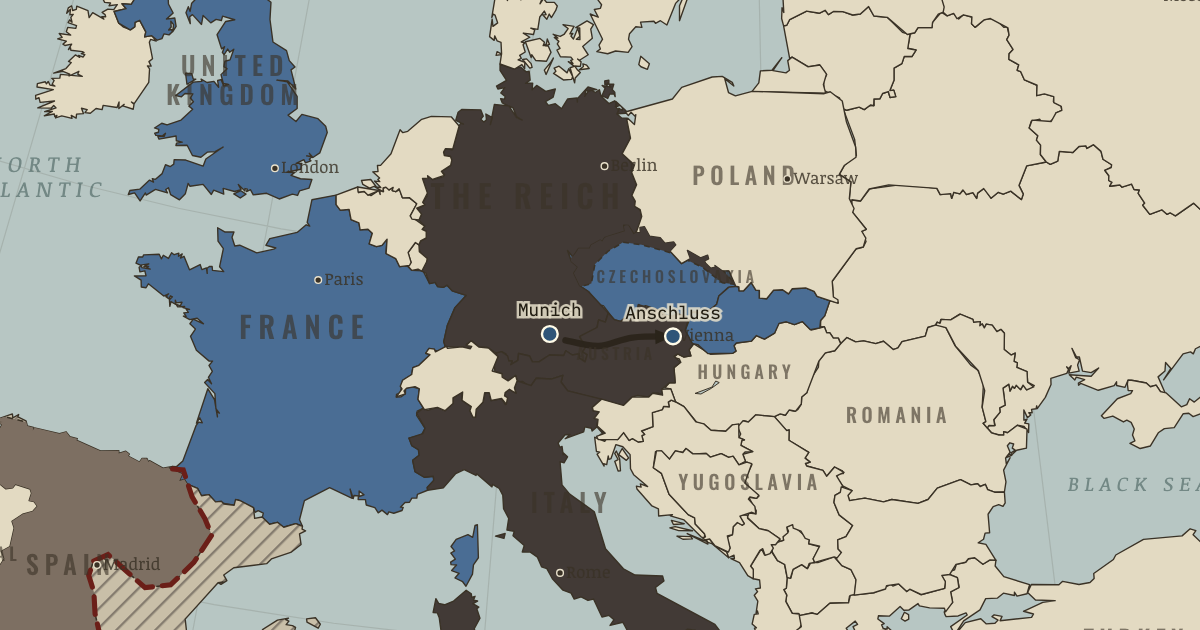
German troops entered Austria in March 1938, and the country was annexed to the Reich. Public celebration went hand in hand with immediate persecution, above all of Austria’s Jews. The annexation also reshaped the map, placing German territory on three sides of Czechoslovakia and leaving the democracy that France was pledged to defend nearly surrounded.
The short answer
- The bomber, the trenches and 1914. Appeasement was not mere cowardice; it was a theory of the world held by serious men with terrible memories. The guiding nightmares: another 1914, in which alliance mechanics turned a border dispute into civilizational slaughter; and the new dread — Baldwin’s “the bomber will always get through” — inflated by air-staff casualty projections for London that proved tenfold too high, and made vivid by Guernica (Ch. 5). If war meant the immediate destruction of cities, then almost any negotiated revision was cheaper. The premise was wrong about 1938 but not absurd; it had merely mistaken which decade’s war it was preventing.
- A grievance with real content, exploited in bad faith. Many British policymakers privately conceded that Versailles had wronged Germany — and the Sudeten Germans, drafted into a state they hadn’t chosen in 1919 and hit hardest by the Depression, had authentic complaints Czechoslovak policy had only partly addressed. Appeasement’s intellectual core was the belief that satisfying legitimate grievances would separate reasonable Germans from Hitler, or Hitler-the-nationalist from Hitler-the-conqueror. The Sudeten crisis was engineered precisely to weaponize that decency: self-determination as siege engine.
- The military arithmetic was contested — then and now. Chamberlain’s advisers told him Britain could not save Czechoslovakia (true: no British army could reach Bohemia) and was two years from air-defense readiness — the “buying time for radar and Spitfires” defense of Munich. Against it: Czechoslovakia’s thirty-five divisions behind mountain fortifications, France’s hundred divisions facing five German ones in the west, German generals so alarmed that a group around Beck and Halder planned a coup if war came — and the year bought armed Germany faster than it armed Britain, while handing over the Czech army whole. The balance of scholarship now leans against Munich’s military logic, but honest accounting admits the decision-makers lacked what we have: the German archives.
- France had subcontracted its policy. The treaty obliging action was French, not British — France had promised Prague since 1924. But French planning was defensive, French politics fractured, and Daladier (who, unlike Chamberlain, believed Hitler’s appetite was unlimited and said so) judged France could not fight without Britain. So the decision migrated to London, which had no treaty with Czechoslovakia at all. The crowds that cheered Daladier at Le Bourget expected to be jeered; “the fools,” he reportedly murmured. Appeasement was in part a failure of alliance mechanics: each democracy waiting for the other’s spine.
THE TURNING POINT
Munich, 29–30 September 1938. Munich is the word every later generation reaches for when it debates concession, which is precisely why it needs careful handling. The turn is real: it is the last moment Hitler could have been fought with Czechoslovakia’s army and fortifications on the board, and the moment the USSR — excluded from the conference table — began pricing a separate deal (Ch. 8). But the “Guilty Men” reading of 1940, in which cowards betrayed an easy victory, has been complicated by decades of archival work: Chamberlain’s rearmament programs, the Dominions’ refusal to fight for the Sudetenland, the French air force’s genuine nakedness. The mature judgment is harsher than either caricature: appeasement was a rational policy resting on one falsifiable premise — that Hitler’s aims were finite — and its authors kept the premise long after the evidence had killed it. March 1939 falsified it beyond argument; the pity is what falsification cost.
What it changed
Czechoslovakia is disarmed for its conquerors. The Wehrmacht that rolled into Prague in March 1939 (Ch. 8) — and into France in 1940 — did so partly on Czech steel: a third of the German army’s tanks in the French campaign were Czech-built 35(t)s and 38(t)s from the works Munich delivered. The democracies’ “peace” rearmed their enemy.
Stalin draws the Munich lesson. Excluded from the settlement of a crisis on his doorstep, Stalin concluded the West would happily point Hitler east. Litvinov, the Jewish champion of collective security, was replaced by Molotov in May 1939; the signal was received in Berlin. The road from Munich to the Nazi–Soviet Pact is direct.
The guarantee reflex. When Prague fell, Chamberlain reversed course in a weekend: guarantees to Poland, then Romania and Greece — commitments Britain could not physically fulfill, issued to deter rather than to fight. Deterrence issued from a reputation Munich had already spent traded at a discount; Hitler discounted it to zero.
The full answer, argued
Run the three verdicts against the evidence. Betrayal is the Czech verdict and morally unanswerable — a functioning democracy was dismembered by its friends, unconsulted; whatever else is argued, this stands. Blunder is the military-historical verdict: the year bought strengthened Germany relatively (Czech divisions and Škoda gone, German tank production up) even if it matured British radar and fighters — and the German coup plotters of September 1938, whatever their real chances, were never tested. Best-of-bad-options was Chamberlain’s own defense: no ally ready, Dominions opposed, publics desperate for peace, and a genuine chance — he believed — that Hitler’s aims were limited. The debate has never closed because it is really a debate about decision-making under uncertainty: Chamberlain’s error was not preferring peace, but structuring the choice so that only Hitler’s good faith could redeem it. When your policy requires your adversary’s honesty, the policy is the hostage.
An interesting fact
The Munich Agreement was signed in the small hours in the Führerbau on Munich’s Königsplatz — and the document Chamberlain waved at Heston airport was not it, but a separate half-page Anglo-German friendship declaration he had asked Hitler to sign the next morning, drafted by Chamberlain himself over breakfast. Hitler signed it, by witnesses’ accounts, barely reading it. The building still stands; it is today a music conservatory, and the room where four powers dismembered a fifth is used for student recitals.
This is the study layer of Anschluss and the Munich Agreement, chapter 7 of The Road to War, 1931–1941; the full index of the atlas is here.
Related questions
THE FREE PRINTABLE STUDY GUIDE
Join the Dispatch — a short welcome series, then a letter when a new atlas opens — and the printable study guide for The Road to War is yours now, free.
NO TRACKING · YOUR ADDRESS IS USED FOR THE DISPATCH AND NOTHING ELSE · UNSUBSCRIBE ANYTIME