Road to WW2 · 1935
Why did so few statesmen take Mein Kampf seriously?
The seminar question: “Hitler wrote his program in Mein Kampf a decade before power. Why did so few statesmen believe him?”
Hitler became chancellor on 30 January 1933, and emergency decrees and the Enabling Act soon made his government a dictatorship. Germany left the League, regained the Saar by plebiscite in 1935 and announced conscription. Britain, France and Italy condemned the rearmament at Stresa, but their front soon broke.
Chapter 3 is part of membership. WW2 is free — every chapter. Try chapters 1–2 of any 2 other atlases (3 with a free account). Opening a new atlas uses one of them. Membership opens all 21 — Join.
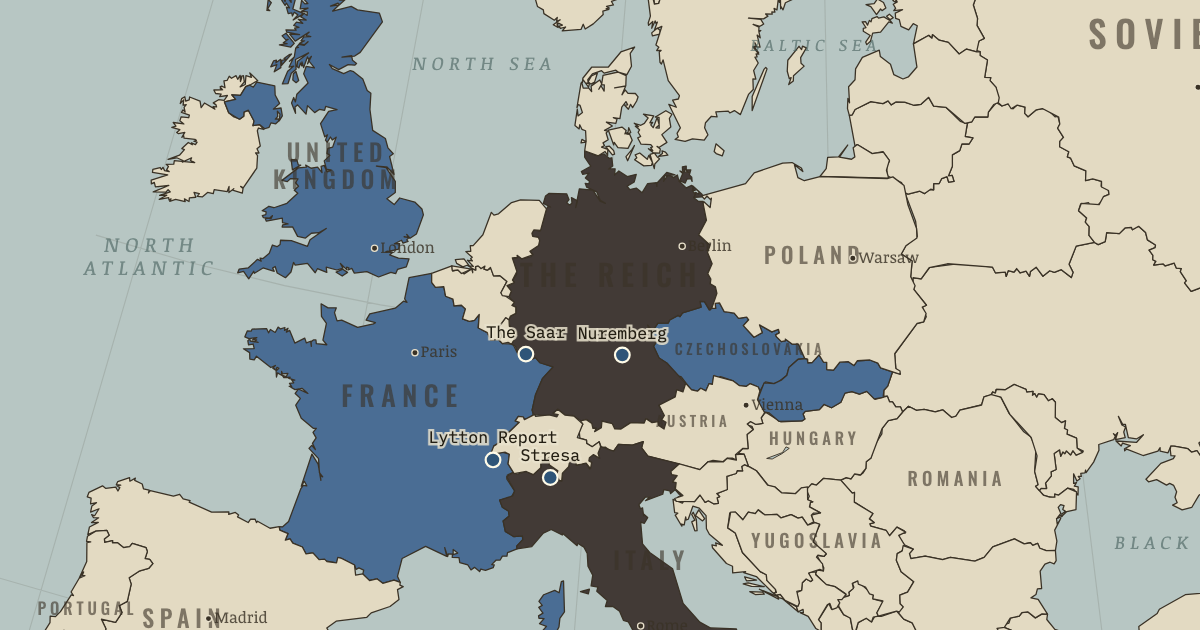
Conservative politicians made Hitler chancellor on 30 January 1933 because they believed his movement could be tamed and turned against the left, and this misjudgment is where the disaster begins. Once in office, the Nazis moved with a speed their sponsors had not imagined. Emergency decrees, organised intimidation and the Enabling Act swept away the constitution’s limits within weeks, converting a coalition post into a dictatorship. Germany left the League and the disarmament conference that same year, began rebuilding its army in defiance of Versailles, and made the persecution of its own citizens a matter of state policy.
The short answer
- A republic died of its rescuers. Weimar’s final crisis was managed by men who despised it: from 1930 chancellors governed by presidential decree, and the conservative clique around Hindenburg — Papen above all — decided the mass movement they could not beat could be hired. “Within two months we will have pushed Hitler so far into a corner that he’ll squeak,” Papen promised. The lesson historians draw is institutional: the Nazis never won a majority in a free election; they were installed by elites who preferred an authoritarian gamble to a left-leaning democracy.
- Versailles was a grievance engine. The 1919 settlement was severe enough to enrage Germans and lenient enough to leave Germany potentially the strongest state in Europe — the worst of both calibrations. Every party in Weimar sought revision; Hitler’s innovation was to pursue it by threat instead of conference, and to want infinitely more than revision. Because his early demands (equality of armaments, the Saar, later the Rhineland) could each be dressed as fairness, the democracies kept granting what looked like justice to what was actually a timetable.
- The disarmament trap. Britain and France had promised at Versailles that German disarmament would begin general disarmament. When the world conference finally met in 1932–33, France (twice invaded in living memory) demanded security before cuts, Britain demanded cuts before security, and Hitler walked out claiming Germany alone had been denied equality — a propaganda gift the conference’s failure gift-wrapped. His rearmament could thereafter be sold at home and abroad as catching up.
- The audience was divided by its empires. Nothing coordinated the potential restrainers. Britain’s priority was its global empire and its treasury; France’s was its border; Italy’s was its Mediterranean ambitions; the USSR was outside the system; America was outside the continent. Hitler’s foreign policy in 1933–35 consisted largely of offering each watcher a separate reassurance — a pact with Poland (1934), naval limits for Britain (1935) — so that no two of them ever moved together. Divide the audience and the stage is yours.
THE TURNING POINT
Stresa, April 1935. The conference on Lake Maggiore is the moment collective containment of Hitler exists on paper — Britain, France and Italy, jointly condemning German rearmament, reaffirming Austria’s independence. It is also the moment the paper is tested and fails: within ten weeks Britain has cut its separate naval deal, and within six months Mussolini — a founding member of the front — has invaded Abyssinia and been sanctioned by his co-signatories, driving him toward Berlin. Historians argue whether the Stresa Front ever could have held; what is certain is that Hitler never again faced three great powers standing together until 1941.
What it changed
The arms race resumes with one runner. By 1936 Germany is spending perhaps ten times what Britain spends on its army. The democracies begin serious rearmament only in 1936–37, and their programs mature — Spitfires, radar chains, the French tank divisions that came too late — on a schedule that makes 1938–39 the window in which Germany is relatively strongest. Hitler knows this; it is why he keeps accelerating.
Mussolini reads the room. The Duce concludes from Stresa’s collapse and the naval agreement that the old powers are unserious — and that his own imperial moment has arrived. The next chapter is his.
The Rhineland is now thinkable. With the Saar banked, conscription unpunished and the Stresa Front broken, the demilitarized Rhineland — Versailles’ last physical restraint on Germany — becomes Hitler’s obvious next slice.
The full answer, argued
Partly because he kept behaving, tactically, like a normal statesman: signing pacts, invoking fairness, taking plebiscites. Partly because believing him was expensive — if Mein Kampf was the plan, the only answers were rearmament or preventive war, and no democracy’s electorate in 1934 would fund either. And partly because of a genuine interpretive problem historians still argue: A.J.P. Taylor’s Origins of the Second World War (1961) claimed Hitler was an improviser who took what blundering opponents offered, while the intentionalist school (Trevor-Roper, Hillgruber) points to the book, the Hossbach conference and the consistent eastward drive as evidence of program. The record of 1933–35 supports a synthesis: fixed objectives, opportunist timing. Which means the statesmen’s error was not misreading any single move — each was ambiguous — but assuming ambiguity meant innocence. When an actor tells you his goals, weight the telling.
An interesting fact
The Saar plebiscite of January 1935 was policed by the League’s first true international peacekeeping force — 3,300 British, Italian, Dutch and Swedish troops — and the vote itself was scrupulously fair: secret ballots, international counting, no German troops within miles. The irony is complete: the League’s single most flawless operation delivered its territory to Hitler, and thousands of Saarlanders who had voted against him (or merely organized the No campaign) fled across the French border within the year.
This is the study layer of Hitler’s rise and German rearmament, chapter 3 of The Road to War, 1931–1941; the full index of the atlas is here.
Related questions
THE FREE PRINTABLE STUDY GUIDE
Join the Dispatch — a short welcome series, then a letter when a new atlas opens — and the printable study guide for The Road to War is yours now, free.
NO TRACKING · YOUR ADDRESS IS USED FOR THE DISPATCH AND NOTHING ELSE · UNSUBSCRIBE ANYTIME