Road to WW2 · 1941
Could Operation Barbarossa have succeeded?
The seminar question: “Could Barbarossa have succeeded — and what turns on the answer?”
Italy’s failures in Greece and North Africa drew Germany into conquering Yugoslavia and Greece in spring 1941 before it launched Operation Barbarossa on 22 June. It was also a planned war of annihilation: Babi Yar alone recorded 33,771 Jewish victims in two days. By December the advance had been halted short of Moscow.
Chapter 11 is part of membership. WW2 is free — every chapter. Try chapters 1–2 of any 2 other atlases (3 with a free account). Opening a new atlas uses one of them. Membership opens all 21 — Join.
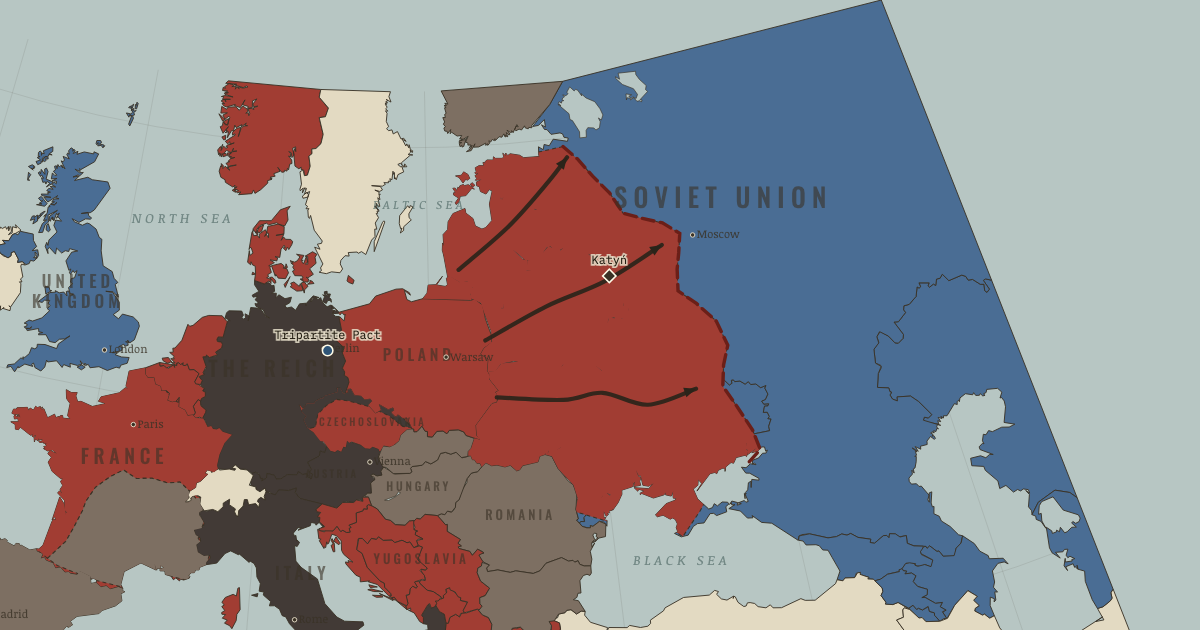
Italy’s failed attacks in Greece and North Africa forced Germany to come to the rescue, sending an expeditionary force to the desert and conquering Yugoslavia and Greece in the spring of 1941. Historians still debate how far this Balkan campaign delayed the invasion of the Soviet Union, since an unusually wet spring and the sheer scale of logistics also governed the date. Whatever the cause of the delay, the far larger project was already fixed.
The short answer
- The program had always pointed east. Whatever tactical opportunism governed 1936–40, Lebensraum in the East was the fixed star — in Mein Kampf, in the Hossbach conference (Ch. 5), in the economic planning for a blockade-proof continental empire. The Pact of 1939 was, on Hitler’s side, always a lease. The intentionalist–functionalist debate (Ch. 3) narrows here: even Taylor’s improvising Hitler improvised his way, within twenty months of maximum power, to exactly the war his book had promised.
- Britain’s survival made Russia the exit. The strategic logic Hitler gave his generals in July 1940 was elegant and mad: Britain fights on because it hopes for Russia (and America); kill the hope, win the war. Invading the largest country on earth as a way to defeat an island was strategy by chain of wishes — but it also reflected a real deadline Hitler named repeatedly: American power was growing yearly, and only a self-sufficient continental empire could face it. The window logic of 1938 (Ch. 7) at planetary scale.
- The underestimate was manufactured in Moscow. German intelligence put Soviet strength at roughly 200 divisions; by August 1941 it had identified 360. The error had Soviet co-authors: the purges of 1937–38 had shot or imprisoned most of the senior officer corps (three of five marshals, the majority of army and corps commanders), and Finland (Ch. 9) had displayed the wreckage. What the Wehrmacht met instead was depth — space, mobilization capacity, the T-34, and a regime willing to spend men at rates no planner had modeled. Berlin planned an eight-week campaign and issued no winter clothing; the clothing drives began in December, from German civilians’ closets.
- Stalin refused his own intelligence. Sorge from Tokyo, Churchill personally, deserters on the final night, his own frontier commands: the warnings were specific to the week. Stalin’s reasoning, reconstructed by historians, was not stupidity but a theory — Hitler would not fight two fronts; the warnings were British provocation to drag the USSR into Britain’s war; any Soviet mobilization might trigger the very attack it prepared for (the 1914 lesson, learned too well). The result: the largest army on earth was caught in barracks and airfields in parade rows. The first week cost the Red Army more aircraft than most nations possessed.
THE TURNING POINT
Berlin, 27 September 1940. The chapter’s pivot is not on the battlefield but at the signing table where the ● stands in Berlin: the Tripartite Pact, by which Germany, Italy and Japan pledged mutual defense against any power not yet in the war — a document with exactly one addressee, the United States. It is the moment the decade’s separate aggressions formally became one system, the two maps of this atlas acknowledging each other. And it framed every decision that followed: it emboldened Japan’s southern advance while guaranteeing that advance would be read in Washington as part of Hitler’s war; it let Roosevelt argue that aid to Britain and pressure on Tokyo were a single policy; and it did the one thing a deterrent must never do — raised the stakes for its target without raising its fear. When Barbarossa broke the Axis’s only common enemy narrative (Japan stayed neutral toward Moscow; Germany declared war on Washington unasked), the pact was revealed as what it had always been: a photograph of an alignment, not an alliance. The world war arrived through its frame anyway.
What it changed
The Holocaust enters its most murderous phase. Behind Barbarossa’s arrows, mass shooting became system: by the end of 1941 the Einsatzgruppen, Order Police and local auxiliaries had murdered on the order of a million Jews, and the Wannsee conference (January 1942) would bureaucratize what the East had begun. This atlas ends in December 1941; the crime it borders does not. It is named here because no map of this war is honest without it.
The Grand Alliance becomes possible. Churchill, anti-Bolshevik of thirty years’ standing, offered alliance the same evening (“If Hitler invaded Hell, I would at least make a favourable reference to the Devil”); American Lend-Lease was extended to Moscow by November. The coalition that wins the world war — capitalist empires and the Soviet state — was assembled by Hitler’s own hand in a single June morning.
Japan’s window opens — and closes. Barbarossa removed the Soviet threat from Japan’s rear (the neutrality pact holding) and seemed to guarantee Germany’s victory in Europe — both readings argued for striking south now, while the European empires were pinned. By the time the Siberian divisions counterattacked before Moscow — five days before Pearl Harbor — Japan’s fleet was already at sea.
The full answer, argued
The “lost victory” tradition (fed by German memoirs) blames the Balkan detour, the August diversion of armor to Kiev, and winter — implying a Moscow taken in October and a Soviet collapse. Modern operational scholarship (Glantz above all) has largely dismantled this: the campaign’s logistics were failing by August regardless of route — trucks, rail gauge, and distance did what no Soviet army yet could — and taking Moscow in 1812 had settled little. The deeper answer is political: the plan assumed the Soviet state was a “rotten structure” that would fall at the door’s kick; instead the regime relocated 1,500 factories eastward and mobilized reserves the plan said could not exist. What turns on the answer matters beyond military history: if Barbarossa was winnable, the world war’s outcome hung on a few marshal’s choices; if it was structurally doomed, then Hitler’s decade of successful gambles ended precisely where gambling met an opponent whose depth no bluff could reach. The evidence favors the second — with the sobering rider that “doomed” took four more years and most of the war’s dead to demonstrate.
An interesting fact
The Wehrmacht crossed the frontier alongside the fruits of the Pact it was breaking: the final Soviet grain train rolled west into German-held Poland less than two hours before the invasion began. Between 1939 and June 1941 the USSR had delivered to Germany roughly 1.5 million tonnes of grain, nearly a million tonnes of oil, plus rubber, manganese and phosphates transshipped along the Trans-Siberian — supplies that helped blunt the British blockade and fuel the very buildup on the border. Some deliveries were still being unloaded as the shooting started.
This is the study layer of Road to Operation Barbarossa, chapter 11 of The Road to War, 1931–1941; the full index of the atlas is here.
Related questions
THE FREE PRINTABLE STUDY GUIDE
Join the Dispatch — a short welcome series, then a letter when a new atlas opens — and the printable study guide for The Road to War is yours now, free.
NO TRACKING · YOUR ADDRESS IS USED FOR THE DISPATCH AND NOTHING ELSE · UNSUBSCRIBE ANYTIME