Crusades · 1229
Why was Frederick II condemned and Louis IX made a saint?
The seminar question: “Frederick II took Jerusalem by treaty and was condemned; Louis IX fought, failed, and was made a saint. What does that reveal about what the crusade was for?”
From 1218 the royal crusades targeted Egypt, whose wealth sustained Muslim power in the region. The Fifth Crusade took Damietta but was trapped by the Nile flood; the excommunicated Frederick II regained Jerusalem by treaty in 1229; and Louis IX was defeated and captured near Mansura after attacking Egypt in 1249.
Chapter 10 is part of membership. WW2 is free — every chapter. Try chapters 1–2 of any 2 other atlases (3 with a free account). Opening a new atlas uses one of them. Membership opens all 21 — Join.
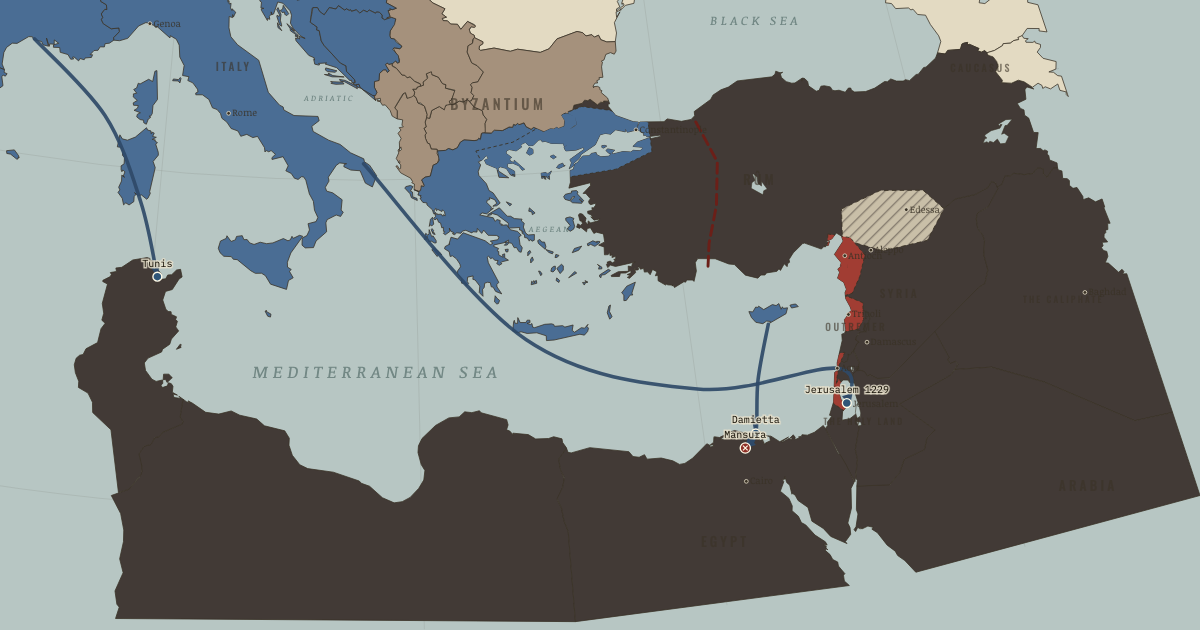
The strategy of the thirteenth-century crusades was correct, and it kept delivering their armies into the one environment where their strengths counted for least. Richard’s insight had hardened into orthodoxy, so the great expeditions aimed at Egypt, whose taxes, grain and fleets underwrote Muslim control of Jerusalem. The Fifth Crusade took Damietta, the fortress guarding the eastern branch of the Nile, in 1219, then rejected the sultan al-Kamil’s astonishing offer to trade Egypt for Jerusalem, marched on Cairo and was trapped by the annual flood, forced to hand back everything it had won. The target made strategic sense, but the delta itself, divided among channels, mud and defended crossings that local forces understood far better, was the graveyard of the plan.
The short answer
- The Egypt-first doctrine. Richard’s insight (Ch. 7) hardened into orthodoxy: the road to a secure Jerusalem ran through Cairo. It was correct in principle — and it repeatedly delivered crusading armies into the one environment, the flooding Nile delta, where their strengths counted for least and local knowledge counted for most.
- Diplomacy could do what war could not. Frederick II regained Jerusalem because al-Kamil, embroiled in a family power-struggle, found a treaty more useful than a war. The episode shows that the crusaders’ goal was sometimes obtainable — just not by the holy-war methods the movement was built to celebrate. Interests, aligned, opened the city that armies could not.
- The gap between piety and power. Louis IX brought unmatched devotion, careful preparation and personal courage — and failed, because none of it substituted for the logistics of campaigning in Egypt. His crusades are the definitive proof that holiness and competence are different virtues, and that the venture kept confusing them.
THE TURNING POINT
Jerusalem regained by treaty, 18 February 1229. The most revealing moment of the later crusades: an excommunicate emperor recovers the Holy City without a battle, by negotiation — and is condemned for it by the Church that preached the crusade. It exposes a contradiction at the heart of the movement: the crusade’s own logic valued holy war so highly that it could not celebrate the peaceful achievement of its central aim. What worked was precisely what the ideology could not honour.
What it changed
A treaty-held Jerusalem, then gone. Frederick’s Jerusalem was undefended and short-lived; in 1244 Khwarezmian mercenaries sacked it and an allied army was destroyed at La Forbie (watch the corridor vanish). The city was lost for the rest of the crusading period.
The Mamluks made. Louis IX’s defeat at Mansura was the making of the slave-soldier officers who, weeks later, overthrew the Ayyubid dynasty and took Egypt for themselves. The crusade that aimed at Egypt instead forged the military state that would destroy Outremer.
The centre of gravity moves to kings — and then away. Great royal expeditions replaced the baronial crusades of the twelfth century. But kings had kingdoms to run, and when they stopped coming, the crusader states were left with no one to relieve them. The road to Acre 1291 runs through the exhaustion of royal crusading.
The full answer, argued
It reveals that the crusade was judged by piety and method, not by results. Frederick achieved the movement’s stated central aim — a Christian-held Jerusalem — but did it as an excommunicate, through negotiation with Muslims, and so his success was treated as almost scandalous; Louis pursued the aim with perfect devotion, failed utterly, and was canonized. If the crusade had been a rational instrument of policy, Frederick would be its hero and Louis its cautionary tale. That the reverse is true tells us the crusade was fundamentally a religious and penitential act — a way of performing holiness through suffering and holy war — in which the manner mattered more than the outcome. Which is also why it kept failing at the practical task of holding territory: it was never only, or even mainly, about the territory.
An interesting fact
The Damascene chronicler Ibn Wasil preserves the most telling hour of Frederick’s Jerusalem. Staying overnight in the city in March 1229, the emperor noticed the muezzins had gone silent — the qadi of Nablus had suspended the call to prayer out of courtesy to the imperial guest — and objected: he had spent the night in Jerusalem, he said, chiefly to hear it. From the excommunicate who had just recovered the city for Christendom by treaty, the remark scandalized both sides — which is exactly why the Muslim sources kept it.
This is the study layer of Fifth to Eighth Crusades, chapter 10 of The Crusades, 1095–1291; the full index of the atlas is here.
Related questions
THE FREE PRINTABLE STUDY GUIDE
Join the Dispatch — a short welcome series, then a letter when a new atlas opens — and the printable study guide for The Crusades is yours now, free.
NO TRACKING · YOUR ADDRESS IS USED FOR THE DISPATCH AND NOTHING ELSE · UNSUBSCRIBE ANYTIME