Chinese Revolution · 1935
How much of the Long March’s importance is myth?
The seminar question: “How did the Long March’s founding story contribute to its historical importance, and how should we assess it?”
The Long March of 1934–35 began as a forced escape from the collapsing Jiangxi Soviet. The column lost perhaps half its strength at the Xiang River, Mao joined the military leadership at Zunyi in January 1935, and survivors reached Shaanxi in 1935 after crossing snow mountains and grasslands.
Chapter 7 is included with every paid plan. WW2 is free in full, and chapter 1 of every atlas is free. A free account opens 3 more chapters a day. Starter, at $9 a month, opens all 21 with no daily limit — see the plans.
Free printable Chinese Revolution study guide, sent by email ↓
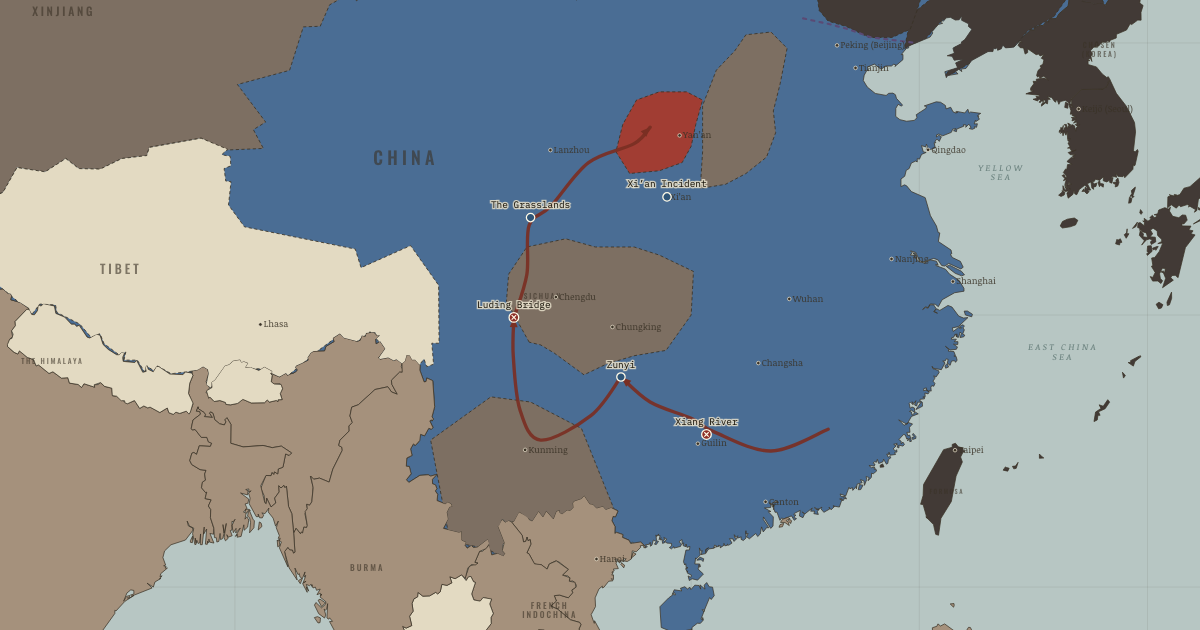
The three red arrows trace roughly 9,000 kilometers, but they can make the Long March look more purposeful than it was. The journey began with the collapse of the Jiangxi base in October 1934. Some 86,000 people broke out, carrying archives, treasury and machine tools with them: the institutions of a state were traveling with an army that had lost its home. Between October 1934 and October 1935, the Communist revolution held no territory at all.
The short answer
- A destination found on the road. The Jiangxi base could no longer be held (Chapter 6), but escape did not dictate a single destination. The column went west along watersheds where pursuit and warlord armies were thinner, then turned north after Zunyi. The call to go “north to fight Japan” gave the retreat a nationalist purpose as well as a strategic direction. Shaanxi became its destination only late in the journey; the endpoint was found on the road.
- Defeat changes the leadership. At Zunyi the leaders had the Xiang losses before them, and the existing military line had become hard to defend. The Comintern’s radio link was down, so Moscow could not veto their decisions. Mao had used methods that helped win earlier campaigns before the leadership abandoned them; he now entered a shared command. His supremacy required years more and the rectification campaigns. The change nevertheless showed that the party could reconsider command after failure, a point worth comparing with the Nationalists’ later wars.
- A corridor through divided provinces. Chiang’s coalition gave the marchers openings. In Guizhou, Yunnan and the edges of Sichuan, provincial warlords feared the Communists, but they also feared that inviting Chiang’s pursuing armies in would leave them subject to central control. Some fought hard enough to usher the column out without welcoming that assistance. The divisions among the party’s enemies, seen in Chapter 3, helped create an escape corridor.
- The survivors as a leadership group. The people who reached Shaanxi were a small fraction of those who had set out. Many were young cadres hardened by an experience they shared with few others. A striking share of the People’s Republic’s first leadership had marched, and survivors remained influential in the party and army for fifty years. The losses thus left a group whose shared endurance could become a source of loyalty and authority.
THE TURNING POINT
Zunyi, 15–17 January 1935. The Xiang crossing had exposed the cost of the existing command’s decisions. At Zunyi the leaders acted on that failure: the Comintern-backed commanders lost ground and Mao joined a shared military leadership. The decision moved the party away from imported strategy, while establishing a way to reconsider command after defeat. Luding and the Grasslands still had to be crossed, and Mao’s supremacy and the later victories associated with his methods remained years away.
What it changed
Yan’an becomes the laboratory. The small red zone around Yan’an remained a base through 1947. In its loess country the party developed practices it would extend after 1945: rent reduction rather than terror, village elections it could guide, army units that farmed, and the education and purging of cadres during rectification. Edgar Snow’s 1936 visit carried the survivors’ story abroad.
An uneasy united front. After Xi’an, civil war could be suspended so that the parties could face Japan. The Red Army was reorganized as the Eighth Route Army under nominal Nationalist command, yet neither side trusted the other; both prepared for a struggle after the war. Chiang was released and became a symbol of national resistance. Eight months later fighting at Marco Polo Bridge brought full-scale war.
The march becomes a founding story. The party began collecting accounts in the 1930s and presented the march as an epic of survival: the Red Army had endured, so the party could claim it could not be destroyed. That story helped recruit students in 1937 and lent authority to the leadership in 1949. Its exaggerations and the treatment of people who gave inconvenient versions are part of its history. To understand the story’s power, we can examine both what it accomplished and claims such as the distance marched.
The full answer, argued
The march was a military catastrophe: roughly nine-tenths of the original force was lost. Its familiar account also enlarged some claims. The traditional 25,000 li (12,500 km) is roughly twice the distance measured by two British writers who walked the route in 2002–03; survivors’ accounts of the twenty-two heroes at Luding differ over the fire and the defenders. Yet the story itself had consequences. The claim that “the Red Army cannot be destroyed” attracted students in 1936–37, impressed war correspondents and shaped party memory. Mao called the march a manifesto and a seeding-machine, expressing what its survivors might still bring into being. They retained cadres and methods as well as a story, and all three helped the movement rebuild. Checking the story’s arithmetic tells us about its construction; its political uses explain why that construction mattered.
An interesting fact
About thirty women made the First Front Army’s march from Jiangxi, chosen largely for political rank and endurance. Among them was Mao’s pregnant wife He Zizhen, who gave birth on the route and left the infant with a peasant family, as marchers’ children commonly were. Kang Keqing, Zhu De’s wife, carried a rifle as a soldier. She and several others later held senior rank in the People’s Republic. Many marchers were in their teens or twenties, and their leaders were barely past forty. The column carried printing presses, while families faced painful choices about children who could not travel with it.
This is the study layer of Long March, chapter 7 of China in Revolution, 1911–1949; the full index of the atlas is here.
Related questions
THE FREE PRINTABLE STUDY GUIDE
Get the printable study guide for China in Revolution free. I’ll send you a few short letters, then one when a new atlas opens. That’s all. — Paul
NO TRACKING · YOUR ADDRESS IS USED FOR THE DISPATCH AND NOTHING ELSE · UNSUBSCRIBE ANYTIME