Indian independence · NOV 1916
Was India’s loyalty in World War I a failed strategy?
The seminar question: “India backed the war expecting self-government in return. Was the loyalist strategy of 1914–18 a failure?”
During the First World War India supplied roughly 1.4 million soldiers and labourers, expecting self-government in return. In 1916 Congress and the Muslim League signed the Lucknow Pact, the Montagu Declaration of 1917 promised responsible government without a date, and Gandhi tested satyagraha at Champaran in 1917.
Chapter 5 is part of membership. WW2 is free — every chapter. Try chapters 1–2 of any 2 other atlases (3 with a free account). Opening a new atlas uses one of them. Membership opens all 21 — Join.
Free printable Indian independence study guide, sent by email ↓
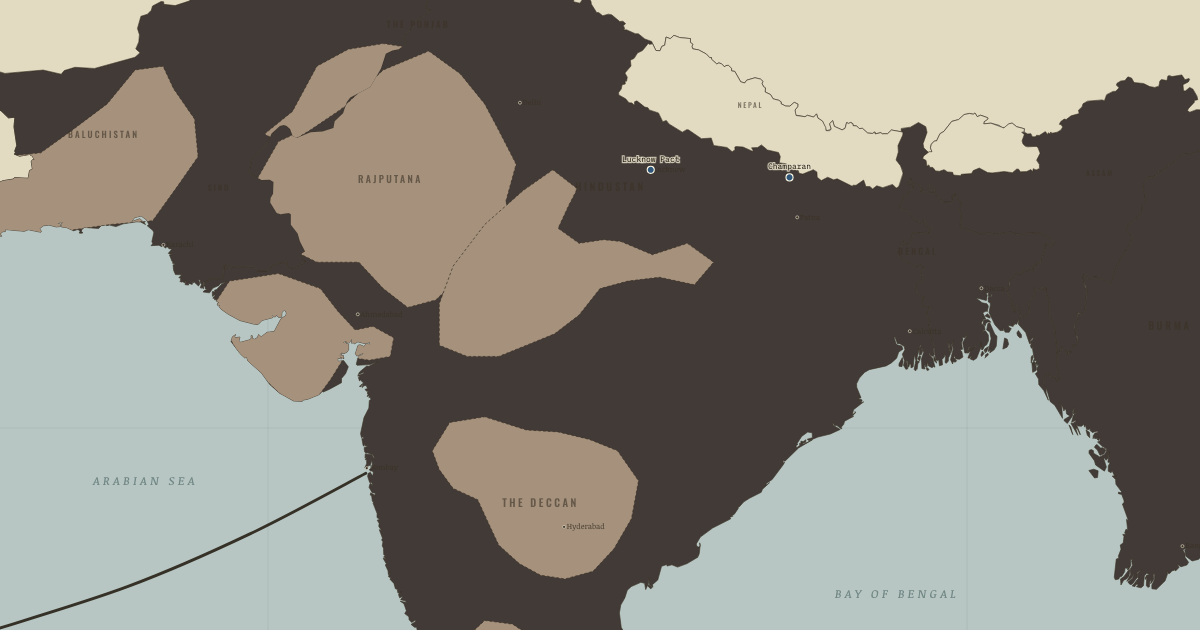
Indian support for the war rested on a clear bargain rather than on simple loyalty to the Crown. Between 1914 and 1918 some 1.4 million Indians sailed west to fight in the mud of Flanders, at Gallipoli and in the Mesopotamian disaster at Kut, India gave a hundred million pounds outright and the wheat of the Punjab, and over 70,000 of her men never returned. Both Congress and the League backed the effort, and Gandhi himself recruited, all on the plain calculation that loyalty now would buy self-government later. For a time the bargain seemed to be paying. In December 1916 Congress and the League met in one city and signed the Lucknow Pact, a joint constitutional scheme in which Congress accepted separate electorates and the League joined the demand for self-rule, brokered by a Bombay barrister named Muhammad Ali Jinnah, then praised as the finest ambassador of Hindu–Muslim unity. In August 1917 London appeared to answer with the Montagu Declaration, promising “the progressive realisation of responsible government in India,” a phrase whose crucial word, the lawyers noticed, was “progressive,” since it named no date.
The short answer
- Loyalty as investment. Indian politicians backed the war almost unanimously because the logic of empire seemed to demand reciprocity: the white dominions — Canada, Australia — were being promised autonomy for smaller sacrifices. Tilak, just out of jail, preached recruitment. Gandhi ran recruiting campaigns in Gujarat that puzzled his own followers. The strategy was rational, dignified. It staked everything on Britain honouring a debt it had never explicitly signed.
- Lucknow: unity brokered at a price. The pact worked because both sides needed it — Congress wanted Muslim weight behind the national demand. The League, post-1911, had learned Britain’s favour was fickle. Jinnah’s formula conceded separate electorates and weighted Muslim representation in provinces where Muslims were few, in exchange for a common front. It was the high-water mark of unity — achieved, note carefully, by accepting the communal architecture, not dissolving it. The wall was built into the pact’s own foundations.
- Champaran: the method finds its country. South Africa had taught Gandhi that a state dependent on cooperation could be defeated by disciplined refusal. But South Africa’s Indians were a minority. Champaran proved the method scaled: a single satyagrahi with documentation and self-suffering could mobilize a district and force the Raj to legislate against its own planters. Ahmedabad and Kheda followed within a year. The national movement now possessed something no colonial empire had faced: a technique of mass resistance that made repression self-defeating.
- The war hollows the Raj itself. Beneath the victory, the instrument of rule was weakened: prices doubled, the Punjab was squeezed by recruitment quotas that shaded into press-gangs, the influenza came home with the troopships, and Britain emerged owing money to India rather than the reverse. The Raj of 1919 had less consent, less cash and fewer reliable men than the Raj of 1914 — while facing a population that had been promised, and now expected, payment.
THE TURNING POINT
Lucknow, December 1916. For one December, the two organizations that will one day partition this map speak with a single voice, in a scheme drafted by the future founder of Pakistan. That is why Lucknow is the hinge: it proves the alternative future was real — Hindu–Muslim political unity was achieved, on paper, by negotiation. It fixes the terms of every later tragedy, because the unity was purchased by writing separate electorates into the nationalist programme itself. When historians ask whether Partition was inevitable, Lucknow is exhibit A for both answers: unity was possible. And even unity’s finest hour ratified the separation.
What it changed
A promise with no date. The Montagu Declaration committed Britain to “responsible government” — someday. The 1919 Government of India Act delivered “dyarchy”: Indian ministers for education and sanitation, Britons keeping finance, police and the army. To politicians who had buried 70,000 men the instalment read as insult, and the gap between promise and delivery became the space in which Gandhi built mass politics.
The Punjab primed. No province gave the war more men than the Punjab — three-fifths of the army — or suffered recruitment’s coercions more rawly. In 1919 it was the Punjab that rose against the Rowlatt Act, and the Punjab that was answered with martial law and massacre. The geography of sacrifice became the geography of the wound.
Jinnah’s first exit. The ambassador of unity found the post-war movement incomprehensible: a constitutionalist to his bones, Jinnah opposed the Rowlatt Act but recoiled from Gandhi’s mass agitation and its religious idiom, resigned from Congress in 1920 warning it would end in “complete disorganization and chaos,” and drifted to London. His return in the 1930s, to a different politics, is chapter 9’s story. But the estrangement begins here.
The full answer, argued
Judge it by what it produced, and the answer is uncomfortable for the simple version. As policy it failed on its own terms: Britain delivered dyarchy and the Rowlatt Act, not dominion status, and the disillusionment radicalized the very politicians who had preached loyalty. But the war years built everything the next phase used — the Lucknow Pact’s united front, the Home Rule Leagues’ organizational networks, Gandhi’s proven method, and above all the moral receipt: a nationalist movement that had demonstrably paid in blood could no longer be dismissed as a seditious clique, in Indian eyes or the world’s. The deeper lesson is about empires: Britain’s refusal to pay a debt its own declarations acknowledged converted moderates into non-cooperators far more efficiently than any Extremist pamphlet had. Empires are rarely destroyed by their enemies’ strength alone. They are destroyed when they teach their loyalists that loyalty is worthless.
An interesting fact
The first Indian to win the Victoria Cross was Khudadad Khan, a machine-gunner from a Punjabi village near Chakwal, who kept his gun in action at Hollebeke in Belgium in October 1914 after every other man of his detachment was killed, and survived by feigning death. Indians had been legally barred from the award until 1911. Eleven Indian soldiers won the VC in the Great War — a fact both empires of memory neglect: the army that held Ypres in that first desperate autumn was, in meaningful part, an army of the Punjab, drawn from the very districts this map will hatch with violence in 1947.
This is the study layer of India in World War I, chapter 5 of Indian Independence & Partition, 1857–1964; the full index of the atlas is here.
Related questions
THE FREE PRINTABLE STUDY GUIDE
Join the Dispatch — a short welcome series, then a letter when a new atlas opens — and the printable study guide for Indian Independence & Partition is yours now, free.
NO TRACKING · YOUR ADDRESS IS USED FOR THE DISPATCH AND NOTHING ELSE · UNSUBSCRIBE ANYTIME