Indian independence · JUL 1937
Did Congress’s 1937 refusal in UP lead to Pakistan?
The seminar question: “Was the Congress refusal of a UP coalition in 1937 the mistake that made Pakistan?”
The Government of India Act of 1935 created elected provincial governments, and in the 1937 elections Congress won office across most provinces while the Muslim League won under five per cent of the Muslim vote. Congress then refused a coalition in the United Provinces, and Jinnah rebuilt the League around Muslim fears.
Chapter 9 is part of membership. WW2 is free — every chapter. Try chapters 1–2 of any 2 other atlases (3 with a free account). Opening a new atlas uses one of them. Membership opens all 21 — Join.
Free printable Indian independence study guide, sent by email ↓
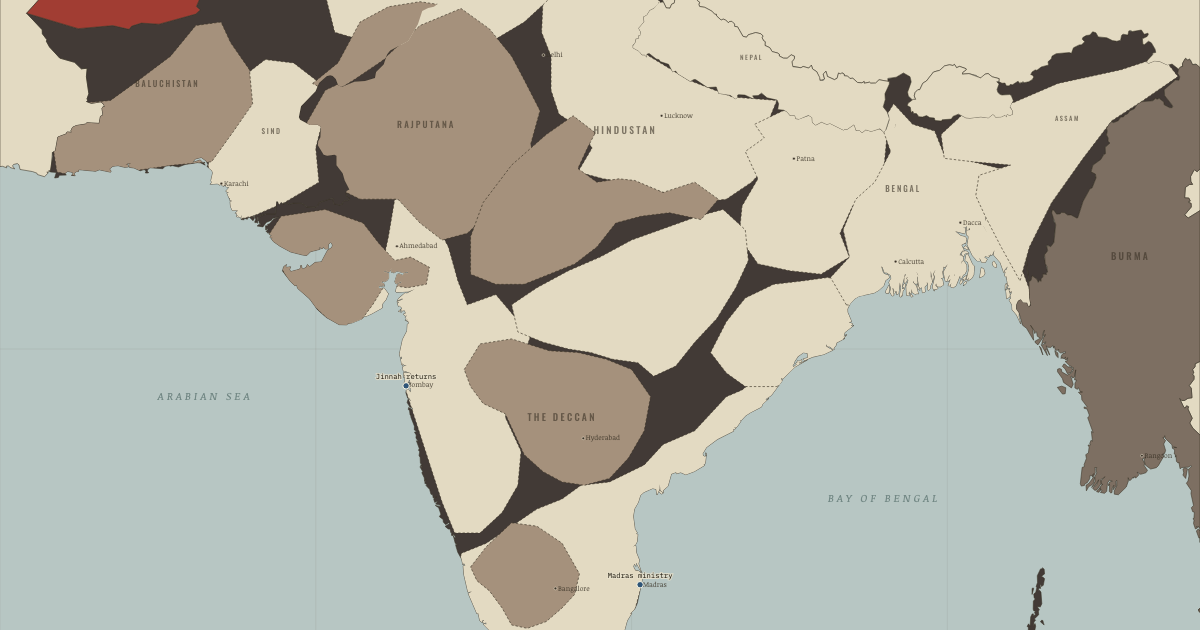
For two years the subcontinent lived under something it would never see again in undivided form, an elected India. The Government of India Act 1935, the longest statute the British Parliament had ever passed, gave the provinces genuine self-government on a franchise of 35 million, and in the winter of 1936–37 India voted. Congress red swept Madras, Bombay, the United Provinces, Bihar, the Central Provinces and Orissa, and, most surprisingly, the overwhelmingly Muslim North-West Frontier Province, where Abdul Ghaffar Khan’s Khudai Khidmatgars, the “Servants of God,” had built a non-violent Pathan movement that marched with Congress. The coalition provinces went another way, with Bengal under Fazlul Huq’s peasant alliance and the Punjab under Sikandar Hayat Khan’s Unionists, landlord parties that were Muslim-led, cross-communal in their fashion, and beholden to neither Congress nor the League. The Muslim League fought its first real election claiming to speak for Muslim India and won under five per cent of the Muslim vote. Jinnah, back from self-imposed exile in London, had rebuilt the party, and the voters had ignored it.
The short answer
- The 1935 Act: self-rule as containment. London designed the Act to split the difference between concession and control: full provincial democracy to absorb Congress energies, a federal centre weighted with princely nominees and viceregal reserve powers to keep the commanding heights. The federation never came into force — the princes would not join — so the Act’s actual legacy was eleven provincial democracies and a constitutional grammar (it remains the skeleton of India’s and Pakistan’s constitutions). Containment built the successor states’ operating manual.
- Why Congress swept and the League failed, 1937. Congress had spent fifteen years building what the League had never bothered with: village units, jail-tested cadres, a peasant programme, and the frontier’s remarkable Khudai Khidmatgars. The League of 1937 was still Lucknow’s club of notables — no organization, no economics, no answer to a Muslim tenant asked why a Muslim landlord’s party deserved his new vote. The lesson Jinnah drew was structural: confessional identity alone, without mass organization, moved no one. He would spend the next nine years building the organization — around confessional identity alone.
- The UP coalition refusal. Congress’s terms to the UP League — dissolution, in effect — were constitutionally ordinary (majority parties owe no one office) and politically fateful. Maulana Azad later judged it the error that made Pakistan possible. Nehru’s “there are only two parties” taunt gave Jinnah his answer — “there is a third: Muslim India.” Historians divide over whether coalition would have changed the arc. What is not in dispute is what the refusal supplied — proof, usable in every Muslim constituency in India, that under majority rule the League’s cooperation was worth nothing.
- Office reveals the stakes of majority rule. The ministries were the first taste of what an Indian-run state would feel like. For politically organized Muslims the taste was ambiguous: competent, honest, and symbolically saturated with a national culture (Bande Mataram in the assembly, Hindi in the schools debate, the tricolour on the buildings) that felt like someone else’s nation wearing the state’s clothes. The League’s 1938–39 grievance reports exaggerated freely. The underlying discovery they exploited was real and it was structural — in a unitary majoritarian India, Muslims would never again un-elect the majority.
THE TURNING POINT
Jinnah refused, 1937. The hinge of the decade is a coalition that did not happen. Had the UP Congress taken two League ministers into office in 1937, the League would have entered government as a junior partner of nationalism — Jinnah’s own trajectory to that point. Refused, it went into opposition with nothing to lose and one asset: the fear the ministries were unwittingly feeding. Jalal’s celebrated thesis holds that even the Pakistan demand that grew from this wilderness was a bargaining counter for power-sharing rather than a blueprint for partition. Her critics answer that counters, brandished for a decade, become commitments. Either way, the turn is here: 1937 is when Muslim mass politics stopped competing for a share of India and started pricing an exit.
What it changed
The League learns mass politics. Between 1937 and 1943 the League built what it had lacked — branches, student wings, a press, Pakistan as a one-word programme. Membership rose from thousands to hundreds of thousands. The organization Congress had taught India how to build was now built against it. The 1946 election result is this effect, measured.
The ministries as proof of capacity. Two years of competent Congress government — budgets balanced, prisoners freed, offices held by men the Raj had jailed — quietly destroyed the last imperial argument, unfitness. Even the war cabinet’s hardliners never again claimed Indians could not govern. The argument shifted to whom India should be handed, which was a concession of everything.
The princes miss their exit. The 1935 federation offered the princely states a negotiated entry into an Indian union on protected terms. They dithered, lobbied and refused, and the offer never returned. In 1947 they would enter the successor states in ten weeks, on terms dictated by Patel and events. The patchwork’s rulers declined the last chance to write their own future.
The full answer, argued
It is the strongest single candidate, and still an insufficient cause alone. The case for: the refusal converted the League’s electoral humiliation into a grievance with perfect explanatory power — “this is what majority rule does” — and Azad, who was in the room, called it the turning point. The League’s astonishing growth dates precisely from it. The case against: separate electorates had been hardening communal politics for thirty years. The ministries’ symbolic Hinduness would have fed the fear regardless. And Jalal’s work shows the Pakistan demand’s content stayed negotiable into 1946 — meaning later exits existed and were also missed (the Cabinet Mission above all). The measured verdict: 1937 did not make Partition inevitable, but it ended the last configuration in which Muslim politics was organized around anything except the communal question. Inevitability is the wrong frame — the road had many exits. After 1937, every exit not taken cost more than the last.
An interesting fact
The Government of India Act 1935 was the longest Act the British Parliament had ever passed — 321 sections and 10 schedules, product of five years of committees, and Churchill fought it clause by clause from the back benches, calling it “a monstrous monument of sham built by the pygmies.” It enfranchised 35 million people including, for the first time in most provinces, women meeting property tests. Both successor states kept it: India’s 1950 constitution and Pakistan’s first constitutional order lifted its administrative skeleton nearly whole, so that the law written to contain Indian freedom became, by adoption, the working chassis of two free states.
This is the study layer of 1937 Indian provincial elections, chapter 9 of Indian Independence & Partition, 1857–1964; the full index of the atlas is here.
Related questions
THE FREE PRINTABLE STUDY GUIDE
Join the Dispatch — a short welcome series, then a letter when a new atlas opens — and the printable study guide for Indian Independence & Partition is yours now, free.
NO TRACKING · YOUR ADDRESS IS USED FOR THE DISPATCH AND NOTHING ELSE · UNSUBSCRIBE ANYTIME