Mongol Empire · 1255
How did so few Mongols rule so many people?
The seminar question: “A million rulers, a hundred million ruled: why did the mathematically impossible occupation hold?”
By the 1250s a small Mongol ruling class governed tens of millions of people through the yam relay of staffed stations, regular censuses and paiza tablets of authority. Most daily administration was left to local rulers, clerks and religious institutions, while Karakorum gathered specialists and envoys from across Eurasia.
Chapter 7 is part of membership. WW2 is free — every chapter. Try chapters 1–2 of any 2 other atlases (3 with a free account). Opening a new atlas uses one of them. Membership opens all 21 — Join.
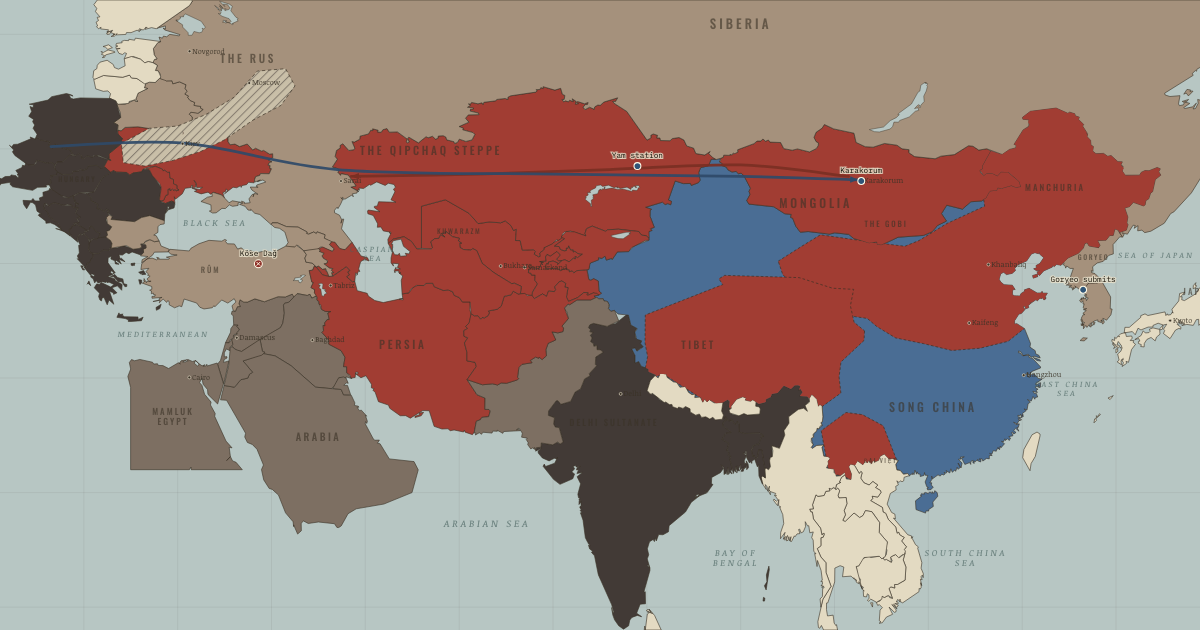
The scale of the empire explains its methods, because no state could garrison every settlement, so the Mongols controlled the key routes and governed through existing institutions. The yam placed relay stations along the major roads, each stocked with horses, fodder and staff, so that a protected messenger could cross great distances at speed. Censuses counted households, herds and labour obligations, and a paiza, or tablet of authority, told local officials that its bearer acted in the khan’s name.
The short answer
- Steppe institutions, scaled. Nothing in the toolkit was invented from zero: the yam scales the nomad habit of remount relays; the census scales the decimal army’s muster rolls; the paiza scales a chief’s safe-conduct token. The genius was believing herding-camp institutions could run continents — and staffing the gaps with the conquered: Khitan clerks, Uyghur scribes (whose alphabet wrote Mongol), Persian tax-farmers, Chinese engineers. The empire was a joint venture in which the junior partners did the paperwork.
- Pluralism as control theory. Exempting every faith’s clergy from tax and requiring only prayers for the khan bought the empire its cheapest loyalty: the men who spoke to the masses each week had a stake in Mongol peace. Rubruck found the khan’s court staging Christian–Muslim–Buddhist debates for sport (his own side, he admits, fared poorly once the drinking started). Cynical, tolerant, effective — pick any three.
- Terror’s dividend, spent on administration. Be precise about the sequence: the machinery worked because the massacres had already happened. Cities paid census-takers politely for the same reason the next ten cities had opened their gates to Genghis. Chapters 4 and 7 are one system observed at two moments — the empire economized on garrisons by having spent lavishly on fear. An honest account keeps both ledgers open at once.
THE TURNING POINT
The silver fountain of Karakorum. Take Boucher’s fountain as the hinge-image of mid-century: a Parisian artisan, seized in the Hungarian catastrophe, building courtly wonders where the Orkhon khans were crowned, beside envoys from Lyon, Baghdad, Kiev and Hangzhou. The world’s regions, which had touched only through chains of middlemen, now met in one room — under duress. Globalization’s first draft was written here, and its author was an army.
What it changed
The roads outlive the swords. Census, yam and paiza make the Silk Road briefly one jurisdiction — the precondition for Chapter 12’s whole story: the Polos’ journey, the technology flows, and the pathogen that follows them. Infrastructure, this atlas keeps insisting, is destiny with a lag.
Clients learn to work the system. Vassalage cut both ways: Rus princes, Seljuk sultans and Korean kings discovered the khans would enforce succession claims for loyal clients — so they competed in usefulness. Moscow’s later rise as chief tax-collector (Ch. 6) and Goryeo’s survival-by-marriage are graduates of this school. Empires govern longest where the governed find the arrangement locally rational.
Centralization loads the succession gun. Möngke’s audits pulled power to the center just as the family’s branches — Jochids on the Volga, Toluids in China and Persia — grew regional roots. A system this centralized has no procedure for two centers; when Möngke dies at Diaoyu (Ch. 10) with brothers in Syria and China, the machinery itself becomes the prize, and the family war begins.
The full answer, argued
The occupation held because it was deliberately thin. Local officials and rulers collected taxes and managed ordinary life, while the Mongol layer controlled routes, censuses, appointments and military punishment. Religious exemptions and trade protection gave some groups positive reasons to cooperate. Fear reduced the number of garrisons needed. The ratio was therefore not one Mongol directly ruling one hundred subjects; it was a small imperial command structure ruling through many local intermediaries.
An interesting fact
One of these tablets can be inspected today: a silver paiza dug up near Minusinsk in Siberia in 1846 and now in the Hermitage, a later Yuan-era issue with its lettering inlaid in gold. The text is the empire’s voice at its most compressed — “By the strength of Eternal Heaven, may the name of the Khan be holy; whoever does not revere it shall be killed and die.” A passport, a threat and a theology in a single sentence, built to work at a gallop anywhere from Korea to the Volga.
This is the study layer of How the Mongol Empire was governed, chapter 7 of The Mongol Empire, 1206–1294; the full index of the atlas is here.
Related questions
THE FREE PRINTABLE STUDY GUIDE
Join the Dispatch — a short welcome series, then a letter when a new atlas opens — and the printable study guide for The Mongol Empire is yours now, free.
NO TRACKING · YOUR ADDRESS IS USED FOR THE DISPATCH AND NOTHING ELSE · UNSUBSCRIBE ANYTIME