Mongol Empire · 1282
Did the kamikaze storms really save Japan?
The seminar question: ““The kamikaze storms saved Japan.” Rewrite that sentence so a historian could defend every word.”
Khubilai then sent forces overseas and into Southeast Asia. Japan defeated the landings of 1274 and 1281 through fortification, resistance, poor Yuan logistics and storms; Đại Việt avoided decisive battle and trapped the Yuan fleet at Bạch Đằng in 1288; Champa and Java held out, and Pagan accepted tributary terms.
Chapter 11 is part of membership. WW2 is free — every chapter. Try chapters 1–2 of any 2 other atlases (3 with a free account). Opening a new atlas uses one of them. Membership opens all 21 — Join.
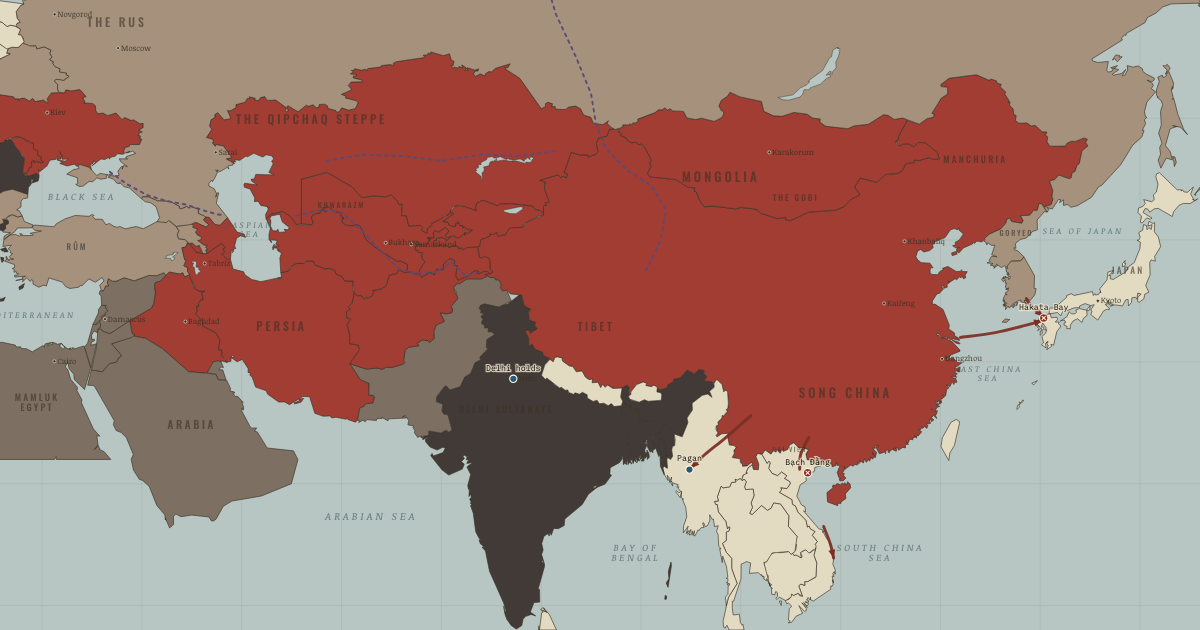
The first Japanese campaign, in 1274, sent a fleet assembled mainly in Korea to attack Tsushima and land near Hakata, where the defenders met coordinated volleys and gunpowder bombs. The Yuan force withdrew to its ships and a storm then damaged the fleet, after which Japan built a stone wall around Hakata Bay. In 1281 Khubilai launched a much larger invasion in two parts, but the fleets struggled to coordinate, never secured a stable beachhead, and stayed exposed through the typhoon season until a powerful storm destroyed most of the force. Weather delivered the final blow, yet the campaign’s vulnerability had already been created by its planning, its coerced crews, its ship quality and the defensive wall.
The short answer
- An ecological engine at the end of its fuel. Chapter 1’s equation runs in reverse: Mongol power was compound interest on grass — remounts, mobility, logistics that grazed. Typhoon seas, paddy deltas and malarial jungle pay no such interest; horses die, bows delaminate in monsoon damp, and the army becomes ordinary infantry with extraordinary supply problems, fighting locals for whom the terrain is home. The machine wasn’t beaten at its own game; it was dragged onto boards where its pieces didn’t move.
- Coerced fleets, reluctant crews. The Yuan navy was extracted from the conquered: Korea’s shipyards (Goryeo’s king begged relief from the levies), Song crews defeated two years earlier, riverine designs conscripted into ocean work — marine archaeology at Takashima has found the 1281 wrecks’ mass-produced, sometimes keel-less hulls. Add August sailing dates in typhoon latitudes, chosen by continental planners, and the divine wind starts to look like deferred maintenance on an empire of forced labor.
- Enemies who had read the file. By the 1270s the Mongol playbook was public knowledge, and the survivors were its best students: Japan fortified the beach and refused open battle; Vietnam refused battle altogether and traded space for disease; Delhi kept a standing steppe-style cavalry army; the Mamluks were the playbook, exported. First-strike advantage — terror, surprise, enemies who fought “correctly” — had been the tide’s hidden subsidy, and it was spent.
- Prestige with a navy attached. Why persist after 1274’s warning, or 1285’s? Because Khubilai’s legitimacy ran on the family’s only shared currency — expansion — precisely when Kaidu’s revolt (Ch. 9) contested his right to the throne. A Great Khan who could not grow the empire was, by the yassa’s lights, no Great Khan; Japan and Vietnam were arguments aimed at Karakorum as much as at their targets. States, note, often export their internal insecurities as foreign wars — and pay foreign prices for domestic goods.
THE TURNING POINT
Hakata Bay, August 1281. The typhoon is the era’s most famous weather, but the hinge is what it revealed: the empire’s method did not transfer across salt water — no reconnaissance-in-force possible, no remounts, no pasture, no feigned retreat on a beachhead — and its coerced maritime base actively wanted the mission to fail. After 1281 no khanate ever again mounts a major expedition beyond the ecological frontier. The wind got the shrine; the limit got the map.
What it changed
Japan is transformed by the war it never quite fought. Victory bankrupts the Kamakura shogunate — there is no conquered land to pay the samurai who manned the wall, and the unpaid grievance helps bring the regime down within fifty years — while the kamikaze legend enters Japan’s self-understanding permanently (to be conscripted, in 1944, for a darker purpose). Even the storm that saves you, this map keeps teaching, sends an invoice.
Southeast Asia keeps its own history. Vietnam’s three repulses become the founding epic of its long resistance tradition — the Bạch Đằng stakes are a national symbol still — and the region’s states enter the Chinese world order as tributaries by negotiation, not provinces by conquest. The difference between those two words, invisible in a tribute list, is the difference between Chapter 6’s Rus and Chapter 11’s Việt: who writes your laws, and in whose language.
The empire turns inward — and to the ledger. With expansion closed, the khanates must live on administration: Yuan finances strain under failed-invasion debt and paper-money inflation; the Ilkhans experiment (disastrously) with China’s paper currency; the Horde monetizes the fur and slave roads. The dynamic empire of Chapters 2–10 becomes the maintaining empire of Chapter 12 — and maintenance, for a state built as a conquest engine, is a different and harder art.
The full answer, argued
A defensible version is: “Two storms completed the defeat of invasions already made vulnerable by geography, Japanese fortification and Yuan logistics.” The strait removed the Mongols’ normal pasture and remount system. Hakata’s wall delayed a landing and left ships exposed. Coerced crews, coordination failures and variable ship quality increased risk. The storms supplied the final destructive force and their timing was contingent; they did not act on an otherwise successful occupation.
An interesting fact
Much of what we can actually see of these invasions exists because one samurai wanted his reward. Takezaki Suenaga, who fought in both landings, commissioned illustrated scrolls — the Mōko Shūrai Ekotoba — in part to document his deeds for the shogunate’s reward commissioners, and they survive as our only pictures of the fighting shaped by an eyewitness. Skeptics long suspected that the famous bomb bursting beside his horse was painted in later; then divers at Takashima raised tetsuhau — ceramic shell-bombs, some still packed with gunpowder and iron shrapnel — from the 1281 wrecks, and the scroll received its corroboration from the seabed.
This is the study layer of Mongol invasions of Japan and Vietnam, chapter 11 of The Mongol Empire, 1206–1294; the full index of the atlas is here.
Related questions
THE FREE PRINTABLE STUDY GUIDE
Join the Dispatch — a short welcome series, then a letter when a new atlas opens — and the printable study guide for The Mongol Empire is yours now, free.
NO TRACKING · YOUR ADDRESS IS USED FOR THE DISPATCH AND NOTHING ELSE · UNSUBSCRIBE ANYTIME