WW2 · JUL 1943
Why did the Soviets choose to defend first at Kursk?
The seminar question: “The Soviets knew exactly where Germany would attack at Kursk — and chose to defend rather than attack first. Why was that the harder, smarter choice?”
In July 1943 Germany attacked the Kursk salient, but Soviet forces, warned months in advance, had built deep defensive belts that halted the attack, and by autumn the Red Army reached the Dnieper. That month the Allies landed in Sicily; Mussolini was voted out and arrested, and Italy signed an armistice in September.
WW2 is free — every chapter. No sign-up.
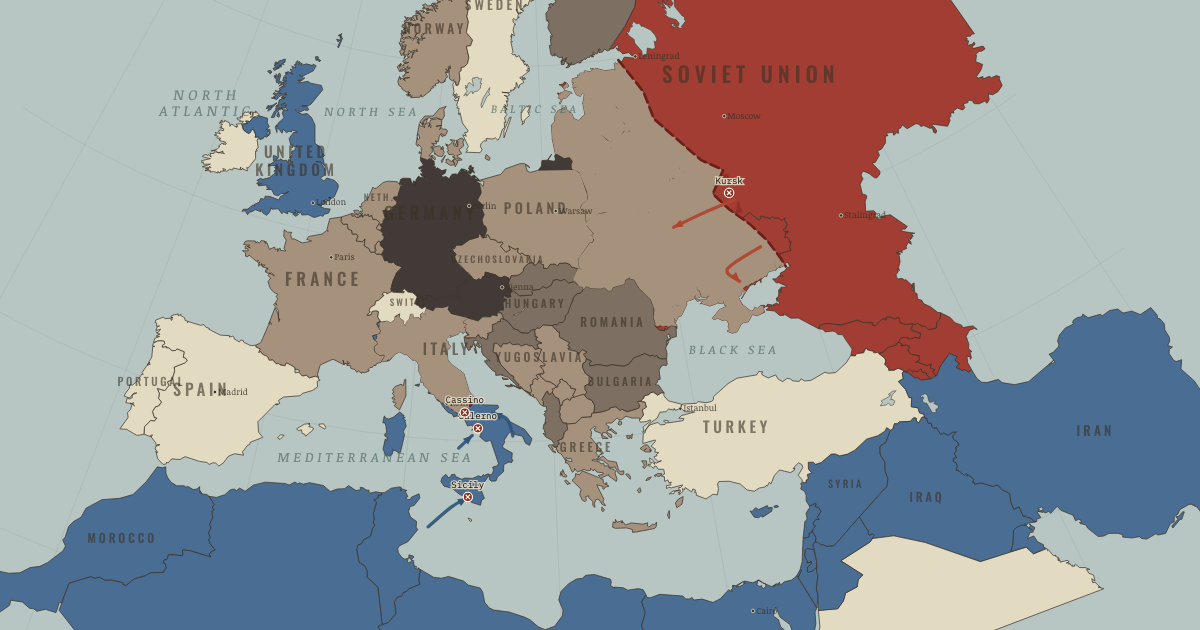
The front around Kursk bulged deep into German-held territory, forming a salient that Germany planned to pinch off from both sides in Operation Citadel, restoring confidence after the disaster at Stalingrad. The trouble was that the target was obvious, the German delays waiting for new tanks were visible, and Soviet intelligence supplied detailed warning of the plan. The Soviets used the time to build layered minefields, anti-tank positions, and deep reserves, so that their defence could absorb the German armoured punch before their own counteroffensives began. By autumn the Red Army had reached the River Dnieper, and Germany would never again launch a strategic offensive in the east.
The short answer
- Germany needed a shop-window victory. After Stalingrad and Tunis, Berlin needed proof — for allies, neutrals and its own public — that it still held the initiative. Kursk was chosen less because it could win the war than because standing still felt like admitting the war was lost.
- The best-advertised attack of the war. The Lucy spy ring and British Ultra decrypts told Moscow the plan; months of German delays waiting for new tanks told everyone the place. For once the Red Army knew exactly where, and spent the time turning steppe into fortress — defense as a chosen weapon, not a last resort.
- The Mediterranean compromise. At Casablanca the Americans wanted France in 1943; the British argued shipping and experience made Sicily the realistic next step. Italy became the compromise: keep pressure on, knock Italy out, draw German divisions south — while the real invasion waited for 1944.
THE TURNING POINT
Prokhorovka and the halt order, 12–13 July. As the southern pincer grinds into the Soviet reserve tank army at Prokhorovka, news arrives of the Sicily landings. Hitler halts Citadel to send forces west — the first time the two-front war visibly forces him to choose. The strategic initiative in the East passes to the Red Army and never returns.
What it changed
The long retreat begins. From Kursk the Eastern Front becomes a conveyor moving west: the Dnieper falls in autumn, Kiev in November. German strategy shrinks to “hold everything, everywhere,” which means losing everything, slowly.
Italy: liberation and civil war. South of the Gustav Line, an Allied co-belligerent Italy; north of it, Mussolini’s Salò republic under German guns, fighting Italian partisans — a civil war inside the world war, whose scars last decades.
Proof the alliance can land. Sicily and Salerno are dress rehearsals — amphibious command, naval gunfire, mistakes included — for the graduation exercise scheduled for a Norman beach next spring.
The full answer, argued
Prepared belts reduced German advantages in speed and coordination. They imposed losses before Soviet reserves counterattacked. Waiting surrendered the appearance of initiative and required confidence that defenses would hold. It worked because Soviet depth and replacement capacity could support an attritional plan that Germany could not afford.
An interesting fact
Prokhorovka — celebrated for decades as a titanic melee that bled both sides equally — reads differently since the Soviet archives opened: on 12 July the attacking 5th Guards Tank Army lost somewhere between 200 and 300 armored vehicles, dozens of them in an anti-tank ditch its own engineers had dug, against German losses a small fraction of that. Stalin convened a commission and considered court-martialing the tank army’s commander; the heroic version was allowed to stand instead. The revision changes the arithmetic, not the outcome — the Red Army could absorb such a day and keep attacking; the panzer force could not afford even its far smaller share.
This is the study layer of Kursk and the fall of Mussolini, chapter 10 of The War Room — WW2, 1936–1945; the full index of the atlas is here.
Related questions
THE FREE PRINTABLE STUDY GUIDE
Join the Dispatch — a short welcome series, then a letter when a new atlas opens — and the printable study guide for WW2 is yours now, free.
NO TRACKING · YOUR ADDRESS IS USED FOR THE DISPATCH AND NOTHING ELSE · UNSUBSCRIBE ANYTIME