Road to WW2 · 1940
Was the fall of France a defeat or a national collapse?
The seminar question: “Was the fall of France a military defeat or a national collapse — and why does the answer matter?”
The Soviet Union attacked Finland in November 1939, and Germany took Denmark and Norway before striking west on 10 May 1940. German armour crossed the Ardennes, broke through at Sedan and reached the Channel. Dunkirk saved 338,000 troops, but France accepted an armistice and the Vichy regime chose collaboration.
Chapter 9 is part of membership. WW2 is free — every chapter. Try chapters 1–2 of any 2 other atlases (3 with a free account). Opening a new atlas uses one of them. Membership opens all 21 — Join.
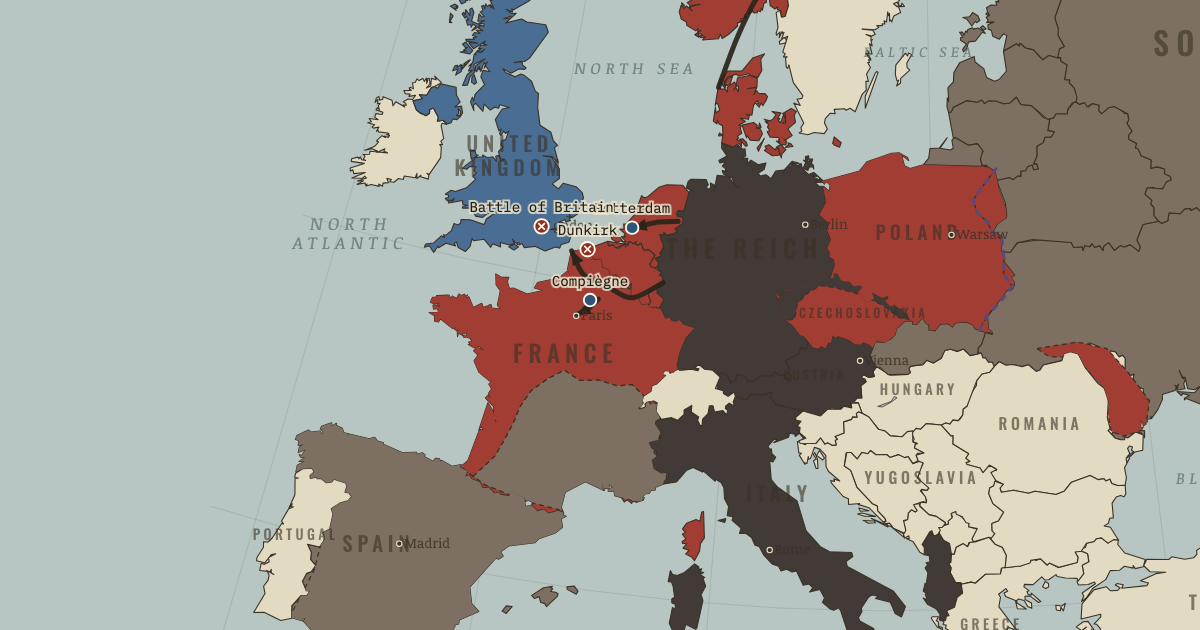
The Soviet Union attacked Finland in November 1939 and suffered heavy losses before finally gaining the territory it wanted, a humiliation that shaped later judgments of the Red Army. Germany then took Denmark and Norway to guard its northern flank. On 10 May 1940 German forces attacked in the west, and the plan worked by deception, since the advance in the north drew the Allied armies into Belgium while concentrated armoured divisions crossed the Ardennes and broke through the thin defences at Sedan.
The short answer
- Sickle-cut was a gamble that punished exactly the Allies’ preparation. The original German plan was a 1914 replay through Belgium — which is precisely what Allied planning (the Dyle-Breda advance) was built to meet. Its compromise in January 1940 (a courier plane with the plans crashed in Belgium) opened the door to Manstein’s alternative: mass the armor where the Allies believed armor could not go. The plan’s brilliance is inseparable from its luck — a French reconnaissance report of columns in the Ardennes was discounted; Sedan’s defenders were second-line reservists. The deeper cause: French doctrine had distributed tanks as infantry support and assumed a continuous front; the Germans concentrated theirs and assumed nothing. France had more tanks, and many better ones. Doctrine, not hardware, decided May 1940.
- Eight months of phoney war spent the Allies’ advantages. Time was supposed to be the democracies’ weapon — blockade tightening, rearmament maturing, the empires mobilizing. Some of it worked (British aircraft production overtook Germany’s in 1940). But the pause also let Germany digest Poland, train on its lessons, and pick its moment; it drained French morale into boredom and defeatism; and it left neutrals — Belgium above all — clinging to a neutrality that forbade joint planning until the invasion morning, so the Allies’ best armies advanced into Belgium along roads they had never been allowed to survey.
- Neutrality was a strategy, and it failed everywhere. Every small state on this map’s northwest had chosen neutrality as the lesson of 1914–18 and of the League’s failures (Belgium formally since 1936, Ch. 5). In April–May 1940 the strategy’s premise — that legal status deters — was falsified in six countries in six weeks. The map is the argument: the parchment of 1939 turns red not because the neutrals provoked anyone but because their territory was useful. Neutrality survives, the era teaches, only where geography or great-power convenience underwrites it — Switzerland, Sweden, Iberia.
- Vichy: defeat, then choice. The armistice was arguably forced; the regime that followed was chosen. A parliamentary majority handed full powers to Pétain in July 1940; “collaboration” was Vichy’s own word (Montoire, October), offered in hope of a favorable place in Hitler’s Europe. The distinction matters for the map: the grey-tan south is not occupied — that is the point — it is a client, policing itself, legislating antisemitically ahead of German demand. France’s agency did not end in June 1940; it divided, between Vichy and the Free French broadcast from London the day of the armistice request.
THE TURNING POINT
Compiègne, 22 June 1940. One railway carriage, used twice, is the era’s neatest symbol — but the 1940 signing is the deeper turn because of what it destroyed off the map: every calculation in every capital had assumed the French army. Its collapse in six weeks orphaned British strategy (hence Mers-el-Kébir eleven days later), reoriented American opinion overnight (the Two-Ocean Navy Act passed in July; the first peacetime draft in September), presented Japan with suddenly ownerless colonial Asia (Ch. 10), and convinced Hitler he was infallible precisely when his next project required him not to be (Ch. 11). Historians debate whether Britain seriously considered terms that summer — the War Cabinet argued it over three days in late May, and chose Churchill’s answer. The world war that followed was built on the ruins of the assumption that fell at Compiègne.
What it changed
The Mediterranean ignites. Mussolini declared war on 10 June, saying he needed “a few thousand dead for the peace table.” This opened the parallel war followed in Chapter 11. Italy invaded Egypt from Libya in September and Greece from Albania in October. Both campaigns went disastrously for Rome. Both also drew Germany into rescue operations that rearranged the calendar of Barbarossa.
America crosses from neutrality to non-belligerence. France’s fall broke US isolationism’s central premise — that Europe’s democracies were a sufficient outer wall. Destroyers-for-bases (Sept 1940), history’s first peacetime conscription, and Lend-Lease (March 1941) followed within nine months: a neutrality re-engineered, in Roosevelt’s phrase, into being the “arsenal of democracy.”
Asia’s colonial powers are suddenly ghosts. The Netherlands occupied, France a client, Britain fighting for its life: the tan empires of the Pacific map now belong to owners who cannot defend them. Within three months Japan is in northern Indochina and the Tripartite Pact is signed. The two theaters of this atlas begin to merge.
The full answer, argued
The “decadence” reading — a Third Republic rotten with division that deserved its fate — was written first by Vichy itself (the defeat as moral judgment) and long echoed abroad. Modern scholarship (Ernest May, Julian Jackson) has largely dismantled it: France in 1940 fielded more tanks than Germany, fought — 50,000–90,000 French soldiers died in six weeks, a rate comparable to Verdun — and fell to a specific, contingent operational failure: a bad doctrine meeting a brilliant gamble at Sedan. The answer matters because each reading carries a policy moral. If France collapsed morally, the lesson is about national character — comfortable and useless. If France lost operationally while fighting hard, the lesson is that doctrine, command tempo and the location of reserves can undo material equality in days — a lesson every general staff since 1940 has studied. And it matters for justice: the “collapse” story was the alibi of the regime that used defeat to bury the Republic.
An interesting fact
The armistice carriage’s afterlife completes the story: Hitler had Compiègne’s memorial site dynamited and the carriage hauled to Berlin as a trophy, where crowds queued to see it; in 1945, with the war lost, SS troops destroyed it — by most accounts burned near Crawinkel in Thuringia — so it could never stage a third signing. The French memorial clearing was rebuilt after the war with a replica carriage of the same series, and the original’s scattered fittings that survive are displayed beside it.
This is the study layer of Phoney War and the fall of France, chapter 9 of The Road to War, 1931–1941; the full index of the atlas is here.
Related questions
THE FREE PRINTABLE STUDY GUIDE
Join the Dispatch — a short welcome series, then a letter when a new atlas opens — and the printable study guide for The Road to War is yours now, free.
NO TRACKING · YOUR ADDRESS IS USED FOR THE DISPATCH AND NOTHING ELSE · UNSUBSCRIBE ANYTIME