WW2 · OCT 1945
Was the Second World War really one war?
The seminar question: “Was the Second World War “one war”? Argue both sides using what you’ve seen on this map.”
The postwar map was set largely by where armies stood in 1945: Soviet forces held much of Eastern Europe, Germany was split into occupation zones and Korea divided at the 38th parallel. About sixty million people died, and new institutions followed, including the United Nations, the Nuremberg trials and the Marshall Plan.
WW2 is free — every chapter. No sign-up.
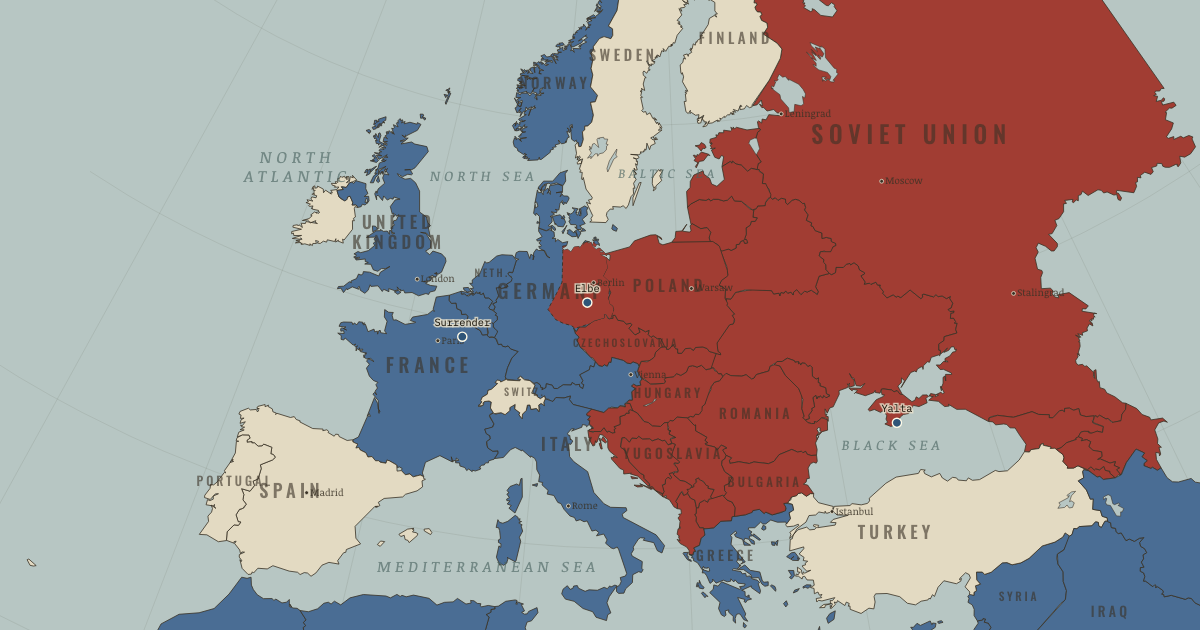
The final map is best read as a distribution of power rather than as a settled peace. Soviet armies occupied much of Eastern Europe while Western armies held the west, and although the agreements reached at Yalta and Potsdam mattered, it was military position that determined how those promises would actually be enforced. Germany was divided into occupation zones and later into two separate states, and Korea was split at the 38th parallel. The former allies now understood security in incompatible ways, because the Soviet Union sought controlled buffer states after suffering repeated invasion, while Western governments read that same control as naked expansion.
The short answer
- Why the peace looked like this: armies are arguments. No conference redrew Europe — Yalta and Potsdam largely ratified where soldiers stood. Occupation zones became states; the 38th parallel became Korea; “facts on the ground” beat every principle. First rule of reading any postwar map: ask where the armies stopped.
- Security through buffer. Invaded twice through Poland in 30 years at a cost of tens of millions, the USSR defined security as controlling everything between Berlin and Moscow. The West read the same control as expansion. Two rational security logics, zero trust: the Cold War in one sentence.
- The productivity superpower. The US ended the war with half the world’s industrial output, the only intact great economy, the bomb, and the dollar (Bretton Woods, 1944) as the world’s money. American hegemony wasn’t declared; it was the arithmetic of 1945.
THE TURNING POINT
The handshake that became a border. Torgau, 25 April 1945: soldiers of two victorious armies grin for the cameras on a broken bridge. Within three years, the line where they met is fortified; within sixteen, a wall runs through Berlin. Alliances of necessity end when the necessity does.
What it changed
The long peace — under a mushroom cloud. No great-power war since 1945: deterrence, exhaustion, institutions, or luck? Historians argue; all four probably. But the wars didn’t stop — they moved to the decolonizing world, fought by proxy, from Korea to Vietnam to Angola.
Never again — the unfinished project. Human-rights law, refugee conventions, genocide prevention: all direct answers to 1939–45, all tested and often failed since (Cambodia, Rwanda, Bosnia — the last on this very map). The war’s deepest lesson is not that evil was defeated once, but what it took, and how late everyone acted.
Your map, your questions. Switch to Free Explore mode: scrub the timeline, click any country, and trace one nation’s whole war — Poland’s erasure and shift westward, Finland’s three wars, Yugoslavia’s resistance, Spain’s watching neutrality. Every color change on this map is a hundred books. Pick one.
The full answer, argued
For “separate wars,” China, Poland, Barbarossa, and the Pacific began with different dates, actors, and aims. For “one war,” December 1941 linked alliances, production, shipping, and strategy across theaters. Lend-Lease and synchronized offensives made outcomes interdependent. The strongest judgment is that several conflicts merged into one global system.
An interesting fact
The war is still physically in the ground. German bomb-disposal services recover on the order of 2,000 tonnes of unexploded wartime ordnance every year, and evacuations for newly found bombs remain routine; in December 2011 some 45,000 people — nearly half of Koblenz — left home while engineers defused a 1.8-tonne British bomb exposed by the falling Rhine. The work still kills: three disposal technicians died at Göttingen in 2010, defusing a bomb dropped before any of them was born.
This is the study layer of Aftermath of WW2, chapter 15 of The War Room — WW2, 1936–1945; the full index of the atlas is here.
Related questions
THE FREE PRINTABLE STUDY GUIDE
Join the Dispatch — a short welcome series, then a letter when a new atlas opens — and the printable study guide for WW2 is yours now, free.
NO TRACKING · YOUR ADDRESS IS USED FOR THE DISPATCH AND NOTHING ELSE · UNSUBSCRIBE ANYTIME