ON THIS DAY ·
Trotsky’s exile to Alma-Ata
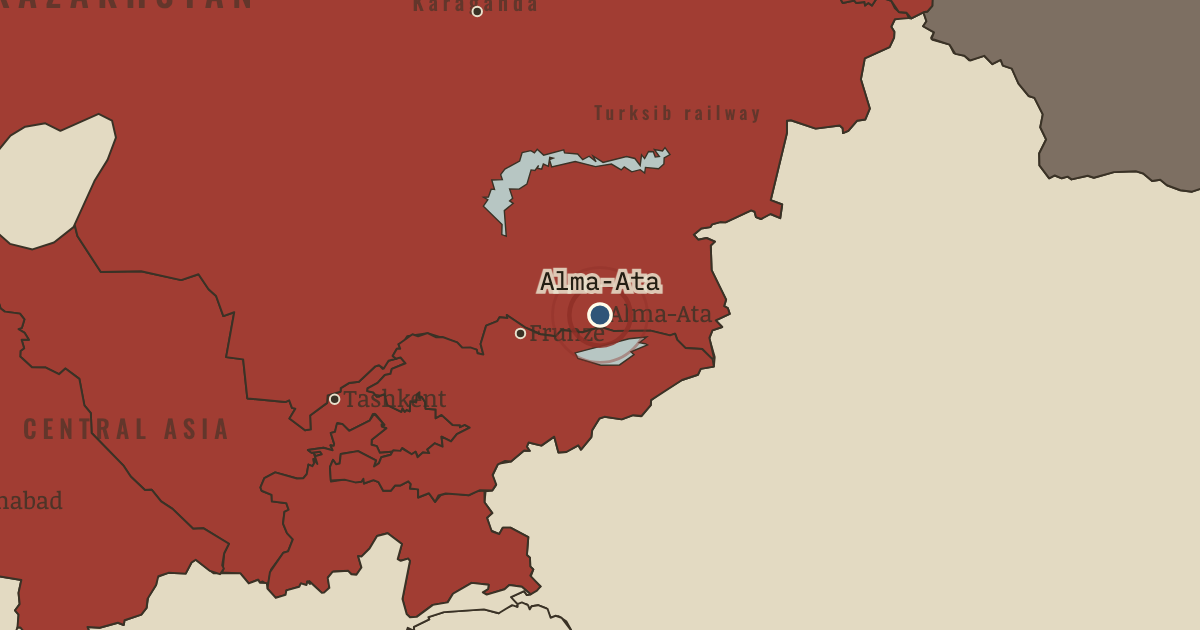
17 Jan 1928 — Leon Trotsky, founder of the Red Army, is carried by OGPU agents onto a train and sent to Alma-Ata, more than 3,000 km from Moscow. He kept writing to his supporters from Kazakhstan until the regime decided that even this exile was too close.
WW2 is free — every chapter. Try chapters 1–2 of any 2 other atlases (3 with a free account). Opening a new atlas uses one of them. Membership opens all 21 — Join.
Free printable Stalin’s Soviet Union study guide, sent by email ↓
The moment in context
Stalin’s rise depended first on surviving a warning from Lenin himself, and the way the leaders handled it shows how the party already worked. In December 1922 and January 1923, partly paralysed by strokes, Lenin dictated notes later called his Testament. He wrote that Stalin had concentrated “unlimited authority” in his hands, and in a postscript of 4 January 1923 he called him “too rude” and proposed removing him as General Secretary, the head of the party’s administrative office, much like a chief of staff. The quarrel behind the postscript was the Georgian Affair, marked on the map at Tiflis, where Stalin and his ally Sergo Ordzhonikidze had bullied Georgian communists into a federation with Armenia and Azerbaijan. When the notes were read to delegation leaders at the Thirteenth Congress, the party’s national gathering, in May 1924, Zinoviev and Kamenev argued that Stalin should stay, because they needed him against Trotsky. The men best placed to stop Stalin chose to shield him, and the text stayed unpublished in the Soviet Union until 1956.
From Stalin’s rise to power, chapter 1 of The Soviet Union under Stalin, 1924–1953 (1928).
The place: Trotsky’s exile to Alma-Ata — map and full story →
Teach this in 5 minutes
- Why it happened — The party had no rules for succession. Lenin led through personal authority, and the party had no office of leader and no procedure for choosing one. Power sat in committees: the…
- The turn — Alma-Ata, January 1928. The train that carried Trotsky to Alma-Ata on 17 January 1928 marks the moment the succession was settled, because the last leader with an…
- What it changed — A leader without rivals launched the Great Turn. With Trotsky gone and Bukharin defeated, Stalin could impose forced collectivisation and breakneck industrialisation without a faction able to stop…
Then ask the room: Did Stalin win the succession mainly through his own skill, or because his rivals made it easy for him? The argued answer is on the chapter page →
The atlas that shows it
THE FREE PRINTABLE STUDY GUIDE
Join the Dispatch — a short welcome series, then a letter when a new atlas opens — and the printable study guide for The Soviet Union under Stalin is yours now, free.
NO TRACKING · YOUR ADDRESS IS USED FOR THE DISPATCH AND NOTHING ELSE · UNSUBSCRIBE ANYTIME