ON THIS DAY ·
Bloody Sunday
22 Jan 1905 — Troops fire on a peaceful procession of workers bringing a petition to the Winter Palace; hundreds are killed. The myth of the Tsar as the people’s father dies in an afternoon. A memorial, not a battle.
WW2 is free — every chapter. Try chapters 1–2 of any 2 other atlases (3 with a free account). Opening a new atlas uses one of them. Membership opens all 21 — Join.
Free printable Russian Revolution study guide, sent by email ↓

The moment in context
Autocracy in Russia meant personal rule, and its central weakness was the absence of any institution that could take the responsibility when things went wrong. Nicholas II inherited a throne with no constitution, no responsible ministry, and no legal opposition, so every grievance, over wages, land, censorship or defeat, flowed directly to him. Every European monarchy that survived the century had learned to place a parliament between the crown and popular anger, and Russia had not, so a system with no way to release pressure eventually bursts under it.
From Russian Revolution of 1905, chapter 3 of The Russian Revolution, 1855–1924 (NOV 1905).
The place: Bloody Sunday — map and full story →
Teach this in 5 minutes
- Why it happened — Autocracy without a shock-absorber. Every European monarchy that survived the century had learned to share power with a parliament that could take the blame for hard times. Russia’s…
- The turn — The October Manifesto, 17/30 October 1905. The autocracy’s cleverest and most fateful act. By conceding a parliament and liberties under duress, Nicholas divided a united opposition into…
- What it changed — A pseudo-constitution. The Duma that met from 1906 was real enough to raise expectations and hollow enough to frustrate them: the Tsar could dissolve it, and Stolypin…
Then ask the room: 1905 failed and 1917 succeeded. What was different — the regime, the revolutionaries, or the circumstances? The argued answer is on the chapter page →
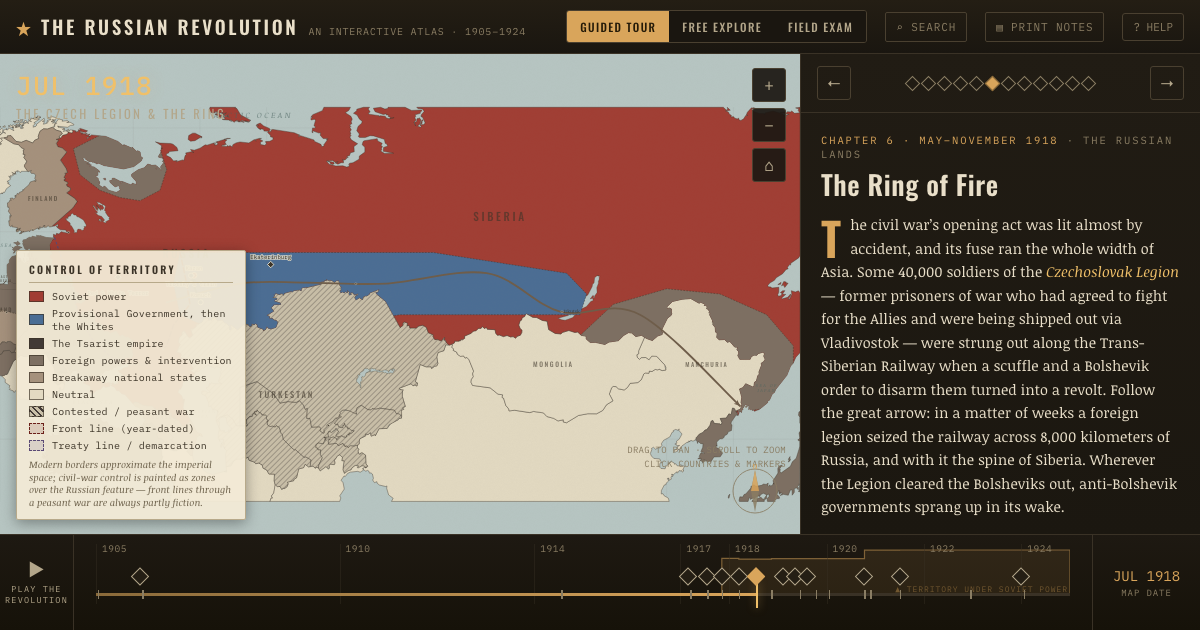
The atlas that shows it
THE FREE PRINTABLE STUDY GUIDE
Join the Dispatch — a short welcome series, then a letter when a new atlas opens — and the printable study guide for The Russian Revolution is yours now, free.
NO TRACKING · YOUR ADDRESS IS USED FOR THE DISPATCH AND NOTHING ELSE · UNSUBSCRIBE ANYTIME