ON THIS DAY ·
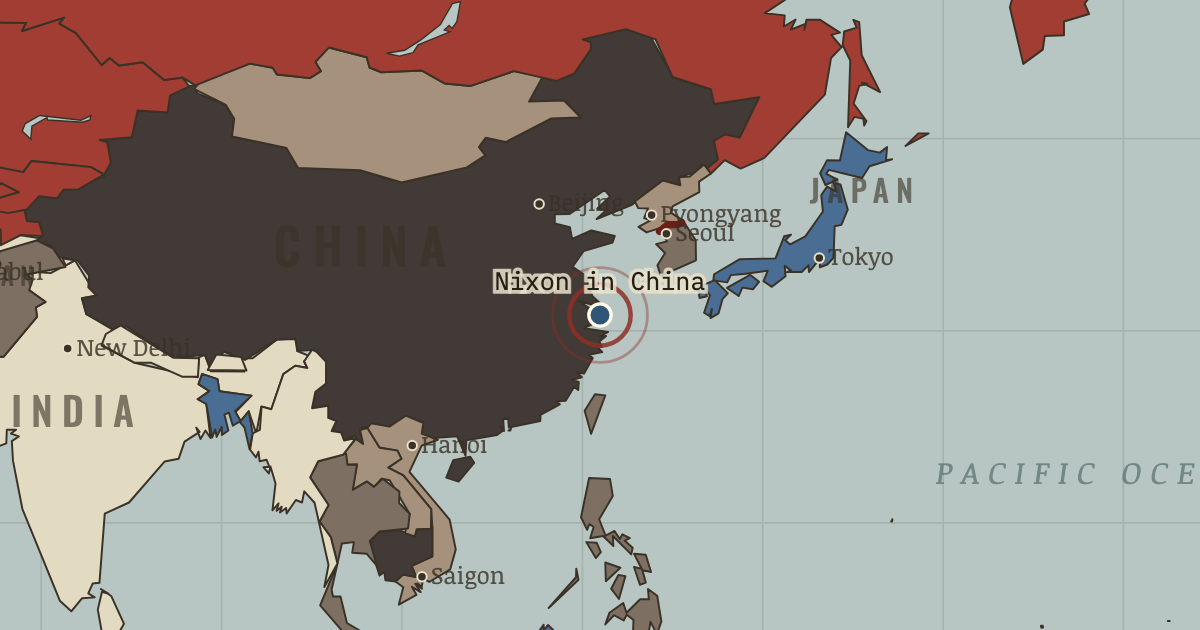
Nixon’s visit to China
21–28 Feb 1972 — The arch anti-communist toasts Mao in Beijing and signs the Shanghai Communiqué. The triangle is complete: each communist power now fears the other more than the West.
WW2 is free — every chapter. Try chapters 1–2 of any 2 other atlases (3 with a free account). Opening a new atlas uses one of them. Membership opens all 21 — Join.
The moment in context
By 1969 all three of the major powers had reasons to ease the confrontation. Washington was bleeding in Vietnam and straining its economy, Moscow faced a hostile China as well as NATO, and Beijing feared a Soviet attack more than an American one. Nixon and Kissinger exploited this triangle by improving relations with China, which pushed an anxious Moscow toward summit diplomacy of its own. The whole movement rested on a cold calculation of interest rather than on any reconciliation of ideologies.
From Détente and Nixon in China, chapter 9 of The Cold War, 1945–1991 (JAN 1977).
The place: Nixon’s visit to China — map and full story →
Teach this in 5 minutes
- Why it happened — The split that made the triangle possible. The Sino-Soviet alliance died of accumulated insults: Khrushchev’s de-Stalinization (undermining Mao’s cult by proxy), his retreat at Cuba…
- The turn — Beijing and Shanghai, 21–28 February 1972. “The week that changed the world” is barely an exaggeration: the map’s two largest anti-Western powers are now each other’s primary enemy, and both…
- What it changed — Helsinki’s slow fuse. Within two years of the signature: Moscow Helsinki Group (1976), Charter 77 in Prague, KOR in Poland. Dissidence reorganized as compliance…
Then ask the room: Détente collapsed within a decade. Was it therefore a failure? The argued answer is on the chapter page →
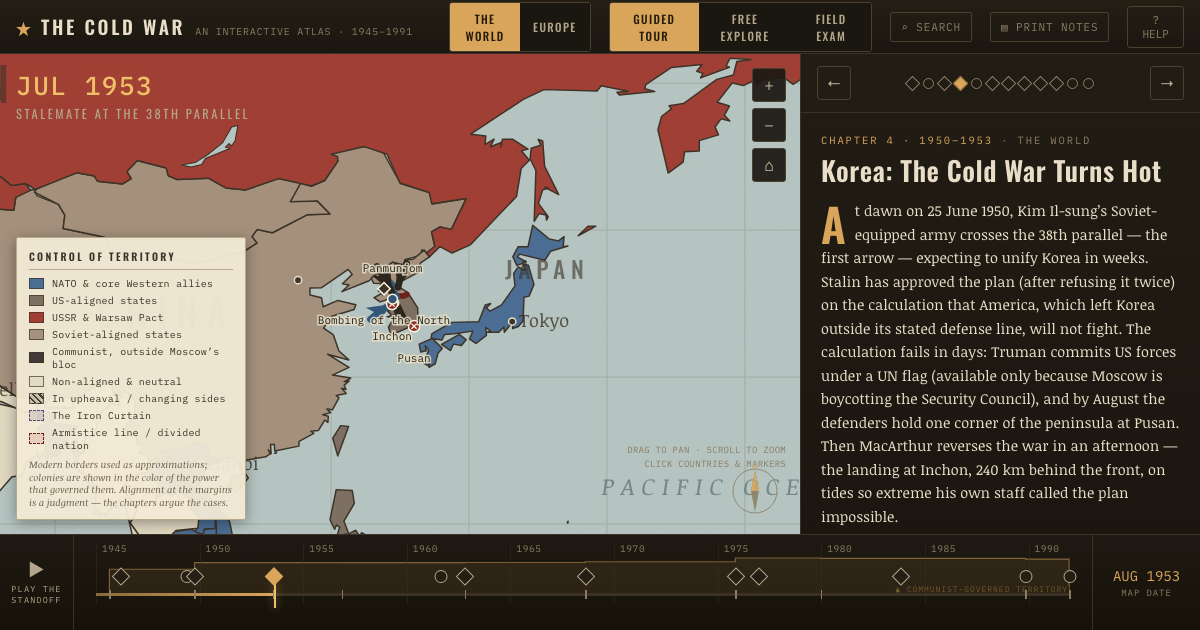
The atlas that shows it
THE FREE PRINTABLE STUDY GUIDE
Join the Dispatch — a short welcome series, then a letter when a new atlas opens — and the printable study guide for The Cold War is yours now, free.
NO TRACKING · YOUR ADDRESS IS USED FOR THE DISPATCH AND NOTHING ELSE · UNSUBSCRIBE ANYTIME