ON THIS DAY ·
Nebraska rescinds the ERA
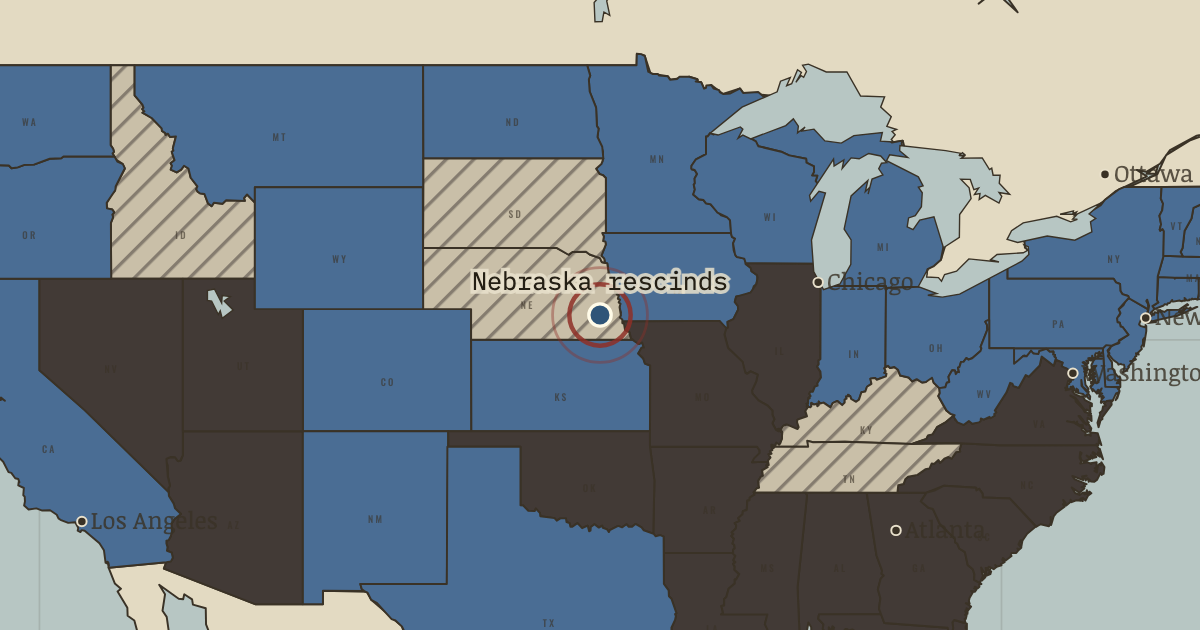
15 Mar 1973 — Nebraska, which ratified within a week of Congress, votes to withdraw its ratification. Tennessee, Idaho, Kentucky and South Dakota follow; whether a state may take back a ratification is never settled in court.
WW2 is free — every chapter. Try chapters 1–2 of any 2 other atlases (3 with a free account). Opening a new atlas uses one of them. Membership opens all 21 — Join.
Free printable Feminism and the Tunisian Revolution study guide, sent by email ↓
The moment in context
The ERA began with enormous momentum because almost everyone in power claimed to support it. Alice Paul of the National Woman’s Party had first drafted an amendment in 1923, both major parties had endorsed it in their platforms for decades, and by 1972 President Nixon, a growing number of trade unions and the new women’s organisations all backed it. The Senate passed it by 84 votes to 8. On the map the first snapshot shows 22 states ratifying within nine months, many with little debate: Hawaii on the same day, then New Hampshire, Delaware, Iowa, Idaho, Kansas, Nebraska and Texas within about a week. By March 1973 the total reached 30, and only eight more were needed. The speed of the early votes concealed a weakness, because legislators who ratify without debate have not been persuaded and can be unpersuaded.
From Equal Rights Amendment, chapter 5 of Protest and Change: Second-Wave Feminism and Tunisia, 1945–2015 (1982).
The place: Nebraska rescinds the ERA — map and full story →
Teach this in 5 minutes
- Why it happened — A supermajority rule. Because 38 of 50 states had to ratify, opponents needed to hold only 13 states, and in each of them they needed to persuade only one chamber of the…
- The turn — STOP ERA, autumn 1972. The founding of STOP ERA is the hinge because the pace of ratification changed almost at once. Twenty-two states ratified in 1972, eight in 1973,…
- What it changed — Equality by other routes. Much of what the ERA promised arrived through courts and statutes: the Supreme Court’s rulings in Reed v. Reed (1971) and Craig v. Boren (1976)…
Then ask the room: Did the ERA fail because of Phyllis Schlafly, or because of the rules for amending the Constitution? The argued answer is on the chapter page →
The atlas that shows it
THE FREE PRINTABLE STUDY GUIDE
Join the Dispatch — a short welcome series, then a letter when a new atlas opens — and the printable study guide for Protest and Change is yours now, free.
NO TRACKING · YOUR ADDRESS IS USED FOR THE DISPATCH AND NOTHING ELSE · UNSUBSCRIBE ANYTIME