ON THIS DAY ·
Annexation of the Ryukyu Kingdom
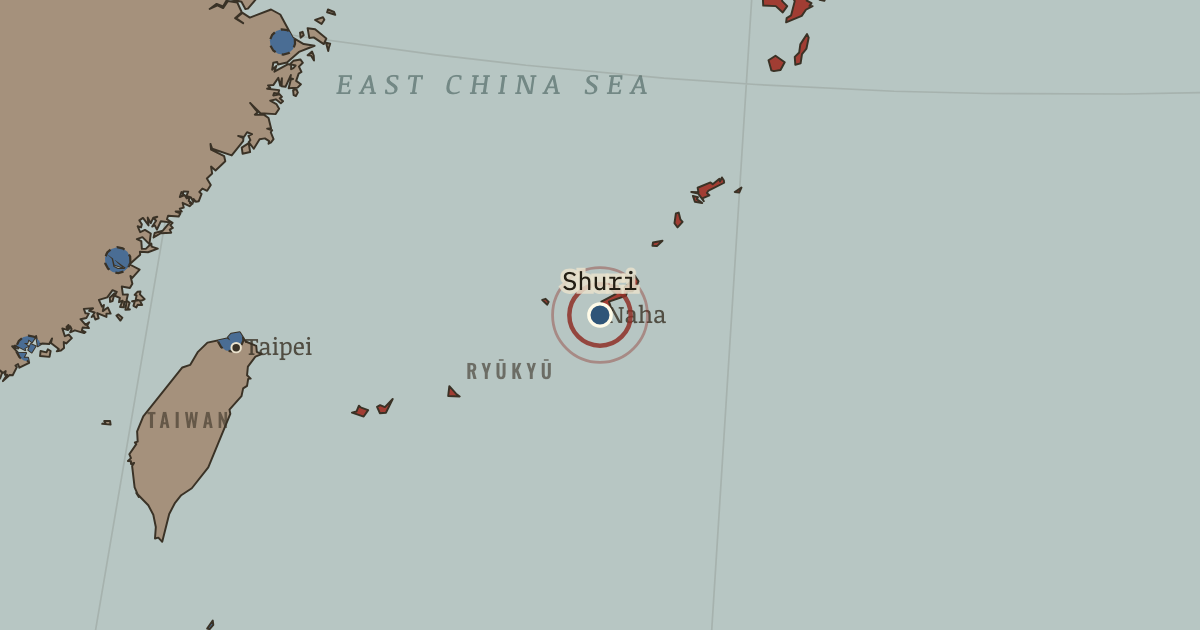
27 Mar 1879 — A Japanese official arrives at Shuri with soldiers and police and orders the Ryukyu kingdom dissolved. King Shō Tai is moved to Tokyo, and the islands become Okinawa Prefecture, ending a kingdom that had sent tribute to China for five centuries.
WW2 is free — every chapter. Try chapters 1–2 of any 2 other atlases (3 with a free account). Opening a new atlas uses one of them. Membership opens all 21 — Join.
Free printable Meiji Japan and post-Soviet Russia study guide, sent by email ↓
The moment in context
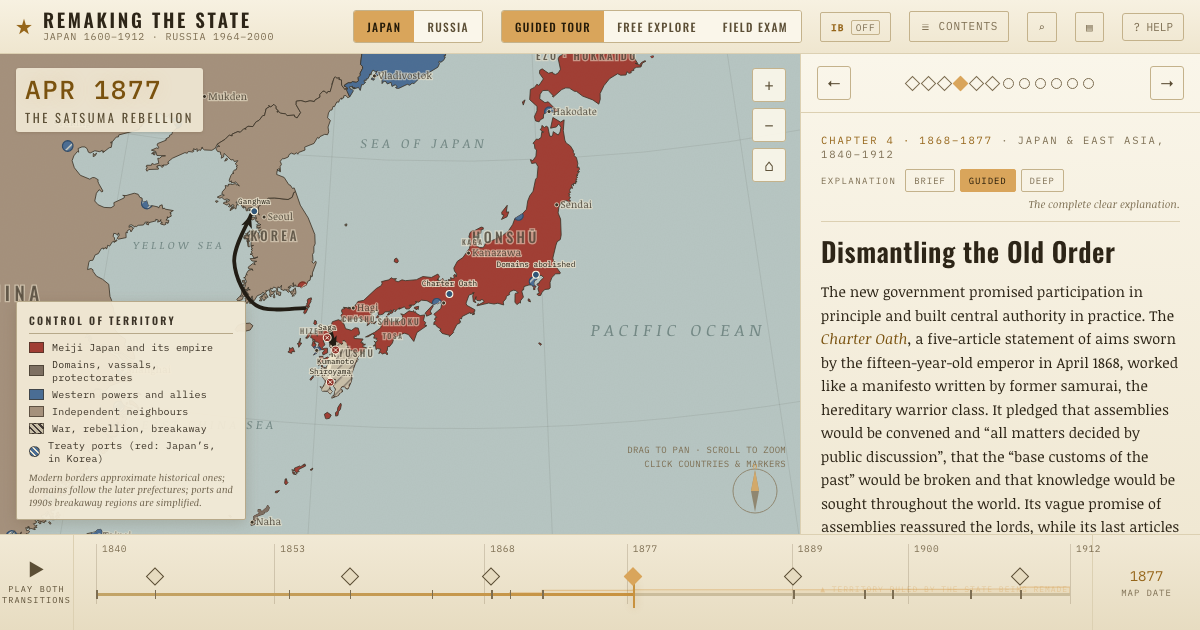
Japan’s builders were a small, stable group who learned systematically from abroad, and that combination explains much of their success. The Iwakura Mission of 1871–73 took about half the government’s leaders, including Ōkubo Toshimichi, Kido Takayoshi and the young Itō Hirobumi, on a tour of America and Europe. It failed to revise the treaties and returned convinced that Japan needed factories, schools and laws before it could demand equality. The government employed foreign experts, sent students abroad and copied selectively: a navy on British lines, an army on French and later German lines, and schools on American and French models. After Ōkubo was assassinated in 1878, power passed to a circle later called the genrō, the elder statesmen, an unelected inner council something like a permanent board of senior partners, among them Itō, Yamagata Aritomo and Matsukata. They took turns as prime minister for thirty years, which gave the state a continuity of purpose that few governments in transition enjoy.
From Meiji Constitution and modernisation, chapter 5 of Remaking the State: Meiji Japan 1600–1912 and Post-Soviet Russia 1964–2000 (1889).
The place: Annexation of the Ryukyu Kingdom — map and full story →
Teach this in 5 minutes
- Why it happened — The Iwakura Mission taught that strength must come first. The mission set out in 1871 to begin revising the unequal treaties and was told politely that Japan’s laws and institutions were not yet acceptable…
- The turn — The constitution, 11 February 1889. The promulgation is the hinge because it fixed the rules of Japanese politics for more than half a century, until 1947. It made Japan the first…
- What it changed — Treaty revision became possible. In July 1894 Britain signed a treaty agreeing to end extraterritoriality from 1899, and the other powers followed. The new constitution, cabinet…
Then ask the room: Was the Meiji constitution a step towards democracy or a device to prevent it? The argued answer is on the chapter page →
The atlas that shows it
THE FREE PRINTABLE STUDY GUIDE
Join the Dispatch — a short welcome series, then a letter when a new atlas opens — and the printable study guide for Remaking the State is yours now, free.
NO TRACKING · YOUR ADDRESS IS USED FOR THE DISPATCH AND NOTHING ELSE · UNSUBSCRIBE ANYTIME