ON THIS DAY ·
Chernobyl disaster
26 Apr 1986 — Reactor 4 explodes; the state lies for days while fallout crosses Europe. ~50 direct deaths, thousands of projected ones, 350,000 displaced. Gorbachev later calls it “perhaps the real cause” of collapse. Remember.
WW2 is free — every chapter. Try chapters 1–2 of any 2 other atlases (3 with a free account). Opening a new atlas uses one of them. Membership opens all 21 — Join.

The moment in context
When Gorbachev took power in 1985 the economy was barely growing, its technology lagged badly, and defence consumed a crushing share of national output. He intended renewal rather than dissolution, and abroad he moved with striking speed: the INF Treaty of 1987 abolished an entire class of missiles, the first true reduction of the arms race, and his 1988 speech at the United Nations cut Soviet forces and signalled that the bloc’s members could now choose their own path.
From Gorbachev and the 1989 revolutions, chapter 11 of The Cold War, 1945–1991 (NOV 1989).
The place: Chernobyl disaster — map and full story →
Teach this in 5 minutes
- Why it happened — Why reform — the numbers Gorbachev read. By the early 1980s Soviet growth was ~1% and possibly negative (the statistics themselves were fiction). Grain imports ran 30–40 million tons a…
- The turn — Berlin, 9 November 1989, 18:53. Asked when new travel rules take effect, Politburo spokesman Schabowski shuffles his notes and guesses: “immediately, without delay.” Tens of…
- What it changed — Germany reunifies — inside the West. Eleven months from wall to unification (3 October 1990): Kohl outruns every ally’s caution, Bush backs him, and Gorbachev. Against his generals, for…
Then ask the room: Could a Soviet leader other than Gorbachev have held the bloc together — and for how long? The argued answer is on the chapter page →
The atlas that shows it
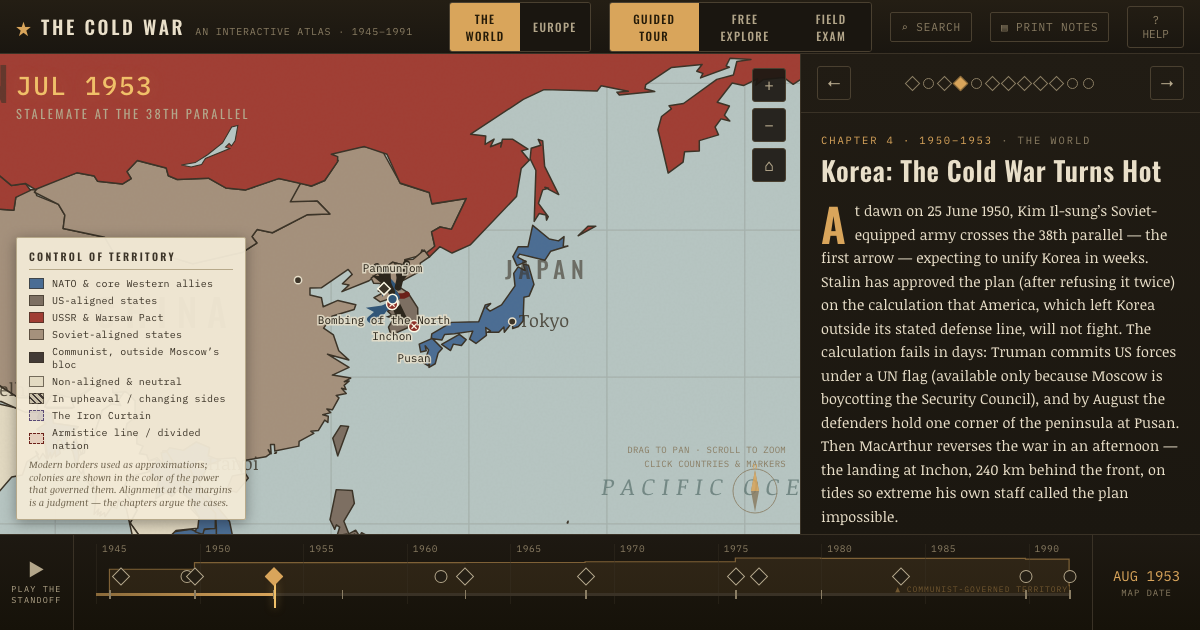
THE FREE PRINTABLE STUDY GUIDE
Join the Dispatch — a short welcome series, then a letter when a new atlas opens — and the printable study guide for The Cold War is yours now, free.
NO TRACKING · YOUR ADDRESS IS USED FOR THE DISPATCH AND NOTHING ELSE · UNSUBSCRIBE ANYTIME