ON THIS DAY ·
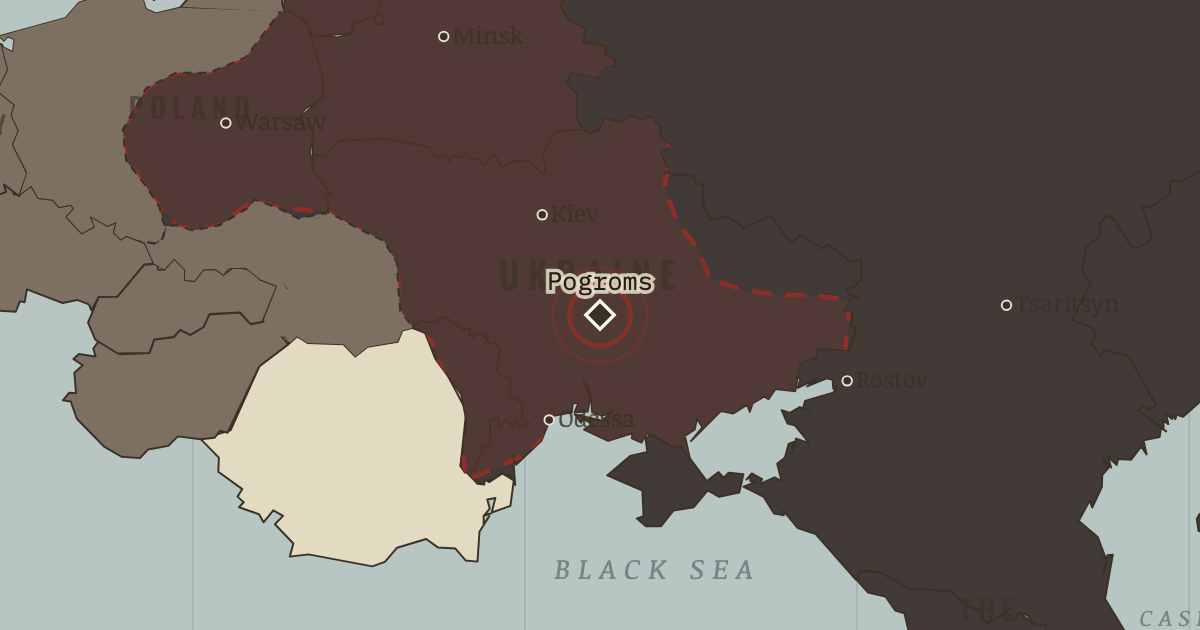
Elisavetgrad pogrom
15/27 Apr 1881 — Anti-Jewish riots, led mostly by townsmen and migrant workers, break out here and spread through some two hundred towns and villages of the south-west in 1881–82. Around fifty people die, half of them rioters, and thousands of Jewish homes and shops are looted. Jewish memory calls the wave the “storms in the south”, and this memorial marks its victims.
WW2 is free — every chapter. Try chapters 1–2 of any 2 other atlases (3 with a free account). Opening a new atlas uses one of them. Membership opens all 21 — Join.
Free printable Russian Revolution study guide, sent by email ↓
The moment in context
Alexander III drew one lesson from his father’s death, that giving way to demands invites revolution, and it shaped every institution of his reign. His manifesto of April 1881, drafted by Pobedonostsev, the layman who ran the Orthodox Church for him, proclaimed unlimited autocracy, one-man rule, like a president with no parliament, and the reforming ministers resigned. The statute of August 1881 let governors ban meetings, close newspapers and exile suspects without trial, like wartime emergency laws, and it was renewed repeatedly until 1917. Because the government blamed educated youth for the assassinations, it ended university self-government in 1884 and in 1887 urged schools to turn away cooks’ children. Because it distrusted the village institutions of 1861, it put land captains over the peasants in 1889, appointed nobles who acted as both administrator and judge, like colonial district officers. Each measure treated a whole class as suspect for the acts of a few.
From Counter-reforms of Alexander III, chapter 2 of The Russian Revolution, 1855–1924 (MAY 1891).
The place: Elisavetgrad pogrom — map and full story →
Teach this in 5 minutes
- Why it happened — The assassination of 1881. Alexander II’s murder persuaded his son that concessions only encourage terror. The People’s Will had tried for two years to kill him, and its bomb…
- The turn — The Catherine Canal, 1/13 March 1881. The assassination is the hinge because it came at the one moment when the autocracy had agreed to listen to elected voices. That morning Alexander…
- What it changed — A state of permanent emergency. The emergency statute of 1881 became a normal tool of government, so a large share of the empire’s people lived under emergency rule for a…
Then ask the room: Did Alexander III’s policies strengthen the autocracy or prepare its collapse? The argued answer is on the chapter page →
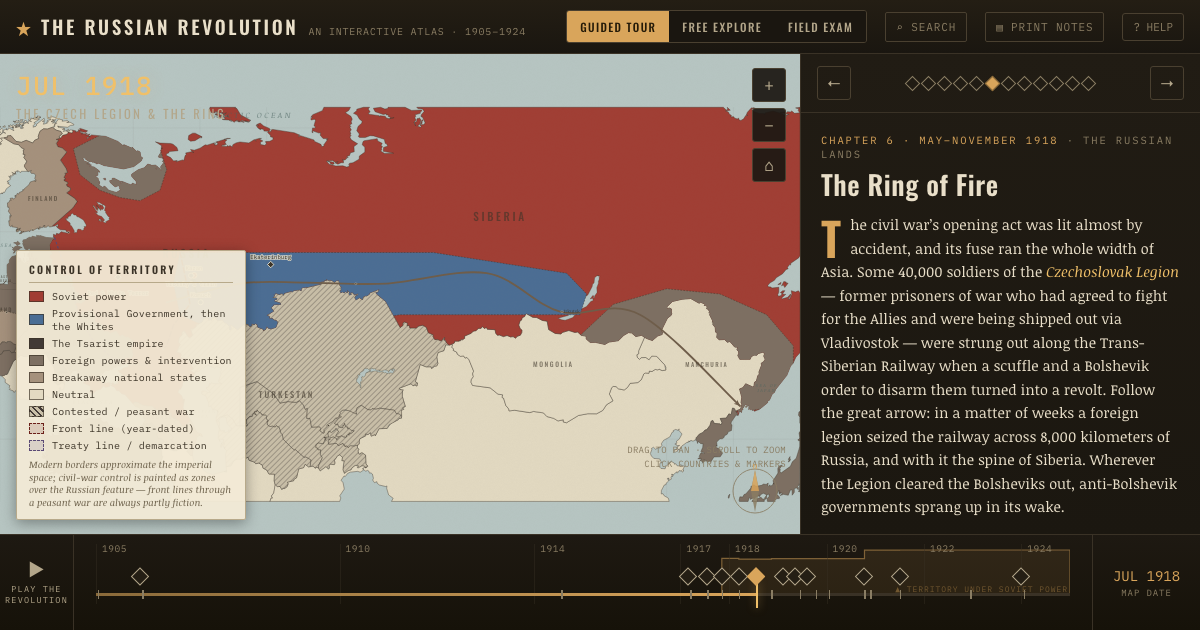
The atlas that shows it
THE FREE PRINTABLE STUDY GUIDE
Join the Dispatch — a short welcome series, then a letter when a new atlas opens — and the printable study guide for The Russian Revolution is yours now, free.
NO TRACKING · YOUR ADDRESS IS USED FOR THE DISPATCH AND NOTHING ELSE · UNSUBSCRIBE ANYTIME