ON THIS DAY ·
Treaty of Frankfurt
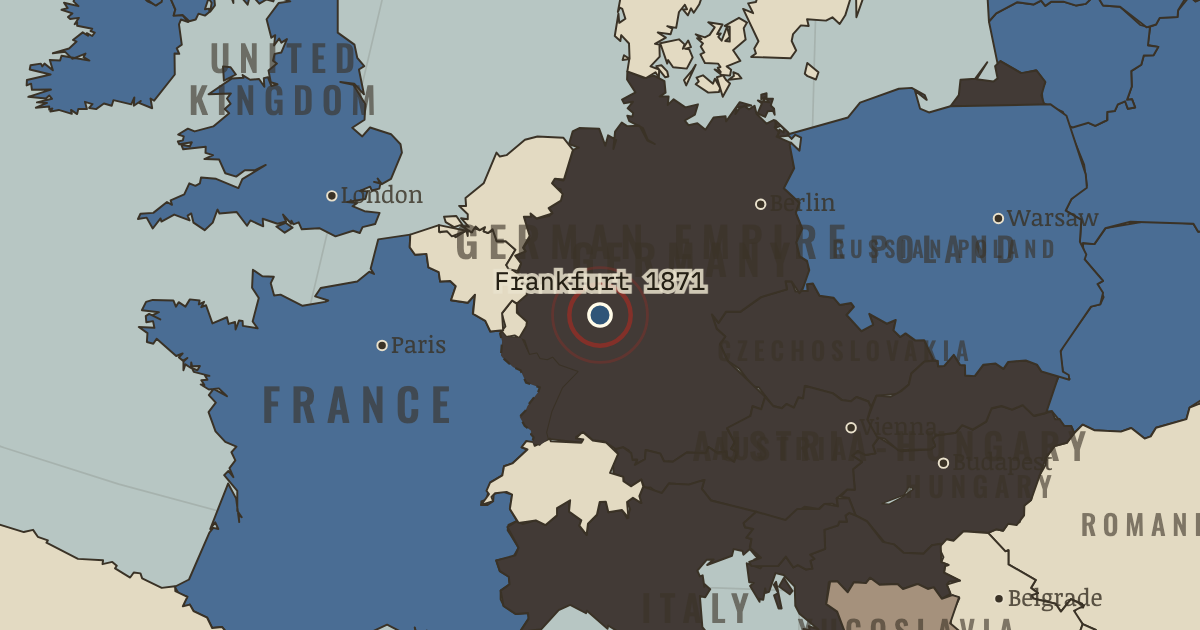
10 May 1871 — France cedes Alsace and most of Lorraine and owes an indemnity of five billion francs, with German troops on its soil until it is paid. France pays early, by September 1873, but never accepts the loss of the provinces.
WW2 is free — every chapter. Try chapters 1–2 of any 2 other atlases (3 with a free account). Opening a new atlas uses one of them. Membership opens all 21 — Join.
The moment in context
Otto von Bismarck, Germany’s chancellor, built his system on a calculation about numbers: in a Europe of five great powers, the states able to fight a major war alone, a state should always try to be one of three. France would never forgive the loss of Alsace and Lorraine, the border provinces Germany annexed in 1871, so Germany had to deny it any ally worth a war of revenge. He tied Austria-Hungary, the Habsburg empire ruled from Vienna, and Russia to Berlin in the Three Emperors’ League of 1873, a pact to consult and keep the peace. Its weakness lay in the Balkans, the peninsula of south-east Europe, where the two empires competed for the lands of the retreating Ottoman Empire, the Turkish state ruled from Constantinople. When Russia’s victory over the Ottomans in 1878 promised a huge client Bulgaria, the great powers cut it back at the Congress of Berlin, a conference that redrew the Balkan map, and Russia blamed Germany. Bismarck answered with the Dual Alliance of 1879, a secret promise to defend Austria-Hungary against Russia, which Italy joined in 1882 to form the Triple Alliance. The rivalry he meant to manage had become a German commitment.
From Alliance system before WWI, chapter 1 of The Great War, 1871–1923 (AUG 1907).
The place: Treaty of Frankfurt — map and full story →
Teach this in 5 minutes
- Why it happened — A new giant in the middle of Europe. Unification turned a loose group of German states into an empire with the largest population west of Russia and the fastest-growing industry on the…
- The turn — Kronstadt, July 1891. The hinge of this chapter is the moment Russia turned to France, and the French squadron’s visit to Kronstadt in July 1891 made that turn visible to…
- What it changed — A war plan built on two fronts. Once France and Russia were allied, German planners assumed that any war would be fought in the west and the east at once. Alfred von Schlieffen’s…
Then ask the room: Did Bismarck’s alliance system keep the peace, or did it build the trap that closed in 1914? The argued answer is on the chapter page →
The atlas that shows it
THE FREE PRINTABLE STUDY GUIDE
Join the Dispatch — a short welcome series, then a letter when a new atlas opens — and the printable study guide for WWI is yours now, free.
NO TRACKING · YOUR ADDRESS IS USED FOR THE DISPATCH AND NOTHING ELSE · UNSUBSCRIBE ANYTIME