ON THIS DAY ·
May Thirtieth Incident
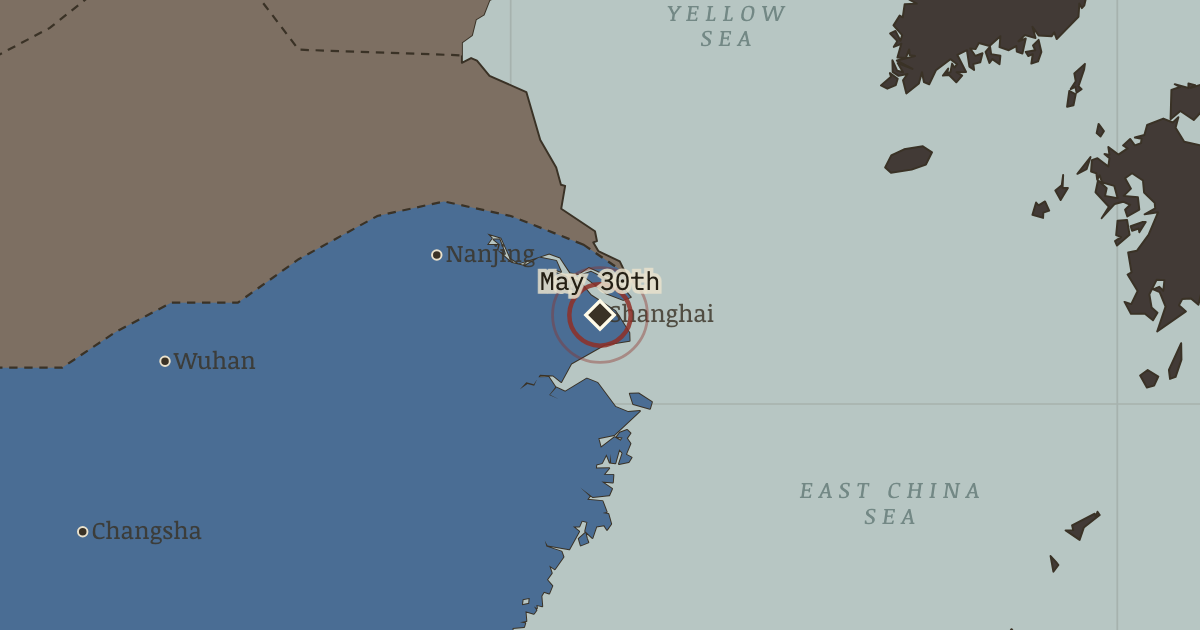
30 May 1925 — British-officered police fire into a crowd protesting a Japanese mill’s killing of a worker: eleven dead on Nanking Road. The empire-wide strike wave that follows hands the Canton government a mass movement — nationalism is now the strongest force on this map.
WW2 is free — every chapter. Try chapters 1–2 of any 2 other atlases (3 with a free account). Opening a new atlas uses one of them. Membership opens all 21 — Join.
Free printable Chinese Revolution study guide, sent by email ↓
The moment in context
A party-army fuses military command with a political organization, a doctrine and a system of discipline. By the mid-1920s the blue in the south was being turned into exactly that kind of machine. In 1923 Sun Yat-sen struck his bargain with Moscow, which sent money, rifles and, more important than either, organizers led by Michael Borodin. Borodin rebuilt the Nationalist Party as a Leninist pyramid of cells and committees, with the tiny CCP folded inside it. On an island below Canton the alliance founded what China had never possessed, an officer academy whose cadets swore loyalty to a party and a doctrine rather than to a paymaster (the ● at Whampoa). Its commandant was a sharp, austere soldier named Chiang Kai-shek, and its political department was run by a polished young Communist named Zhou Enlai. Nearly every commander of every war left in this atlas, on both sides, passed through Whampoa’s first classes. Then, in May 1925, British-officered police fired into a Shanghai crowd (the ◆ on the Bund), and the empire-wide strike wave that followed handed Canton a mass movement to lead.
From Northern Expedition and United Front, chapter 4 of China in Revolution, 1911–1949 (1926).
The place: May Thirtieth Incident — map and full story →
Teach this in 5 minutes
- Why it happened — The Soviet package: party, army, mass line. What Moscow exported was not Marxism (Borodin was under orders to keep the revolution “national”) but Leninist technique: a party organized in…
- The turn — Whampoa, June 1924. Choose the founding over any battle: Tingsi Bridge was won by the kind of army Whampoa existed to create, and the campaign was won by dozens of…
- What it changed — Two victors inside one victory. By spring 1927 the United Front holds the Yangtze. It has become two rival governments (Wuhan’s left KMT with the Communists. Chiang with the army…
Then ask the room: Could the First United Front have held — or was the 1927 rupture written into its founding documents? The argued answer is on the chapter page →
The atlas that shows it
THE FREE PRINTABLE STUDY GUIDE
Join the Dispatch — a short welcome series, then a letter when a new atlas opens — and the printable study guide for China in Revolution is yours now, free.
NO TRACKING · YOUR ADDRESS IS USED FOR THE DISPATCH AND NOTHING ELSE · UNSUBSCRIBE ANYTIME