ON THIS DAY ·
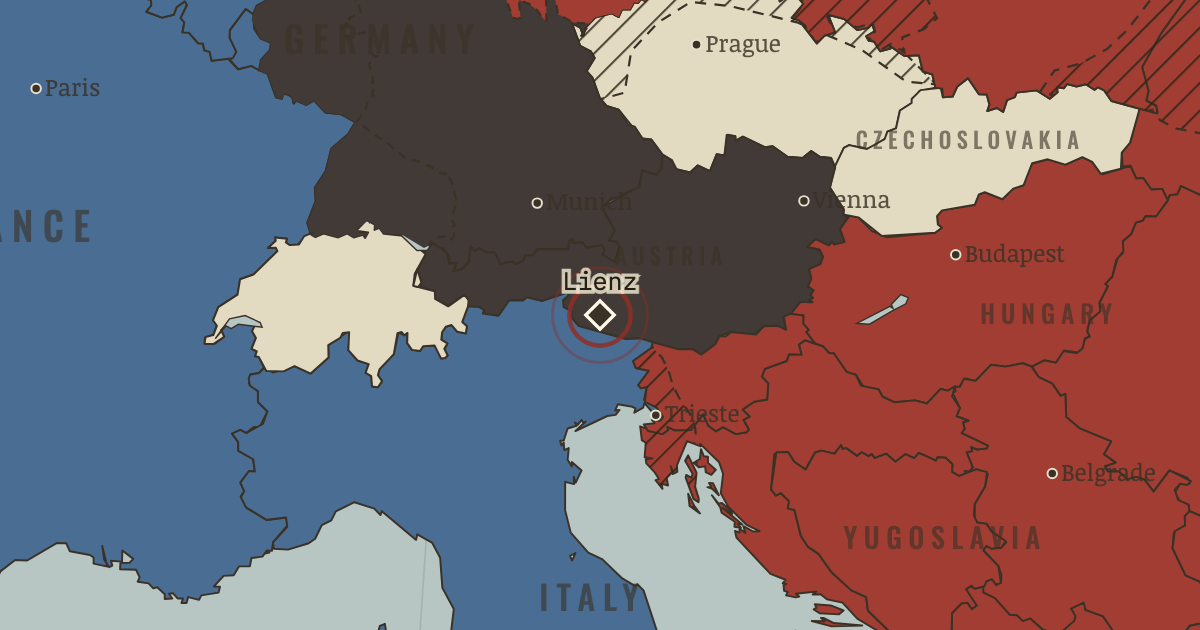
Repatriation of Cossacks at Lienz
1 Jun 1945 — British troops force Cossacks and their families, many of whom had fought for the Germans, onto lorries for handover to the Soviets at Judenburg under the Yalta accords; some die resisting and others take their own lives. Many of those returned were shot or sent to the Gulag. Remember them.
WW2 is free — every chapter. Try chapters 1–2 of any 2 other atlases (3 with a free account). Opening a new atlas uses one of them. Membership opens all 21 — Join.
The moment in context
Repatriation, the return of people to their country of citizenship, was the Allies’ answer to displacement, and for most displaced persons (DPs), the civilians stranded abroad by the war, it worked quickly. French, Belgian and Dutch workers went home within weeks, and by the end of September 1945 nearly six million people had left the western zones. The Soviet case was different, because the Yalta accords of February 1945, signed at the Allied summit in the Crimea, bound Britain and the United States to return Soviet citizens and Stalin treated anyone who had lived under German rule as suspect. At Lienz on 1 June 1945 British troops forced Cossacks, Russian frontier horsemen who had fought for Germany, and their families onto lorries for handover to the Soviets, and at Dachau in January 1946 eleven of 399 former Soviet soldiers killed themselves rather than board a train. Such scenes pushed Western governments to narrow and then abandon forced return, and the right not to be sent back began as a lesson learned in these camps.
From Displaced persons camps after WW2, chapter 4 of Uprooted: Refugees in Europe 1945–1960 and Indochina 1975–1990 (1947).
The place: Repatriation of Cossacks at Lienz — map and full story →
Teach this in 5 minutes
- Why it happened — Yalta’s promise of return. The Allies had agreed at Yalta to return each other’s citizens, and repatriation was the simplest way to empty Germany of millions of foreigners it…
- The turn — The Harrison Report, August 1945. Earl Harrison’s report is the hinge because it changed the basis on which help was given. Until August 1945 DPs were sorted by nationality, so a…
- What it changed — Survivors to Israel. The founding of Israel emptied the Jewish camps. When the British Mandate ended in May 1948, the new State of Israel opened its doors to the Jewish…
Then ask the room: Why did the Western Allies abandon forced repatriation by 1947, and what does the change reveal about how refugee protection is created? The argued answer is on the chapter page →
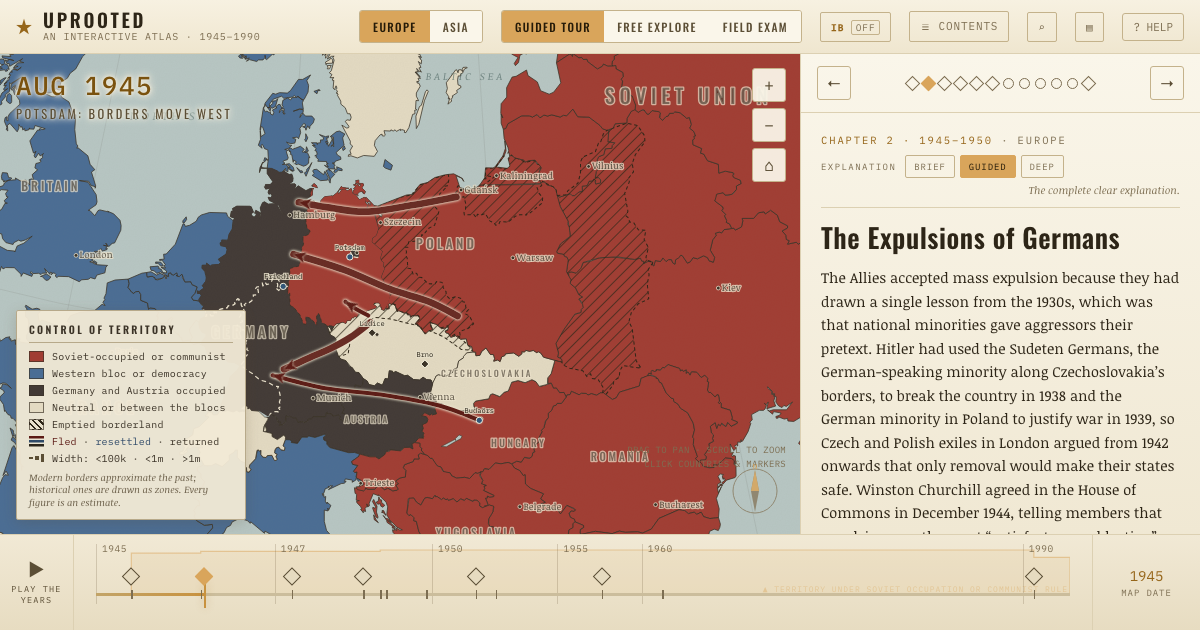
The atlas that shows it
THE FREE PRINTABLE STUDY GUIDE
Join the Dispatch — a short welcome series, then a letter when a new atlas opens — and the printable study guide for Uprooted is yours now, free.
NO TRACKING · YOUR ADDRESS IS USED FOR THE DISPATCH AND NOTHING ELSE · UNSUBSCRIBE ANYTIME