ON THIS DAY ·
Viking raid on Lindisfarne
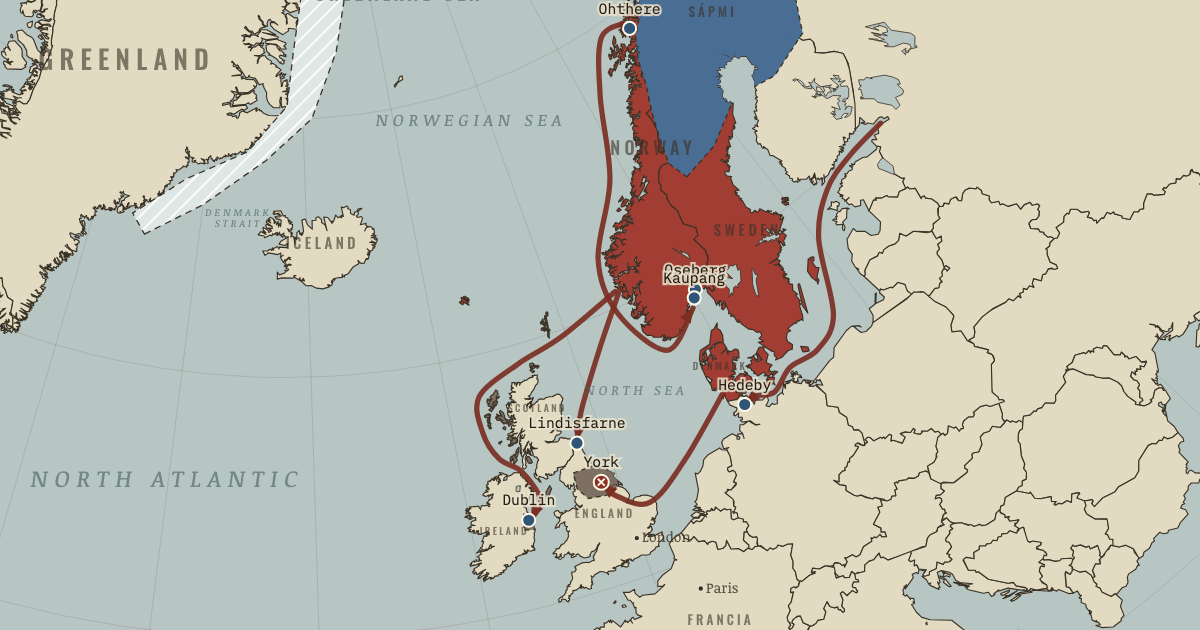
Raiders from the sea strike the monastery of Lindisfarne. Alcuin writes that nobody had thought such a voyage possible — the Viking Age has begun.
WW2 is free — every chapter. Try chapters 1–2 of any 2 other atlases (3 with a free account). Opening a new atlas uses one of them. Membership opens all 21 — Join.
Free printable Norse and Aztecs study guide, sent by email ↓
The moment in context
The ship was the decisive invention because it changed what distance meant for people living along the North Sea. Archaeologists know it from boats buried as graves and wrecks sunk as barriers. The Oseberg ship, built around 820 and buried in 834, is 21.5 metres long and was rowed by fifteen pairs of oars; the Gokstad ship, built of timber felled around 890, carried thirty-two. Its overlapping planks flexed with the waves and absorbed their force, and its draft, the depth of hull below the waterline, was only about a metre, roughly waist height on an adult, so crews could beach it on any strand. By the eleventh century the warship Skuldelev 2, built near Dublin in about 1042, was 30 metres long and carried a crew of 65–70. A fleet like that could appear at a coast with almost no warning, and that surprise was the source of Norse power.
From Viking expansion and the longship, chapter 2 of Climate and Innovation: The Norse and the Aztecs, c. 790–1521 (866).
Teach this in 5 minutes
- Why it happened — A scarcity of farmland at home. Norway is mostly mountain, forest and rock, and only about 3 percent of its land can be cultivated, so good farms along the fjords were limited and…
- The turn — Lindisfarne, 793. The raid on the monastery of Lindisfarne, off the coast of Northumbria, is the conventional start of the Viking Age, and it earns that place because…
- What it changed — Settlement follows the raiders west. Once the routes were known, raiders were followed by families seeking farms. Norse settlers took the Northern Isles, the Hebrides and the Faroe…
Then ask the room: Was the Viking expansion driven more by the ship or by the society that built it? The argued answer is on the chapter page →
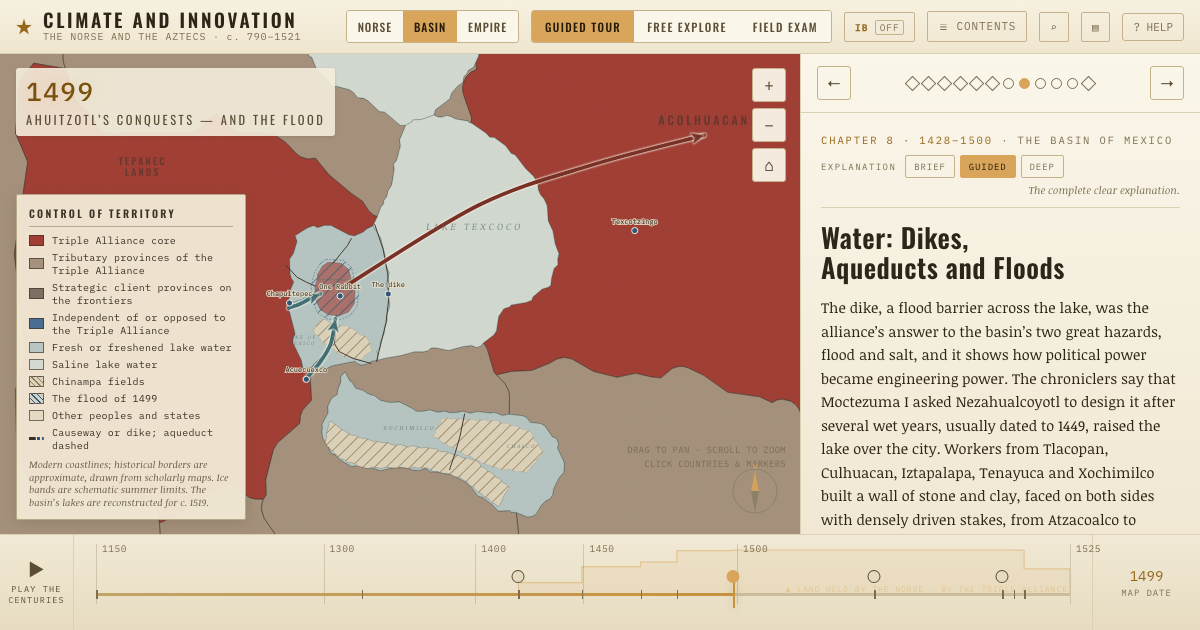
The atlas that shows it
THE FREE PRINTABLE STUDY GUIDE
Join the Dispatch — a short welcome series, then a letter when a new atlas opens — and the printable study guide for Climate and Innovation is yours now, free.
NO TRACKING · YOUR ADDRESS IS USED FOR THE DISPATCH AND NOTHING ELSE · UNSUBSCRIBE ANYTIME