ON THIS DAY ·
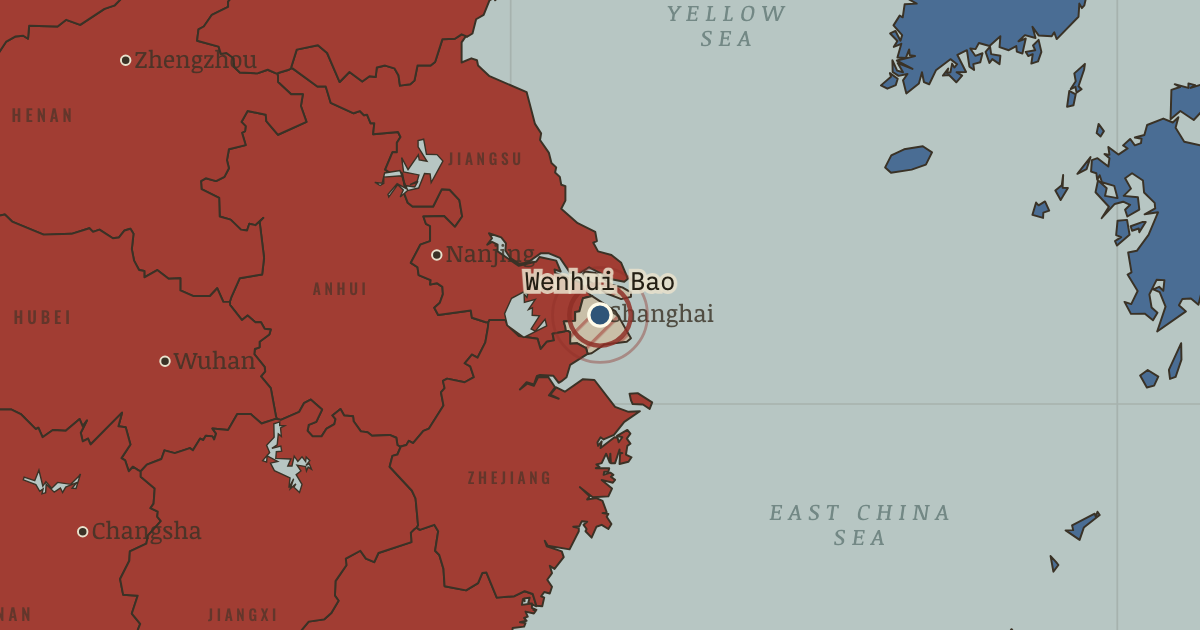
Mao’s editorial against Wenhui Bao
1 Jul 1957 — A People’s Daily editorial, written by Mao himself, attacks Shanghai’s Wenhui Bao for its “bourgeois orientation” in printing criticism during the Hundred Flowers. Editors, writers, teachers and business people who had spoken out in Shanghai are named as rightists in the months that follow.
WW2 is free — every chapter. Try chapters 1–2 of any 2 other atlases (3 with a free account). Opening a new atlas uses one of them. Membership opens all 21 — Join.
The moment in context
The Hundred Flowers grew out of a crisis in world communism and Mao’s confidence that China was different. Khrushchev’s secret speech of February 1956 had shown that a Communist leader could be judged and condemned by his own party, and the risings in Poland and Hungary that autumn showed what could happen when grievances were suppressed for too long. Mao’s speech of 27 February 1957, “On the Correct Handling of Contradictions among the People”, drew a line between disagreements among the people, which should be settled by discussion, and conflicts with enemies, which called for force. In April the Communist Party, which ruled alone at every level of government, launched a rectification campaign, a drive to correct its own faults much like an organisation inviting complaints about its managers. It asked outsiders to criticise its “bureaucratism, sectarianism and subjectivism”. Mao seems to have expected mild complaints from grateful intellectuals, and his confidence that the Party had won their loyalty was the premise of the whole experiment.
From Hundred Flowers Campaign, chapter 5 of The People’s Republic under Mao, 1949–1976 (1957).
The place: Mao’s editorial against Wenhui Bao — map and full story →
Teach this in 5 minutes
- Why it happened — Khrushchev’s secret speech. On 25 February 1956 Khrushchev told the Soviet party congress that Stalin had been a criminal and a self-glorifying tyrant. The speech shook every…
- The turn — 8 June and 1 July 1957. The People’s Daily editorials of 8 June and 1 July 1957 are the hinge because they turned an invitation into a hunt and defined criticism of the…
- What it changed — No one left to warn. The economists, engineers, statisticians and journalists who might have exposed the impossible targets of 1958 had been labelled, sent away or…
Then ask the room: Was the Hundred Flowers campaign a genuine opening that failed, or a deliberate trap? The argued answer is on the chapter page →
The atlas that shows it
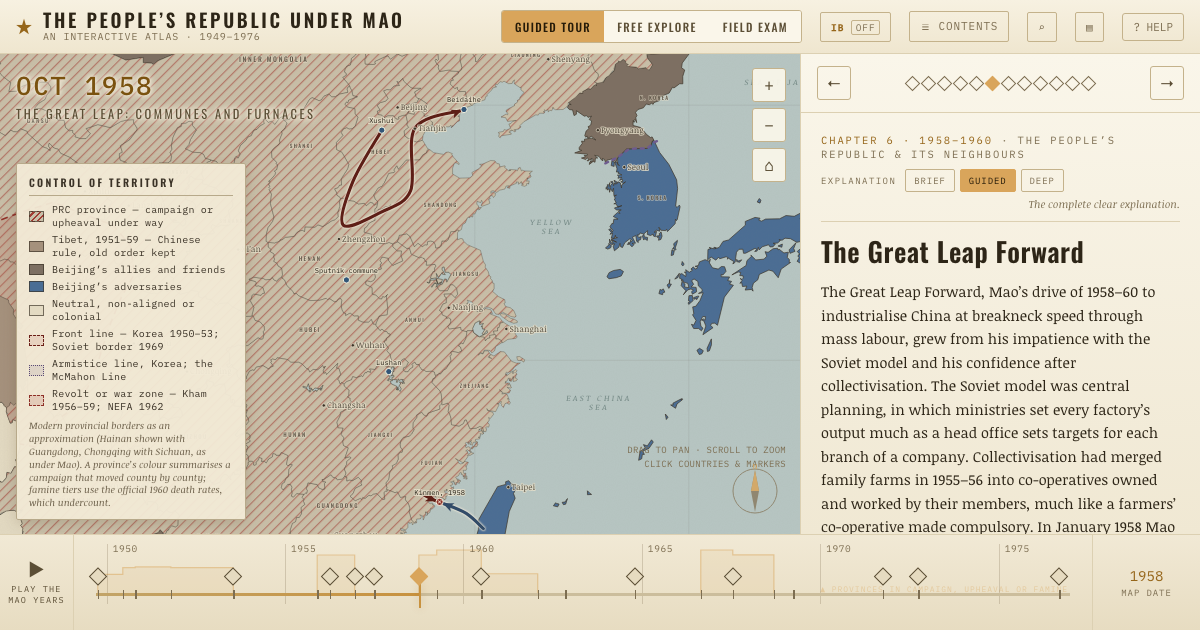
THE FREE PRINTABLE STUDY GUIDE
Join the Dispatch — a short welcome series, then a letter when a new atlas opens — and the printable study guide for The People’s Republic under Mao is yours now, free.
NO TRACKING · YOUR ADDRESS IS USED FOR THE DISPATCH AND NOTHING ELSE · UNSUBSCRIBE ANYTIME