ON THIS DAY ·
UN Refugee Convention adopted in Geneva
A UN conference in Geneva adopts the Refugee Convention, defining a refugee and forbidding return to persecution — for events in Europe before 1951 only.
WW2 is free — every chapter. Try chapters 1–2 of any 2 other atlases (3 with a free account). Opening a new atlas uses one of them. Membership opens all 21 — Join.
The moment in context
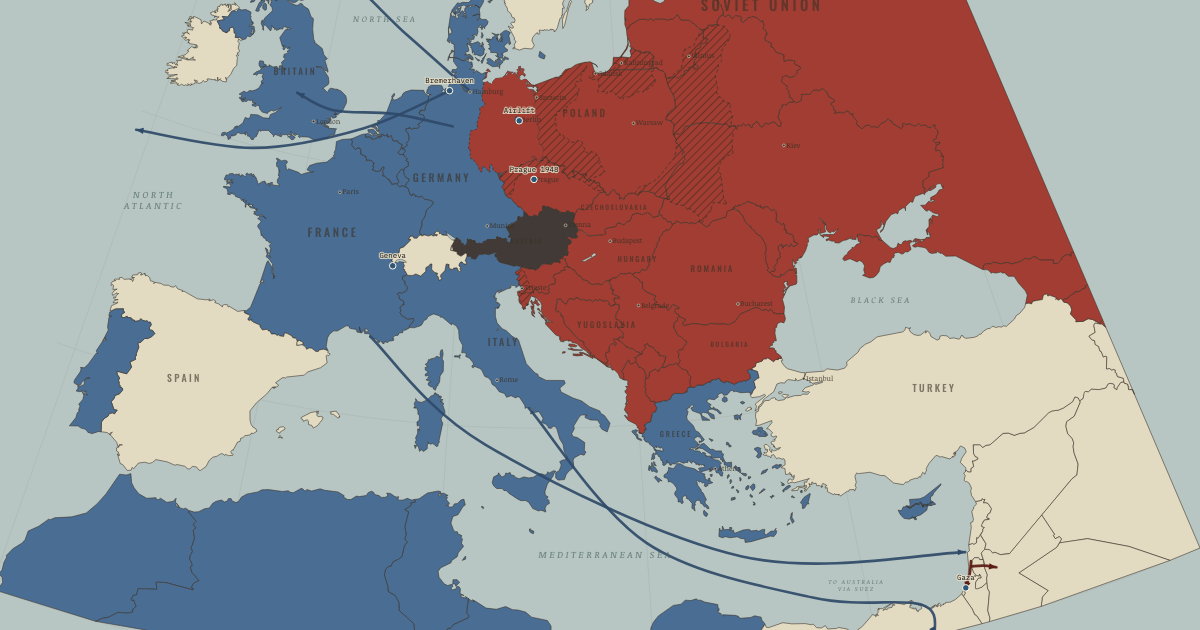
The IRO, the UN agency that succeeded the wartime relief agency UNRRA in 1947, was created because repatriation, sending people home, had run its course, and it turned refugee policy into a form of labour migration through resettlement, permanent settlement in a third country. Most of the million people still in camps in 1947 refused to return east, while Australia, Canada, Britain and Latin America needed workers. Selection teams sought the young, the healthy and the skilled, so Balts and single men were in demand while the old, the sick and large families waited. Australia required its displaced persons (DPs), the uprooted civilians of the camps, to work for two years wherever the government sent them, and the United States admitted refugees under the Displaced Persons Act of June 1948, which President Truman called “flagrantly discriminatory” because its cut-off date of 22 December 1945 excluded most Jews who had fled Poland in 1946. By 1952 about 394,000 DPs had sailed for the United States. Resettlement gave a million people a future, and it showed that receiving states chose refugees in their own interest.
From 1951 Refugee Convention, chapter 5 of Uprooted: Refugees in Europe 1945–1960 and Indochina 1975–1990 (1951).
Teach this in 5 minutes
- Why it happened — The last million would not go home. Relief had to become resettlement because the last million would not go home. By 1947 the DPs still in camps were mostly people who refused return…
- The turn — Geneva, 28 July 1951. The adoption of the Refugee Convention is the hinge of this chapter because it turned protection from an act of charity by armies and agencies into…
- What it changed — A definition that travelled. The Convention’s definition of a refugee, persecution for one of five reasons, became the global standard after the 1967 Protocol removed its…
Then ask the room: To what extent was the 1951 Refugee Convention a humanitarian achievement rather than an instrument of the Cold War? The argued answer is on the chapter page →
The atlas that shows it
THE FREE PRINTABLE STUDY GUIDE
Join the Dispatch — a short welcome series, then a letter when a new atlas opens — and the printable study guide for Uprooted is yours now, free.
NO TRACKING · YOUR ADDRESS IS USED FOR THE DISPATCH AND NOTHING ELSE · UNSUBSCRIBE ANYTIME