ON THIS DAY ·
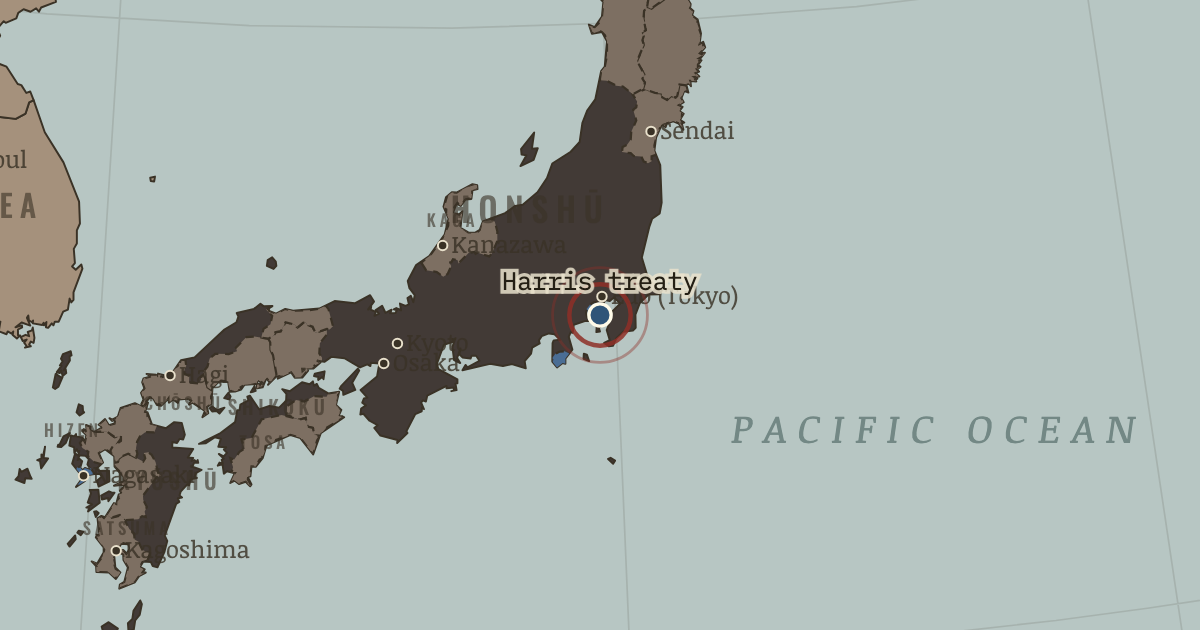
Harris Treaty
29 Jul 1858 — On the authority of the shogun’s chief minister, Ii Naosuke, commissioners sign the commercial treaty aboard USS Powhatan in Edo Bay, although the emperor has refused his consent. Ii then purges the treaty’s critics, and within two years he is assassinated outside Edo Castle.
WW2 is free — every chapter. Try chapters 1–2 of any 2 other atlases (3 with a free account). Opening a new atlas uses one of them. Membership opens all 21 — Join.
Free printable Meiji Japan and post-Soviet Russia study guide, sent by email ↓
The moment in context
Perry’s squadron forced the shogunate, the shogun’s military government in Edo, today’s Tokyo, into decisions that exposed how its power worked, although its guns never fired in anger. The United States wanted coal for steamships crossing the Pacific to China, safety for American whalers in Japanese waters, and trade, and Perry refused to go to Nagasaki, where foreigners were supposed to be received. A month later a Russian squadron under Admiral Putyatin reached Nagasaki, the arrow from the west, so the shogunate faced two powers at once. The senior councillor Abe Masahiro then did something no shogunal government had done: he sent the American letter to the daimyo, the 260-odd lords who ran their own domains much as governors run semi-independent states, and to the emperor’s court in Kyoto, and asked for their opinions. Most lords advised refusal or delay, and none could offer a fleet, so in 1854 the shogunate signed at Kanagawa, opening Shimoda and Hakodate for supplies. By asking for advice, the shogunate admitted that it could no longer decide foreign policy alone.
From Black Ships and the opening of Japan, chapter 2 of Remaking the State: Meiji Japan 1600–1912 and Post-Soviet Russia 1964–2000 (1859).
The place: Harris Treaty — map and full story →
Teach this in 5 minutes
- Why it happened — Steam and the Pacific brought America to Japan. The United States had gained California in 1848 and wanted a steamship route to China, which needed coaling stations on the way. American whaling…
- The turn — The Harris treaty signed, 29 July 1858. Signing the Harris treaty without the emperor’s approval is the hinge because it converted a diplomatic retreat into a crisis of legitimacy. Until…
- What it changed — Terror entered politics. Ii’s assassination opened a decade in which young samurai calling themselves “men of high purpose” (shishi) murdered officials and foreigners in the…
Then ask the room: Did the unequal treaties weaken Japan more through their economic terms or through the political crisis they caused? The argued answer is on the chapter page →
The atlas that shows it
THE FREE PRINTABLE STUDY GUIDE
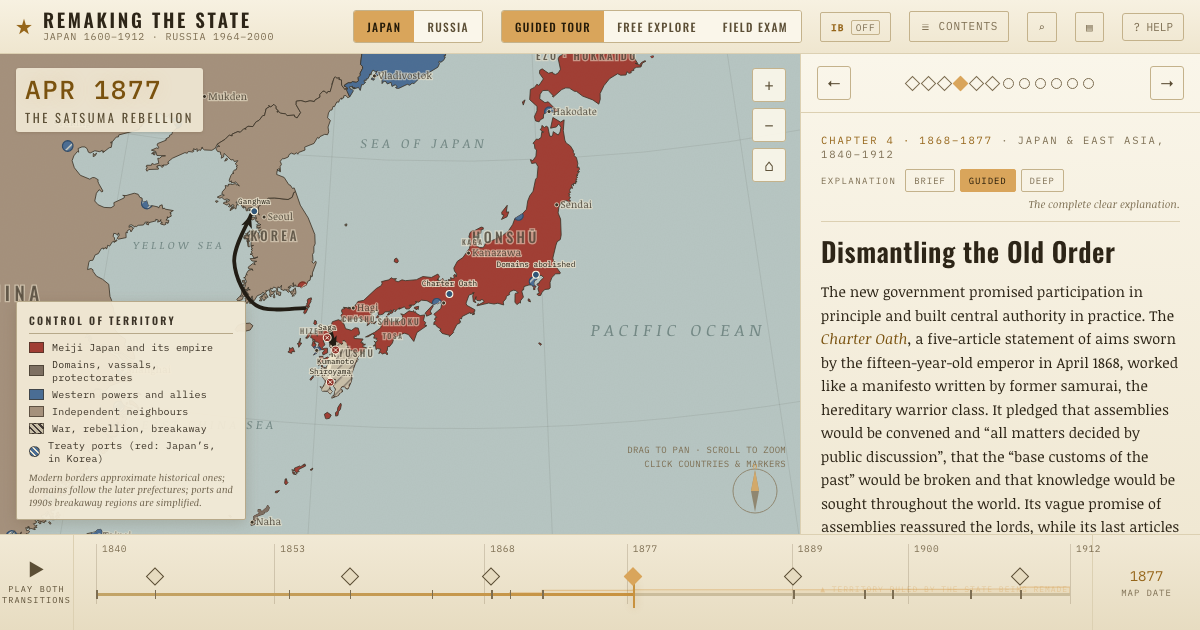
Join the Dispatch — a short welcome series, then a letter when a new atlas opens — and the printable study guide for Remaking the State is yours now, free.
NO TRACKING · YOUR ADDRESS IS USED FOR THE DISPATCH AND NOTHING ELSE · UNSUBSCRIBE ANYTIME