ON THIS DAY ·
Bombardment of Kagoshima
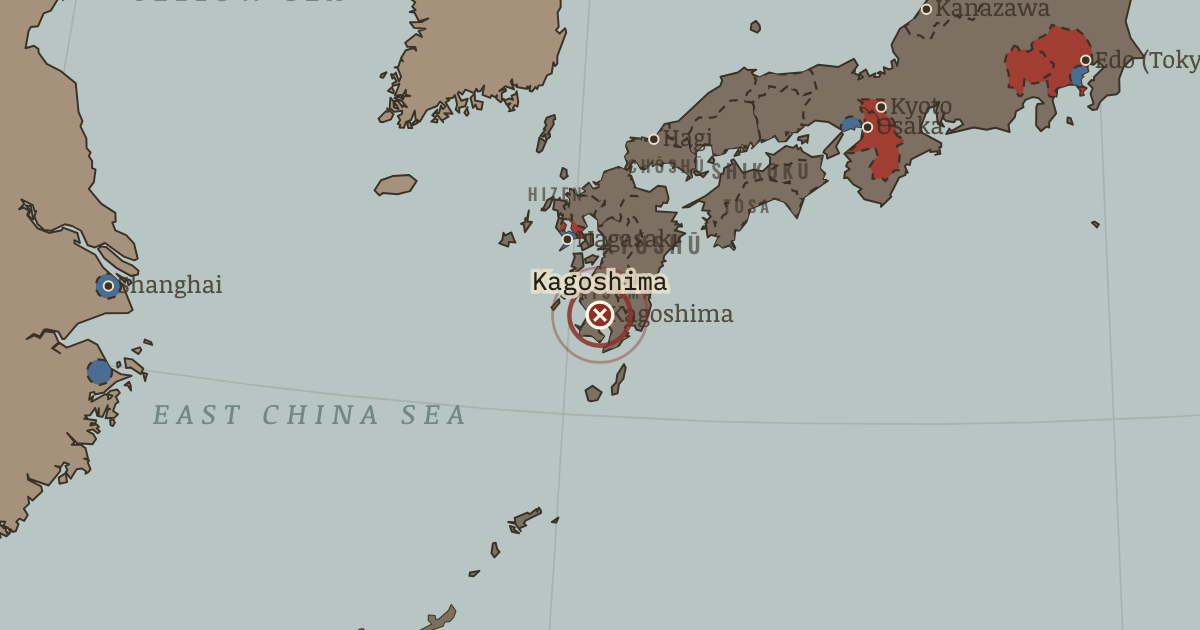
15–17 Aug 1863 — A British squadron shells Satsuma’s capital to punish the killing of the merchant Charles Richardson at Namamugi the year before. Satsuma’s batteries fight back, but much of the town burns. Satsuma pays, makes peace and starts buying British ships and rifles.
WW2 is free — every chapter. Try chapters 1–2 of any 2 other atlases (3 with a free account). Opening a new atlas uses one of them. Membership opens all 21 — Join.
Free printable Meiji Japan and post-Soviet Russia study guide, sent by email ↓
The moment in context
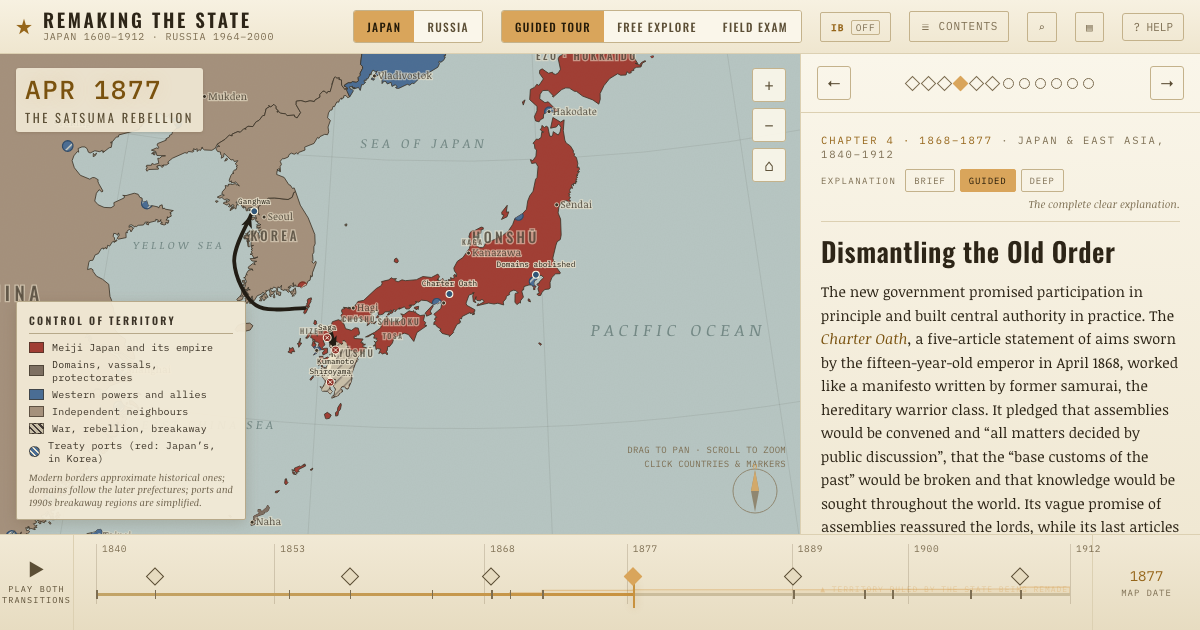
Terror and the emperor’s name gave the opposition its power after 1860. The young activists known as shishi, “men of high purpose”, were mostly samurai, members of the hereditary warrior class, from Chōshū, Tosa and Satsuma, outer domains whose lords ran them almost like independent states, and much like the student radicals of later revolutions they assassinated officials they called traitors and foreigners they called barbarians. Because whoever controlled the powerless court could issue orders in the emperor’s name, Chōshū’s leaders took over the court’s politics in Kyoto and pushed the emperor to order the expulsion of foreigners by 25 June 1863. Chōshū obeyed by firing on ships in the strait at Shimonoseki, while Satsuma faced Britain over the killing of a British merchant at Namamugi. The Western powers punished them swiftly. A British squadron burned much of Kagoshima in August 1863, and in September 1864 an allied Western fleet silenced Chōshū’s batteries in two days. Expulsion had been tested against the most powerful navies in the world, and the domains most committed to it were the first to learn that it could not work.
From Meiji Restoration and Boshin War, chapter 3 of Remaking the State: Meiji Japan 1600–1912 and Post-Soviet Russia 1964–2000 (1868).
The place: Bombardment of Kagoshima — map and full story →
Teach this in 5 minutes
- Why it happened — The emperor gave the opposition a higher loyalty. Once the court had refused the 1858 treaty, the shogun could be cast as disobedient to the emperor, and loyalty to the throne became a reason to…
- The turn — Toba–Fushimi, 27–30 January 1868. The coup of 3 January was a palace manoeuvre that could have been reversed; the battle south of Kyoto made it permanent. When the court gave Satsuma…
- What it changed — Edo surrendered and was renamed Tokyo. The negotiated handover of Edo Castle in May 1868 saved a city of about a million from a siege. In September the city was renamed Tokyo, “eastern…
Then ask the room: Was the Meiji Restoration made by ideas, by guns, or by the shogunate’s own mistakes? The argued answer is on the chapter page →
The atlas that shows it
THE FREE PRINTABLE STUDY GUIDE
Join the Dispatch — a short welcome series, then a letter when a new atlas opens — and the printable study guide for Remaking the State is yours now, free.
NO TRACKING · YOUR ADDRESS IS USED FOR THE DISPATCH AND NOTHING ELSE · UNSUBSCRIBE ANYTIME