ON THIS DAY ·
Japanese annexation of Korea
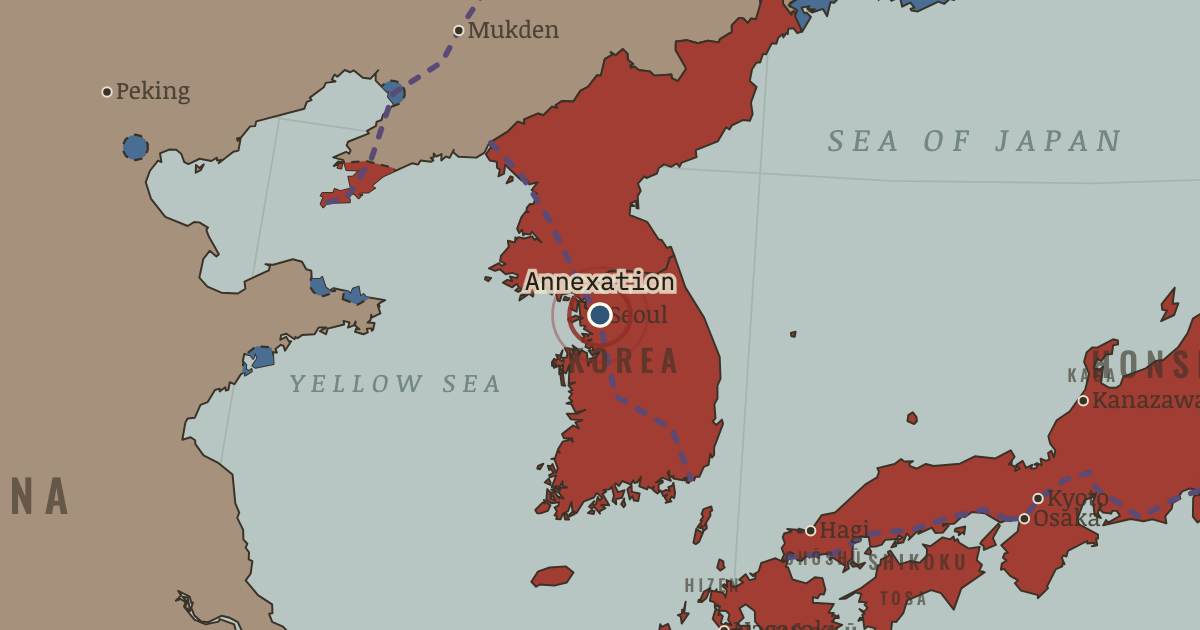
22 Aug 1910 — In Seoul the Korean prime minister Yi Wan-yong signs a treaty handing “complete and permanent” sovereignty to the Japanese emperor; it is announced on 29 August. Korea, ruled by the Joseon dynasty since 1392, becomes the Japanese colony of Chōsen for 35 years.
WW2 is free — every chapter. Try chapters 1–2 of any 2 other atlases (3 with a free account). Opening a new atlas uses one of them. Membership opens all 21 — Join.
Free printable Meiji Japan and post-Soviet Russia study guide, sent by email ↓
The moment in context
Korea was the strategic centre of Japan’s foreign policy, and the war of 1894–95 decided who would dominate it. Japanese leaders saw the peninsula as a dagger pointed at Japan, in a phrase later attributed to the Prussian adviser Jakob Meckel. When a peasant rebellion led by the Donghak religious movement made Korea ask China for troops in 1894, Japan sent a larger force, seized the royal palace in Seoul and declared war on Qing China in August. It won at Pyongyang and off the Yalu in September, and in November its troops took Port Arthur and massacred prisoners and many civilians, marked on the map. The Treaty of Shimonoseki in April 1895 gave Japan Taiwan, the Pescadores and Liaodong, ended China’s claim over Korea and imposed an indemnity, a forced payment like war reparations, of 200 million taels of silver. Within a week Russia, Germany and France made Japan return Liaodong. Japan had learned the rules of imperialism, the scramble among strong states for colonies, and those rules favoured the larger fleet.
From Sino-Japanese and Russo-Japanese wars, chapter 6 of Remaking the State: Meiji Japan 1600–1912 and Post-Soviet Russia 1964–2000 (1910).
The place: Japanese annexation of Korea — map and full story →
Teach this in 5 minutes
- Why it happened — Korea sat between three empires. Korea’s kingdom was weak, divided at court and traditionally a tributary of China, while Russia expanded towards it from the north. Japanese…
- The turn — Tsushima, 27–28 May 1905. The destruction of Russia’s Baltic fleet decided the war, and it is the hinge of Japan’s transition because it proved that the new state could…
- What it changed — Japan joined the great powers. By 1911, when Japan regained full control of its tariffs, every clause of the treaties of 1858 had been undone, and the alliance with Britain was…
Then ask the room: To what extent was Japan’s transition a success by 1912, and for whom? The argued answer is on the chapter page →
The atlas that shows it
THE FREE PRINTABLE STUDY GUIDE
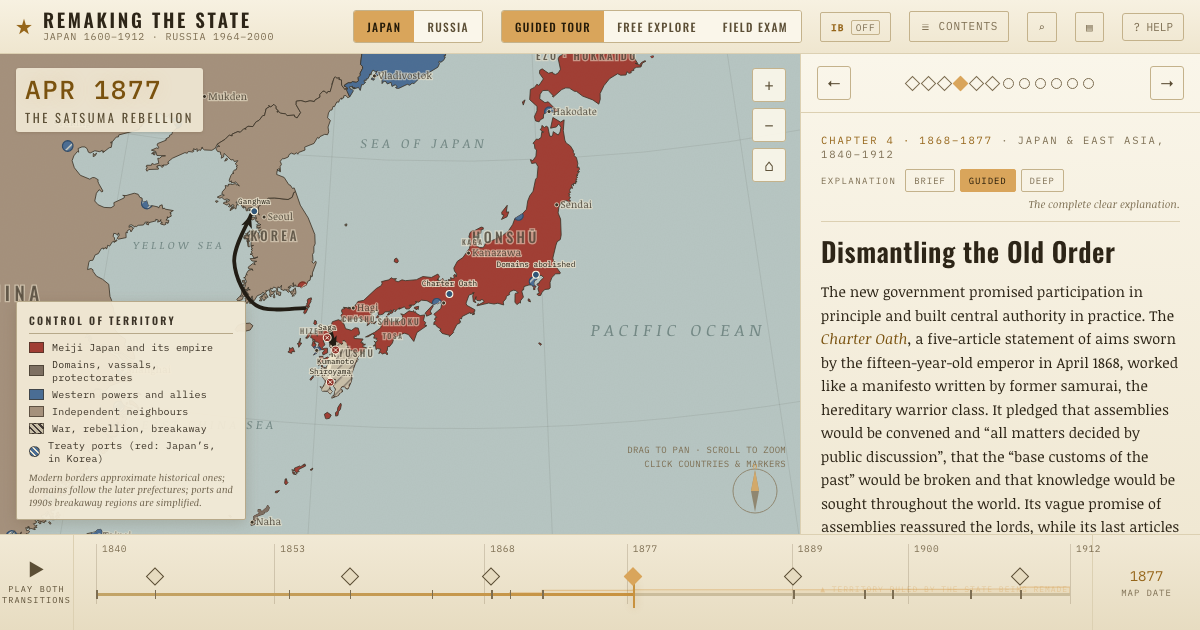
Join the Dispatch — a short welcome series, then a letter when a new atlas opens — and the printable study guide for Remaking the State is yours now, free.
NO TRACKING · YOUR ADDRESS IS USED FOR THE DISPATCH AND NOTHING ELSE · UNSUBSCRIBE ANYTIME