ON THIS DAY ·
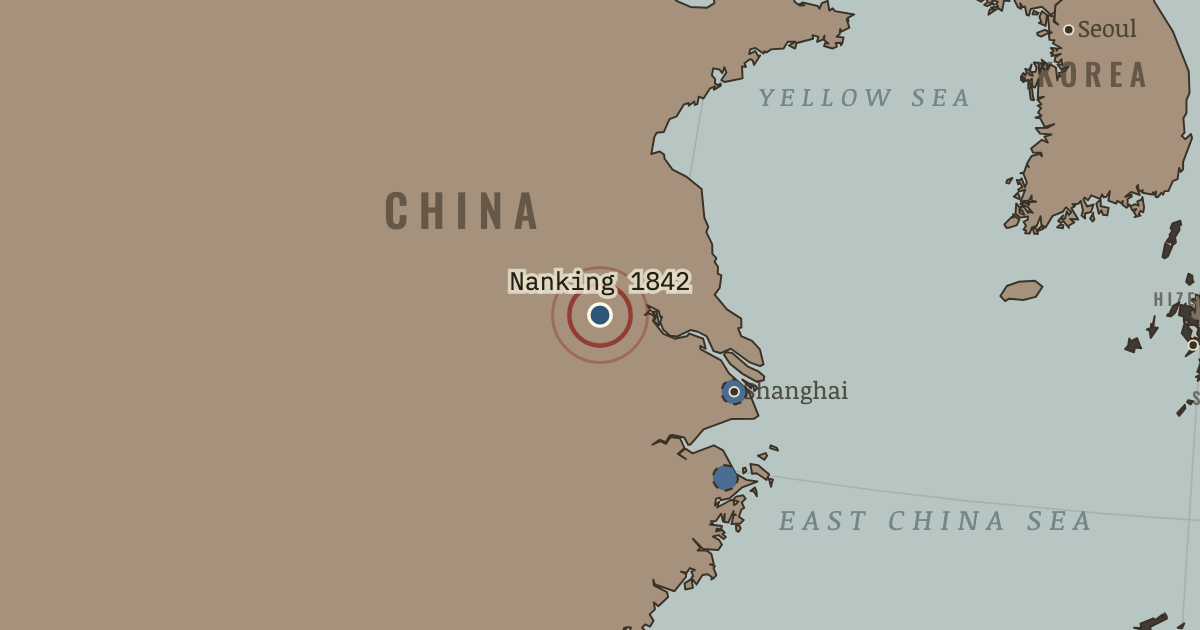
Treaty of Nanking
29 Aug 1842 — Qing China, defeated by Britain in the Opium War, cedes Hong Kong, pays 21 million silver dollars and opens five ports to foreign trade. That same summer, alarmed by news of Britain’s victories, the shogunate softened its order to fire on foreign ships.
WW2 is free — every chapter. Try chapters 1–2 of any 2 other atlases (3 with a free account). Opening a new atlas uses one of them. Membership opens all 21 — Join.
Free printable Meiji Japan and post-Soviet Russia study guide, sent by email ↓
The moment in context
The Tokugawa order was designed to make another civil war impossible, and the map shows how it did so. After his victory at Sekigahara in 1600, Tokugawa Ieyasu became shogun in 1603, a hereditary general ruling behind a powerless emperor, much like a strongman behind a figurehead king, and he redistributed the land. His own house and the fudai lords, families who had served the Tokugawa before 1600 like a ruler’s trusted inner circle, took the strategic centre around Edo, Kyoto and Osaka, all in charcoal. The lords who had fought him or joined him late, the tozama or “outer” lords such as the Shimazu of Satsuma and the Mōri of Chōshū, kept large domains on the edges, in grey-tan, but were shut out of national office. Alternate attendance, the rule from 1635 that each lord live every other year in Edo, the shogun’s capital and today’s Tokyo, then tied the lords to the centre, because the processions and a permanent mansion swallowed much of each domain’s income. The result was 250 years without civil war, bought by watching the lords and leaving the government of most Japanese to them.
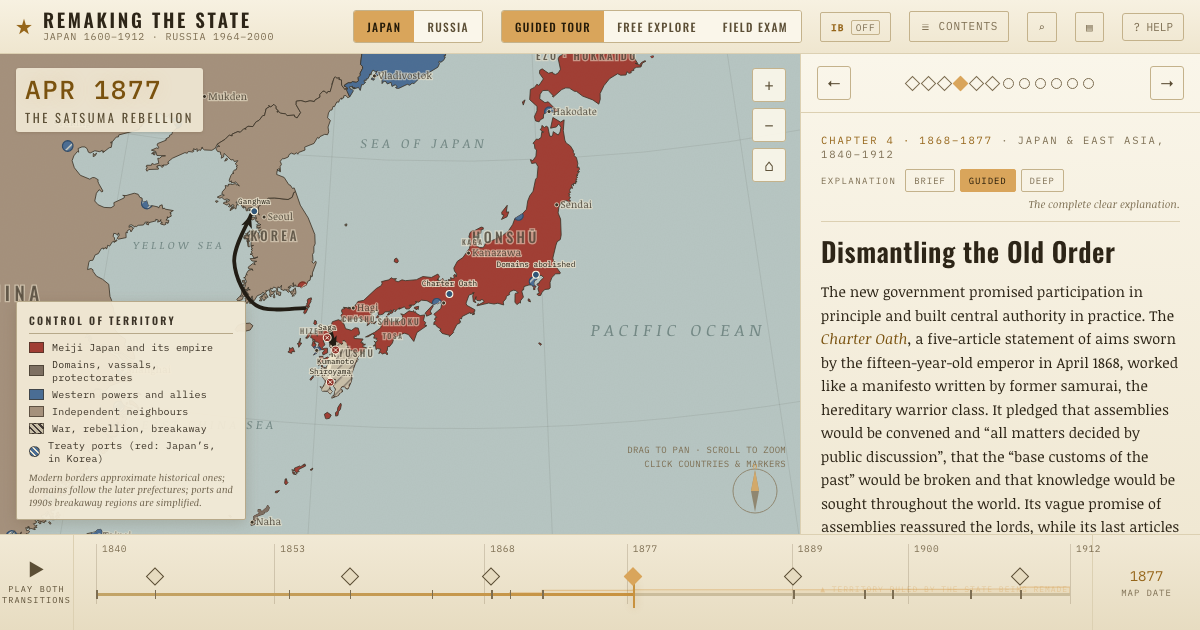
From Tokugawa shogunate and sakoku, chapter 1 of Remaking the State: Meiji Japan 1600–1912 and Post-Soviet Russia 1964–2000 (1842).
The place: Treaty of Nanking — map and full story →
Teach this in 5 minutes
- Why it happened — Sekigahara settled who ruled and left the losers in place. Ieyasu won in 1600 but could not destroy every enemy, so he cut their lands and left them armed on the edges of the country. The Mōri of Chōshū lost…
- The turn — The Treaty of Nanking, 29 August 1842. China’s defeat is the hinge of this chapter because it turned an abstract danger into a concrete precedent. Japan’s rulers had read about Western…
- What it changed — Caution replaced preparation. After 1842 the shogunate chose to avoid provocation, offering fuel and water to foreign ships, and it rejected a Dutch royal letter of 1844 urging…
Then ask the room: Was the Tokugawa order already collapsing before 1853, or did the outside world break a system that still worked? The argued answer is on the chapter page →
The atlas that shows it
THE FREE PRINTABLE STUDY GUIDE
Join the Dispatch — a short welcome series, then a letter when a new atlas opens — and the printable study guide for Remaking the State is yours now, free.
NO TRACKING · YOUR ADDRESS IS USED FOR THE DISPATCH AND NOTHING ELSE · UNSUBSCRIBE ANYTIME