ON THIS DAY ·
Alexei Stakhanov’s record coal shift
Alexei Stakhanov cuts 102 tonnes of coal in a single shift, about fourteen times the norm — and a movement is born that will raise everyone else’s quotas.
WW2 is free — every chapter. Try chapters 1–2 of any 2 other atlases (3 with a free account). Opening a new atlas uses one of them. Membership opens all 21 — Join.
Free printable Stalin’s Soviet Union study guide, sent by email ↓
The moment in context
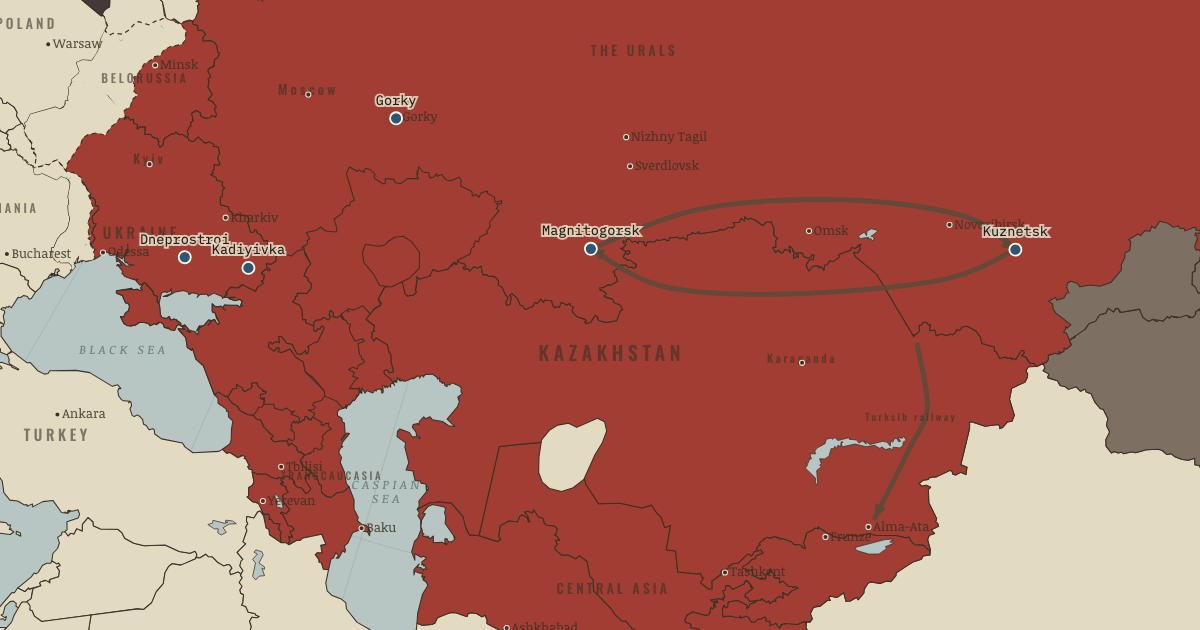
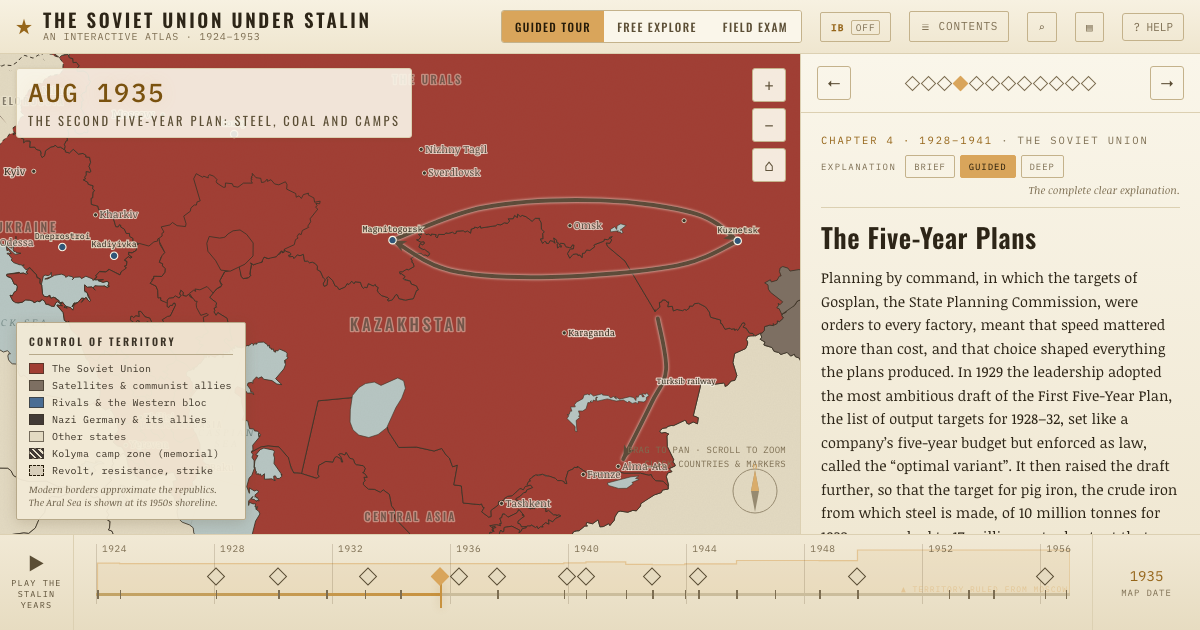
Planning by command, in which the targets of Gosplan, the State Planning Commission, were orders to every factory, meant that speed mattered more than cost, and that choice shaped everything the plans produced. In 1929 the leadership adopted the most ambitious draft of the First Five-Year Plan, the list of output targets for 1928–32, set like a company’s five-year budget but enforced as law, called the “optimal variant”. It then raised the draft further, so that the target for pig iron, the crude iron from which steel is made, of 10 million tonnes for 1932 was pushed to 17 million; actual output that year was about 6 million. Managers who missed targets risked prosecution, especially after the Shakhty trial of 1928 accused mining engineers of “wrecking”, the deliberate sabotage of production, so they hoarded materials, inflated their reports and drove workers harder. The plan was declared fulfilled in four years and three months, in January 1933, because heavy industry had grown fast even when most targets had been missed. Success was defined as growth in the priority sectors, which is why the regime could celebrate while consumers went short.
From Stalin’s Five-Year Plans, chapter 4 of The Soviet Union under Stalin, 1924–1953 (1935).
Teach this in 5 minutes
- Why it happened — Fear of war drove the pace. Bolsheviks expected the capitalist powers to attack the first socialist state, and the war scare of 1927 made that fear urgent. Heavy industry meant…
- The turn — Magnitogorsk, February 1932. The first blast furnace at Magnitogorsk, lit in the winter of 1932 on a site that had been empty steppe three years earlier, is the hinge of the…
- What it changed — The industrial base for victory in 1941–45. The plants built in the Urals and Siberia, and the experience of moving and building whole factories, made the evacuation of 1941 possible and…
Then ask the room: To what extent were the Five-Year Plans a success? The argued answer is on the chapter page →
The atlas that shows it
THE FREE PRINTABLE STUDY GUIDE
Join the Dispatch — a short welcome series, then a letter when a new atlas opens — and the printable study guide for The Soviet Union under Stalin is yours now, free.
NO TRACKING · YOUR ADDRESS IS USED FOR THE DISPATCH AND NOTHING ELSE · UNSUBSCRIBE ANYTIME