ON THIS DAY ·
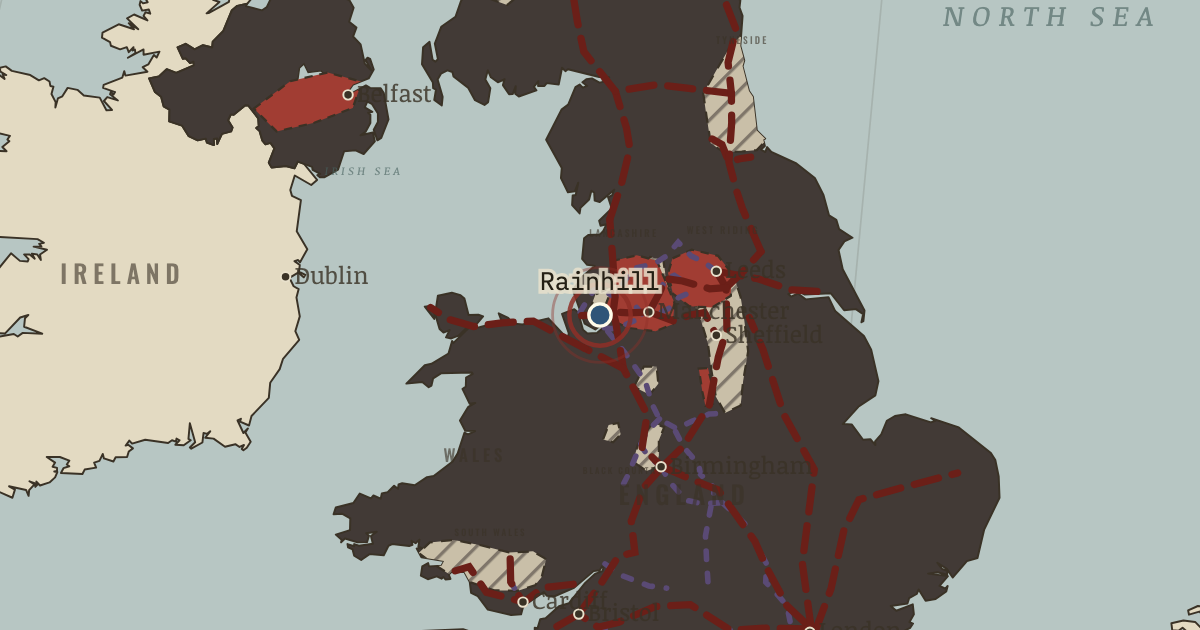
Rainhill trials
Oct 1829 — Trials to choose the locomotive for the Liverpool & Manchester. The Stephensons’ Rocket wins, reaching about 30 mph. The line opens on 15 Sep 1830 as the first inter-city railway run entirely by steam.
WW2 is free — every chapter. Try chapters 1–2 of any 2 other atlases (3 with a free account). Opening a new atlas uses one of them. Membership opens all 21 — Join.
Free printable Industrial Revolution study guide, sent by email ↓
The moment in context
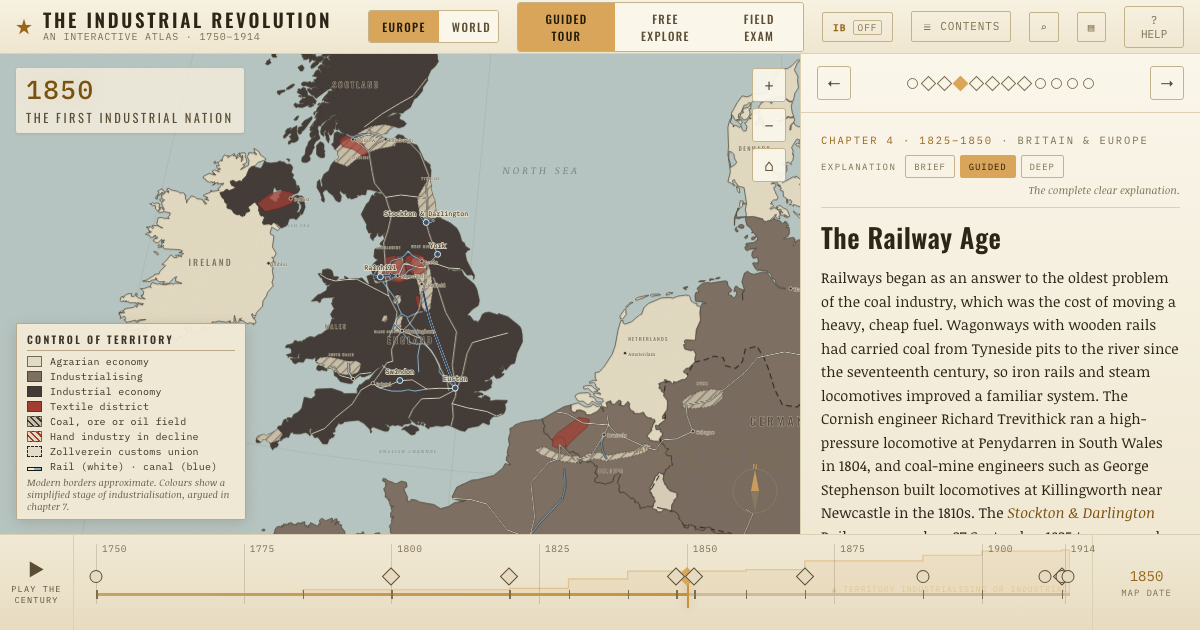
Railways began as an answer to the oldest problem of the coal industry, which was the cost of moving a heavy, cheap fuel. Wagonways with wooden rails had carried coal from Tyneside pits to the river since the seventeenth century, so iron rails and steam locomotives improved a familiar system. The Cornish engineer Richard Trevithick ran a high-pressure locomotive at Penydarren in South Wales in 1804, and coal-mine engineers such as George Stephenson built locomotives at Killingworth near Newcastle in the 1810s. The Stockton & Darlington Railway opened on 27 September 1825 to carry coal from the Durham pits to the River Tees, using steam locomotives for freight and horses for most passengers. Its success showed that a public railway, open to anyone who paid, could earn money, and merchants in Liverpool and Manchester, frustrated by slow and costly canal carriage, set out to build a better one.
From Early railways and Railway Mania, chapter 4 of The Industrial Revolution, 1750–1914 (1850).
The place: Rainhill trials — map and full story →
Teach this in 5 minutes
- Why it happened — Coal needed cheaper carriage. Coal was bulky and cheap, so the cost of moving it often exceeded the cost of mining it. Collieries, as coal mines were called, had used horse-drawn…
- The turn — Rainhill, October 1829. The Rainhill trials, a contest to find the best locomotive for the new Liverpool & Manchester Railway, are the hinge because they settled what kind…
- What it changed — A national market and national time. Railways carried coal, cloth, fish, milk and newspapers across the country overnight, so prices converged and local monopolies collapsed. Railway…
Then ask the room: Did railways create Britain’s industrial economy, or did an industrial economy create the railways? The argued answer is on the chapter page →
The atlas that shows it
THE FREE PRINTABLE STUDY GUIDE
Join the Dispatch — a short welcome series, then a letter when a new atlas opens — and the printable study guide for The Industrial Revolution is yours now, free.
NO TRACKING · YOUR ADDRESS IS USED FOR THE DISPATCH AND NOTHING ELSE · UNSUBSCRIBE ANYTIME