ON THIS DAY ·
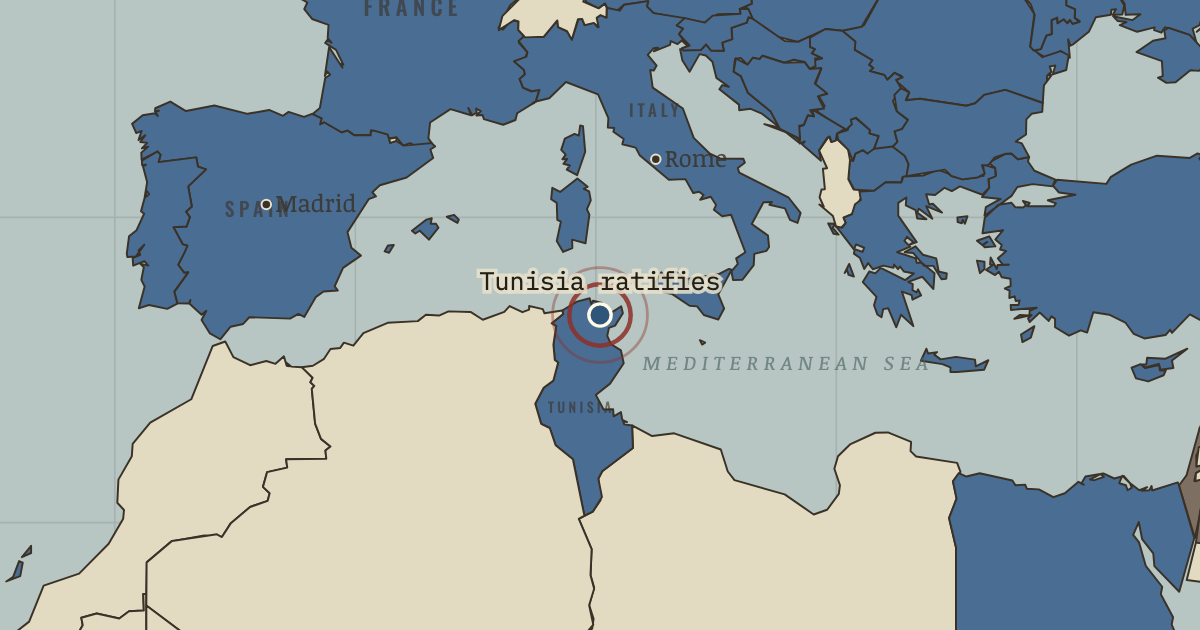
Tunisia ratifies CEDAW
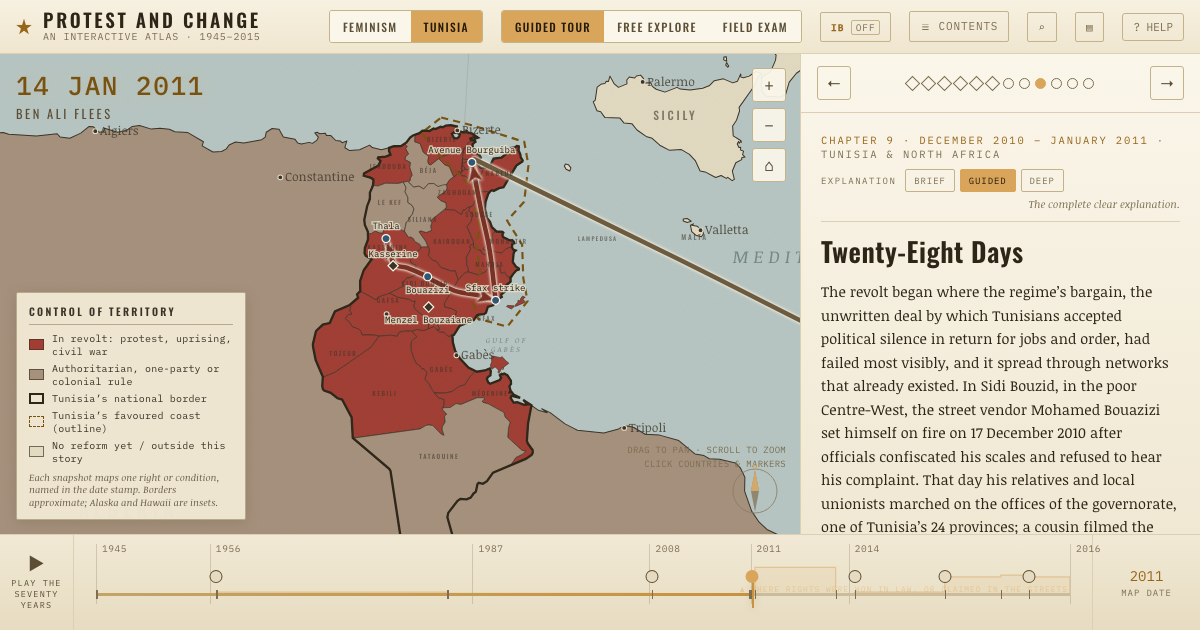
20 Sep 1985 — Tunisia ratifies CEDAW, with reservations on family law and nationality that it lifts only after the 2011 revolution. The second half of this atlas follows Tunisia.
WW2 is free — every chapter. Try chapters 1–2 of any 2 other atlases (3 with a free account). Opening a new atlas uses one of them. Membership opens all 21 — Join.
Free printable Feminism and the Tunisian Revolution study guide, sent by email ↓
The moment in context
The UN became feminism’s global stage because it combined a forum, a staff and the authority to set standards. Its Commission on the Status of Women, a committee of government delegates, had monitored women’s rights since 1946. The proposal for an International Women’s Year came in 1972 from the Women’s International Democratic Federation, aligned with the Soviet bloc, which shows how Cold War competition to appear progressive helped put women on the agenda. The first World Conference on Women met in Mexico City in June and July 1975, with delegations from 133 governments. A parallel forum, the Tribune, gathered non-governmental organisations (NGOs), citizens’ groups much like today’s charities. There Domitila Barrios de Chungara, the wife of a Bolivian tin miner, challenged middle-class feminists from the North. Her community’s enemy, she argued, was poverty and the mine owners, and men and women had to fight it together. The quarrel announced the central tension of the Decade, between a feminism of legal equality and a feminism of survival.
From UN Decade for Women and CEDAW, chapter 6 of Protest and Change: Second-Wave Feminism and Tunisia, 1945–2015 (1985).
The place: Tunisia ratifies CEDAW — map and full story →
Teach this in 5 minutes
- Why it happened — The UN as an amplifier. An international institution can magnify a movement by making governments answer questions they would otherwise avoid, and the UN had the tools to…
- The turn — CEDAW adopted, 18 December 1979. The adoption of CEDAW is the hinge because it converted a decade of declarations and conferences into a binding legal standard that states could…
- What it changed — A standard for movements everywhere. The CEDAW Committee of independent experts, which first met in October 1982 and reviewed its first national reports the next year, gave campaigners…
Then ask the room: Did the UN Decade for Women unite women across the world, or reveal how divided they were? The argued answer is on the chapter page →
The atlas that shows it
THE FREE PRINTABLE STUDY GUIDE
Join the Dispatch — a short welcome series, then a letter when a new atlas opens — and the printable study guide for Protest and Change is yours now, free.
NO TRACKING · YOUR ADDRESS IS USED FOR THE DISPATCH AND NOTHING ELSE · UNSUBSCRIBE ANYTIME