ON THIS DAY ·
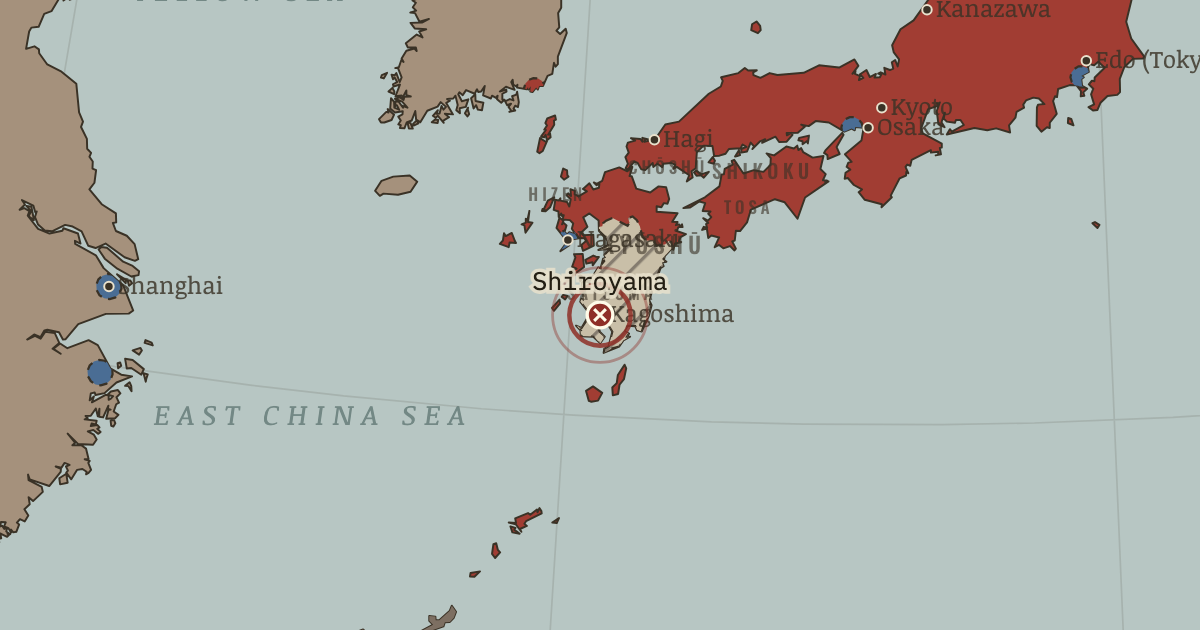
Battle of Shiroyama
24 Sep 1877 — Saigō Takamori, a hero of the restoration, dies with his last few hundred followers on a hill above Kagoshima. The Satsuma Rebellion cost at least 12,000 lives on both sides and was the last armed challenge by the samurai.
WW2 is free — every chapter. Try chapters 1–2 of any 2 other atlases (3 with a free account). Opening a new atlas uses one of them. Membership opens all 21 — Join.
Free printable Meiji Japan and post-Soviet Russia study guide, sent by email ↓
The moment in context
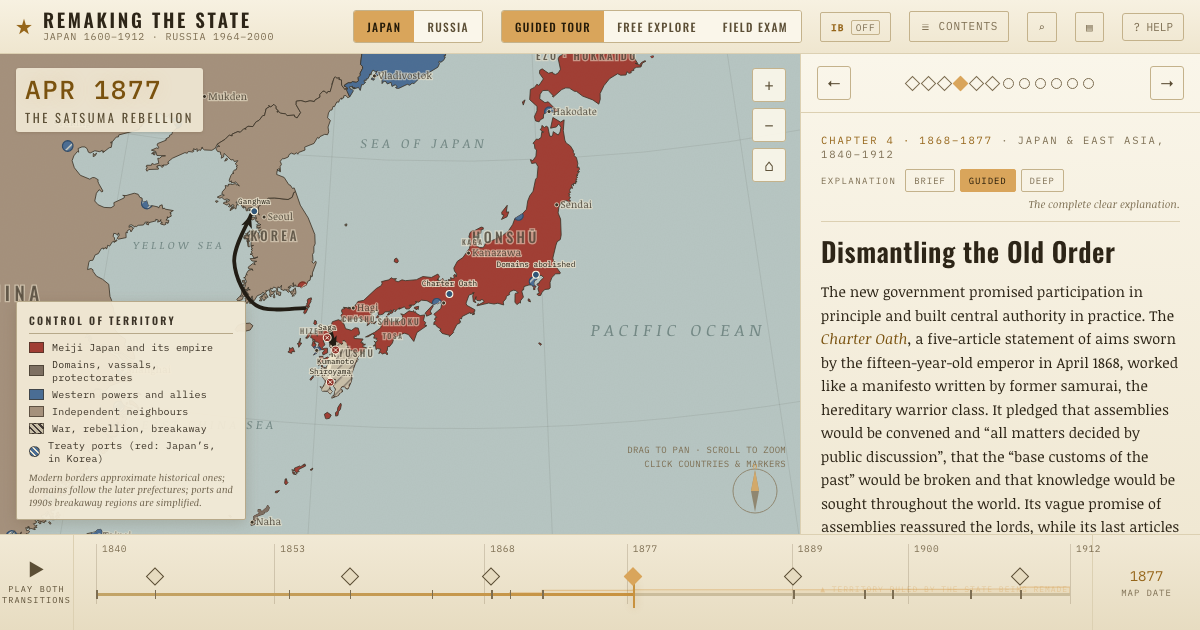
The new government promised participation in principle and built central authority in practice. The Charter Oath, a five-article statement of aims sworn by the fifteen-year-old emperor in April 1868, worked like a manifesto written by former samurai, the hereditary warrior class. It pledged that assemblies would be convened and “all matters decided by public discussion”, that the “base customs of the past” would be broken and that knowledge would be sought throughout the world. Its vague promise of assemblies reassured the lords, while its last articles licensed sweeping change. In 1869 the lords, led by Satsuma, Chōshū, Tosa and Hizen, handed their land and population registers to the emperor. The daimyo, the hereditary lords of the domains, stayed on as appointed governors of their old lands with a tenth of the domain’s revenue as household income, much as a nationalised company might keep its former owners on salary. These steps looked like a formality and established the principle that every acre and every person in Japan belonged to the state.
From Early Meiji reforms (1868–77), chapter 4 of Remaking the State: Meiji Japan 1600–1912 and Post-Soviet Russia 1964–2000 (1877).
The place: Battle of Shiroyama — map and full story →
Teach this in 5 minutes
- Why it happened — The domains kept the new state weak. After 1868 the new government still depended on the domains for soldiers and revenue, ruling directly only the confiscated shogunal lands. Its…
- The turn — The domains abolished, 29 August 1871. This is the hinge of Japan’s whole transition, because it changed how the country was governed, which the restoration of 1868 had not yet done. In…
- What it changed — One army, one tax, one school system. With the domains gone, the government issued the Education Ordinance of 1872, which aimed at compulsory primary schooling for boys and girls,…
Then ask the room: Why did Japan’s centralising revolution of 1871–77 cost so much less blood than most revolutions that remove an entire ruling class? The argued answer is on the chapter page →
The atlas that shows it
THE FREE PRINTABLE STUDY GUIDE
Join the Dispatch — a short welcome series, then a letter when a new atlas opens — and the printable study guide for Remaking the State is yours now, free.
NO TRACKING · YOUR ADDRESS IS USED FOR THE DISPATCH AND NOTHING ELSE · UNSUBSCRIBE ANYTIME