ON THIS DAY ·
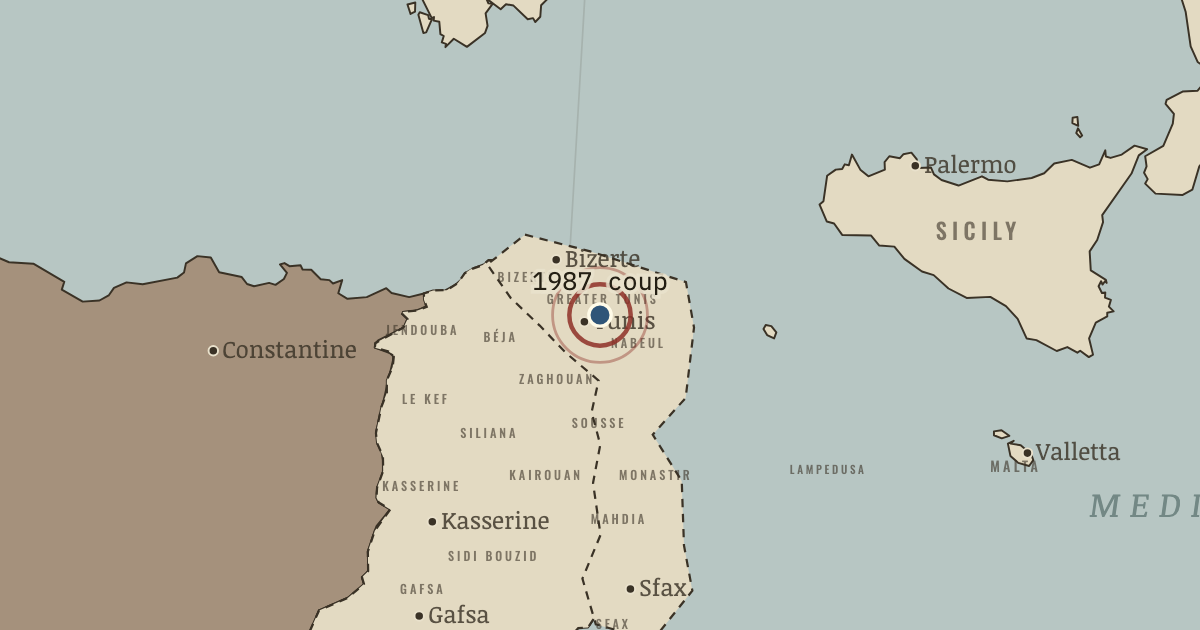
Ben Ali’s medical coup
7 Nov 1987 — Prime Minister Zine el-Abidine Ben Ali has doctors certify the 84-year-old Bourguiba unfit to govern and takes power under Article 57 of the constitution, promising pluralism. Within four years Islamists are crushed and opposition is hollowed out.
WW2 is free — every chapter. Try chapters 1–2 of any 2 other atlases (3 with a free account). Opening a new atlas uses one of them. Membership opens all 21 — Join.
Free printable Feminism and the Tunisian Revolution study guide, sent by email ↓
The moment in context
Ben Ali’s regime began with the promise of freedom and became one of the most thoroughly policed states in the Arab world. The “medical coup” of 7 November 1987 used Article 57 of the constitution, which transferred power if the president was incapacitated, and seven doctors signed the certificate. Ben Ali released political prisoners and in 1988 signed a National Pact with the opposition, the UGTT and even Islamist leaders. The UGTT, the General Tunisian Labour Union, was the national trade-union federation, large enough to call a general strike, much like a national union congress elsewhere. In the elections of April 1989, candidates backed by Ennahda, standing as independents because the party was not allowed to register, won around 14 per cent of the vote by the official count, and possibly more. That result convinced the regime that free competition was too dangerous. From 1990 thousands of Islamists were arrested, tortured and tried, and Ennahda’s leader Rached Ghannouchi went into exile in London. Newspapers, opposition parties and human-rights groups survived only as long as they were harmless. A regime that offers pluralism and then withdraws it teaches its citizens that only silence is safe.
From Tunisia under Ben Ali, chapter 8 of Protest and Change: Second-Wave Feminism and Tunisia, 1945–2015 (2008).
The place: Ben Ali’s medical coup — map and full story →
Teach this in 5 minutes
- Why it happened — A coup that promised freedom. Ben Ali removed a senile president constitutionally and without bloodshed, released prisoners and promised democracy, so many Tunisians, including…
- The turn — Redeyef, January–June 2008. The mining-basin revolt is the hinge of this chapter because it broke twenty years of silence and revealed both the regime’s weakness and its…
- What it changed — A template for revolt. Gafsa established a repertoire that reappeared two years later: sit-ins outside local government buildings, hunger strikes, marches led by…
Then ask the room: Was Ben Ali’s regime maintained more by repression or by consent? The argued answer is on the chapter page →
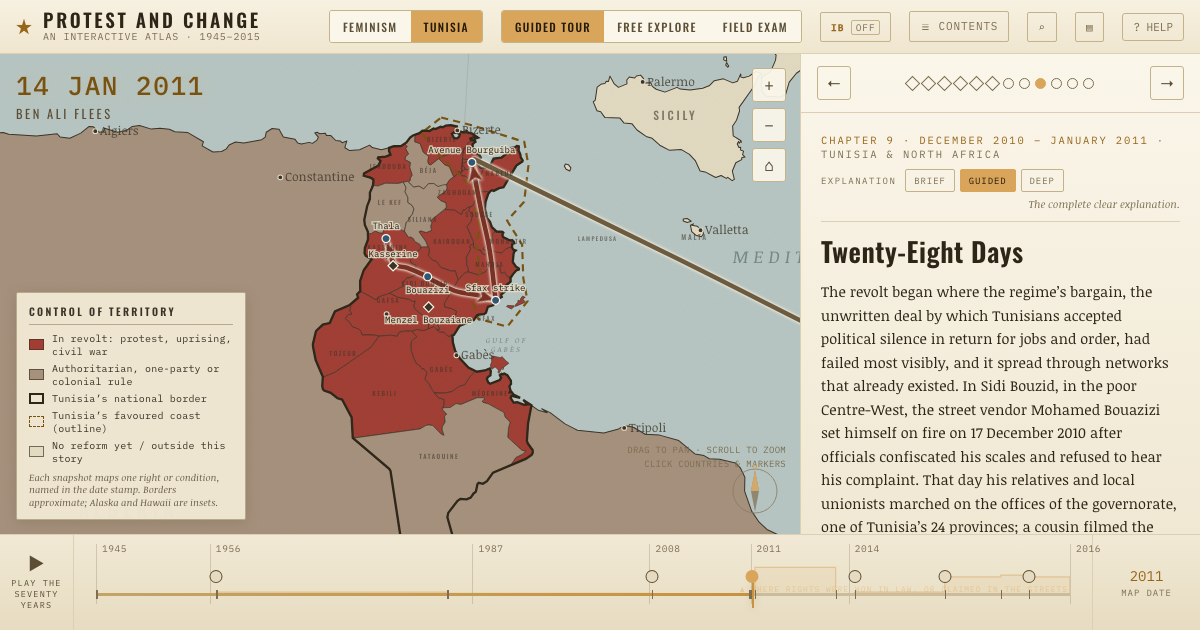
The atlas that shows it
THE FREE PRINTABLE STUDY GUIDE
Join the Dispatch — a short welcome series, then a letter when a new atlas opens — and the printable study guide for Protest and Change is yours now, free.
NO TRACKING · YOUR ADDRESS IS USED FOR THE DISPATCH AND NOTHING ELSE · UNSUBSCRIBE ANYTIME