MAPS OF HISTORY · Indian Independence & Partition · ALL CHAPTERS · CHAPTER 6
CHAPTER 6 · 1930–1935 · APR 1930
Salt
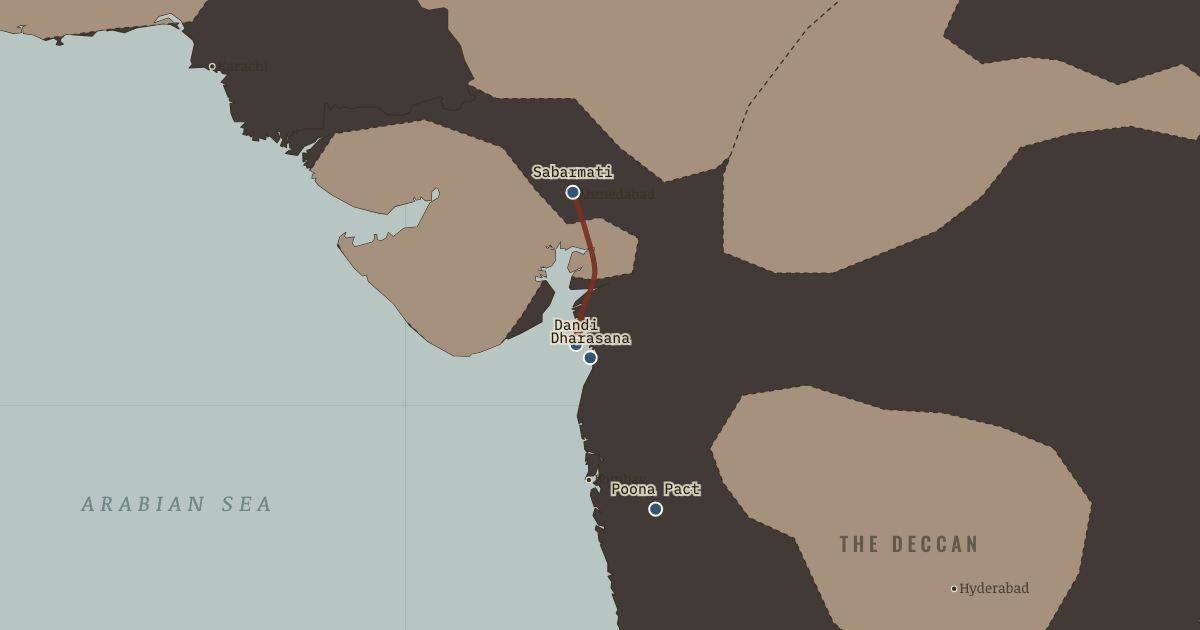
The map above is the world of APR 1930 — Civil disobedience.
BRIEF EXPLANATION — THE ESSENTIAL ARGUMENT
The salt campaign shows how a carefully chosen symbol could turn a whole population into resisters. Gandhi picked the salt tax because everyone understood it and almost everyone paid it, since the Raj taxed a necessity that the sea gave away for free. His march to the coast at Dandi in 1930 dramatized how colonial authority reached into the most ordinary corner of daily life. Across India people then made illegal salt, refused taxes and courted arrest by the tens of thousands, while newsreels and foreign reporters turned every act of repression into a cost to the empire’s reputation abroad.
The campaign did not win independence outright, yet it changed who set the terms of Indian politics. It forced the Viceroy to negotiate with Gandhi as an equal and established Congress as a mass claimant to power. Britain’s eventual answer, the Government of India Act of 1935, offered self-government in the provinces while keeping the central safeguards firmly in imperial hands. That left Congress facing a genuine dilemma, because accepting the reforms would enlarge Indian government yet risked normalizing the continued imperial control the reforms were designed to preserve.
GUIDED EXPLANATION
Civil disobedience means openly and non-violently breaking a particular law in order to challenge the authority behind it, and Gandhi built the salt campaign to make that breach unanswerable. Congress had declared purna swaraj, or complete independence, on 26 January 1930, a date the republic still keeps, and Gandhi chose his ground with an eye for the absurd, since every Indian ate salt, the Raj monopolized and taxed it, and the sea made it free. On 12 March he left Sabarmati ashram with 78 chosen marchers, having first written to the Viceroy to say exactly what he intended to do. Over 240 miles and 24 days on foot the march gathered crowds, correspondents and newsreel cameras village by village. On 6 April at Dandi he stooped on the shore and lifted a handful of salt mud, and the signal released the country into illegal salt pans on every coast, boycotts of cloth and liquor, and no-tax campaigns. The movement’s quieter revolution was that women joined public politics for the first time in their tens of thousands, and some 60,000 arrests followed within months, turning the jails into the movement’s finishing school.
At the Dharasana salt works in May, columns of satyagrahis walked deliberately into police lathis with no arm raised, while the American reporter Webb Miller counted the stretchers, and his dispatch ran in over a thousand newspapers. The Raj’s claim to be a civilizing power died a little in each of them. The campaign forced what agitation had never achieved before, as the Viceroy negotiated with the rebel as an equal in the Gandhi–Irwin Pact of March 1931, and Gandhi travelled to London for the Round Table Conference as Congress’s sole representative. The conference failed on the question of separate electorates, now demanded for the untouchables, the Depressed Classes, as well as for Muslims. In 1932, from jail in Poona, Gandhi fasted against a separate electorate for the Depressed Classes, and Dr B. R. Ambedkar, their formidable leader, signed the Poona Pact conceding reserved seats within a joint electorate. Ambedkar never forgave the method, writing that “there was nothing noble in the fast,” and the episode left permanently open who truly spoke for India’s most oppressed: the Mahatma who called them Harijans, or the leader they had themselves raised.
DEEP EXPLANATION — EVIDENCE & INTERPRETATION
1930: the year women entered the public square
The salt campaign’s least reversible achievement was demographic, because in 1930, for the first time, Indian women entered mass politics in their tens of thousands, picketing liquor and cloth shops, making illegal salt and courting arrest. Leaders such as Sarojini Naidu, who took over the Dharasana column after Gandhi’s arrest, and Kamaladevi Chattopadhyay became national figures. This was no accident, since Gandhi framed satyagraha in terms of endurance and self-suffering that he explicitly coded as suited to women’s moral strength, and the movement’s base in the home economy of khadi and boycott gave women a doorway into public life that electoral politics had not. Historians debate how deep the change ran, because much of the mobilization receded once the campaigns ended and the leadership stayed overwhelmingly male. The precedent held nonetheless, as women’s suffrage entered the nationalist programme and the constitution of 1950 granted universal adult franchise without the decades of separate struggle it had taken in the West. A campaign about a tax on salt had quietly enlarged the definition of who counted as a political person.
Gandhi and Ambedkar: the argument the nation could not resolve
The Poona Pact of 1932 was the visible edge of the freedom struggle’s deepest internal argument, one the map cannot show and that deserves stating in full. B. R. Ambedkar, born into an untouchable community and the most formidable Dalit intellectual of the age, held that Congress nationalism subordinated the question of caste to the question of empire, so that swaraj won without the annihilation of caste would merely transfer power to a Hindu upper-caste elite and leave the oppressed of Hindu society oppressed under a national flag. His demand for separate electorates for the Depressed Classes was a bid for political autonomy from precisely that elite. Gandhi, who regarded untouchability as a sin to be purged from within Hinduism, fasted against the separate electorate as a device that would split Hindu society for good, and the fast, a moral instrument to his admirers and coercion to Ambedkar, forced the compromise of reserved seats within a joint electorate. Ambedkar never accepted the method, and his 1936 essay “Annihilation of Caste” remains the sharpest critique of the nationalist consensus written from inside it. That the republic would later ask this same man to chair the drafting of its constitution is the argument’s extraordinary and unresolved coda.
New here? Chapters 1–2 of every atlas are free to sample, and the WW2 atlas is free in full. One membership opens all thirteen — the Cartographer’s Circle.
THE SITES
ON THIS DAY
WHY IT HAPPENED
Why salt was the perfect target. The tax was small, universal and indefensible — it fell hardest on the poorest, it monetized a gift of the sea, and breaking it required no violence, no organization, only a pan of brine. Nehru had privately thought the choice quaint. He watched it detonate. Gandhi’s genius was to find the point where the Raj’s law was most visibly severed from any moral claim, so that breaking the law became the ethical act. Every successful civil-resistance campaign since has hunted for its own salt.
The lesson of 1922, applied. The decade of constructive work paid its dividend: this time the cadres were trained, the discipline held almost everywhere, and the leadership had succession plans for its own arrests (Sarojini Naidu, poet and Congress president, led the Dharasana columns after Gandhi was taken). Non-violence was no longer a hope about crowds. It was a drilled technique. The contrast with 1922 is the measure of what the quiet years built.
A world now watching. By 1930 the wire services, the newsreels and Gandhi’s own showmanship had made the Indian struggle global theatre — Time named him Man of the Year. Dharasana’s dispatch was read into the U.S. Congressional Record. The Raj now policed a stage. Repression that had been routine in 1919 was, by 1930, a worldwide reputational event — the movement had successfully moved the battlefield to where the empire was weakest.
Depression squeezes the countryside. The slump halved agricultural prices after 1929 while the land revenue stayed fixed — rural India was being wrung dry, and the no-tax campaigns of 1930–31 fused Gandhi’s moral theatre with hard peasant interest. Mass movements need both a saint and a grievance. The Depression supplied the grievance on schedule.
THE TURN
Dandi, 6 April 1930. A sixty-one-year-old man picks up salt from a beach, and the act — petty larceny, on the statute book — reorders the politics of a fifth of humanity. Dandi is the hinge because it perfected the method: a law chosen so its breach was self-evidently moral, announced in advance so repression carried no surprise, staged for cameras so every lathi swung twice — once on a body, once on the Raj’s legitimacy before the world. After Dandi the Raj never again set the terms of the argument. It responded — pact, conference, new constitution — to initiatives taken in Gujarat, not Whitehall. The salt itself was auctioned. The sovereignty it stole was never returned.
WHAT IT CHANGED
Negotiation as recognition. The Gandhi–Irwin Pact settled little on paper — prisoners released, the march’s gains half-kept. But the fact of it changed the grammar: the Raj had bargained, viceroy to rebel, with a movement it jailed. Churchill saw the point precisely. That is why he was nauseated. Legitimacy, once shared, is never quite recovered.
The Act of 1935 — concession as containment. London’s eventual answer was the Government of India Act 1935: provincial self-government on a wide franchise, and a federal centre carefully weighted with princes and reserved powers so that Congress could win office without winning power. It was designed to domesticate the movement. The next chapter is the movement using it better than its designers intended.
Ambedkar’s question, permanently on the table. Poona put Dalit representation inside the general electorate and Dalit distrust inside the national coalition. Ambedkar spent the era building separately — parties, colleges, the great 1936 indictment Annihilation of Caste. In 1947 the new state would ask him, of all men, to draft its constitution. Whether Poona was a unity preserved or a voice muffled is argued to this day. This atlas records that both descriptions fit the facts.
FIELD QUESTION — Civil disobedience never militarily threatened the Raj, and the Round Table Conference failed. In what sense did the salt campaign succeed?
Measure it in sovereignty rather than statutes. Before 1930, the Raj decided and India petitioned. After Dandi, the sequence ran the other way — campaign, pact, conference, Act — with London responding to Indian initiative each time. The campaign proved to the peasantry that the state was disobeyable, to women that politics included them, to the world that the empire ruled by the lathi, and to the Treasury that governing India now cost consent it no longer had. The concrete deliverable, the 1935 Act, was designed as containment. But containment is what a power concedes when command has failed, and Congress promptly used the Act’s provinces as a school of government. The deeper answer is that satyagraha’s target was never the garrison. It was the twin beliefs that held the Raj up — British belief in their own civilizing legality, Indian belief that obedience was fate. Salt dissolved both. Everything after 1930 is negotiation about terms. The verdict on the connection itself had been returned on a Gujarat beach.
AN INTERESTING FACT
The pinch of salt itself had an afterlife: the salt Gandhi lifted at Dandi was auctioned on the spot to a Parsi supporter for 1,600 rupees — a labourer’s decade of wages for a handful of mud — and Time magazine, which had mocked the march’s beginnings, named Gandhi its Man of the Year for 1930. Eighty-one years later a small quantity of Dandi salt crystals was carried aboard the final flight of the space shuttle Endeavour. And the march’s route is walked still: the republic re-enacted it nationally on its 75th anniversary in 2005, politicians competing for a place in the column their predecessors had jailed.
THE DISPATCH
One short letter when a new atlas opens — and the printable study guide for Indian Independence & Partition is yours now, free.
NO TRACKING · YOUR ADDRESS IS USED FOR THE DISPATCH AND NOTHING ELSE · UNSUBSCRIBE ANYTIME