Meiji Japan and post-Soviet Russia · CHAPTER 7 ·
Brezhnev and the Era of Stagnation
Chapter 7 of Remaking the State: Meiji Japan 1600–1912 and Post-Soviet Russia 1964–2000: “The Stagnant Superpower”
After removing Khrushchev in October 1964, Leonid Brezhnev offered Soviet citizens stability: secure jobs, subsidised housing and food, and officials no longer purged. But growth slowed as the planned economy ran out of new inputs, reform was shelved after Prague 1968, and in December 1979 Soviet forces went into Afghanistan.
Chapter 7 is part of membership. WW2 is free — every chapter. Try chapters 1–2 of any 2 other atlases (3 with a free account). Opening a new atlas uses one of them. Membership opens all 21 — Join.
Free printable Meiji Japan and post-Soviet Russia study guide, sent by email ↓
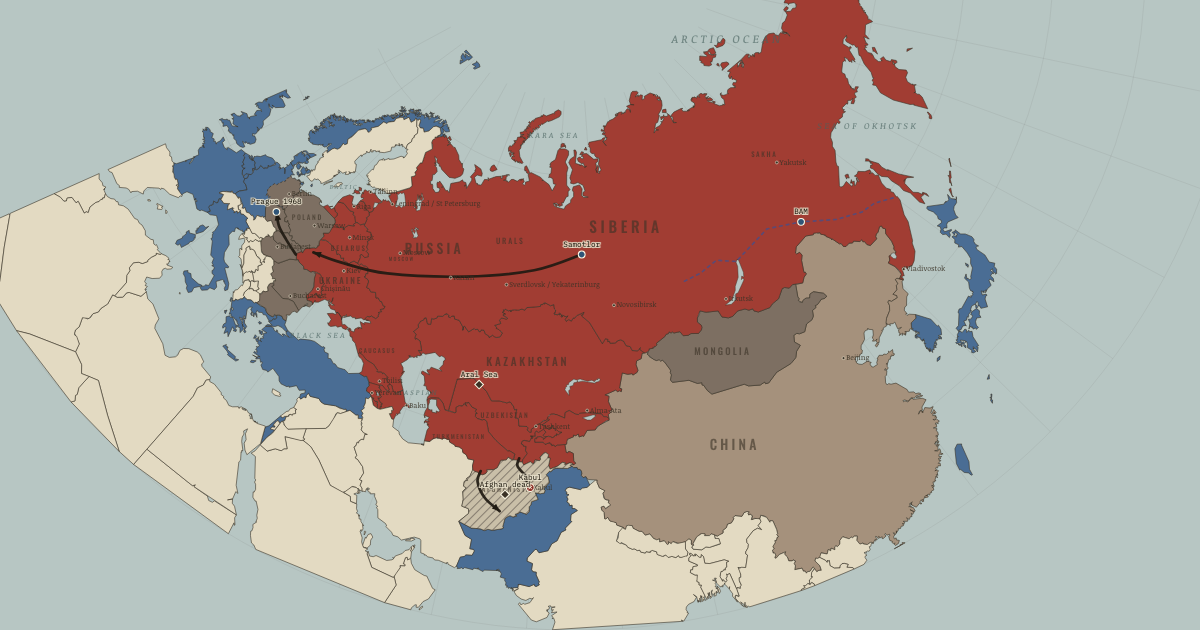
The map above is the world of The Soviet Union, January 1980 — Afghanistan invaded.
Part of IB History: Meiji Japan and post-Soviet Russia →
BRIEF EXPLANATION — THE ESSENTIAL ARGUMENT
The second half of this atlas turns to a state that looked as solid in 1964 as the Tokugawa order had looked in 1840: the Soviet Union, the largest country on earth and one of two superpowers. It was a federation of fifteen union republics, national territories with their own capitals and parliaments, all red on the map, ruled in practice by a single party, the Communist Party of the Soviet Union. Its economy was planned: officials of the State Planning Committee, Gosplan, set what each factory produced, whom it supplied and what everything cost, much as the head office of one giant company might direct all its branches. In October 1964 Leonid Brezhnev and his colleagues removed the Soviet leader Nikita Khrushchev, because party officials were tired of a decade of his erratic campaigns, and promised stability. They delivered it through what historians call the Soviet social contract, an unwritten bargain of secure jobs, cheap bread and cheap rent in exchange for political silence.
Beneath the stability the economy slowed, and the reasons explain why reform later became unavoidable. Growth had come from adding ever more workers, machines and raw materials, and by the 1970s each was running short; American intelligence estimates show annual growth falling from about 5% in the late 1960s to under 2% in the early 1980s. Factories were rewarded for meeting output targets, so they hoarded materials and neglected quality and cost. Oil from West Siberian fields such as Samotlor, sold for hard currency, money such as dollars that could buy goods on world markets, paid for imported grain after world prices soared in 1973 and 1979, while defence absorbed perhaps a sixth of national output. The leaders avoided reform because the Prague Spring of 1968, a reform movement in Czechoslovakia crushed by Soviet-led armies, had shown how quickly change could escape control. Secure in their oil income, they sent the army into Afghanistan in December 1979, hatched on the map. Oil money bought the system a decade and removed the pressure that might have forced reform while reform was still cheap.
The full story
The Brezhnev system offered stability in exchange for obedience, and for many Soviet citizens the exchange seemed fair. Power ran through the party and its nomenklatura, the list of important posts that could be filled only with party approval, much as if one organisation appointed every manager, editor and general in a country. Brezhnev promised these officials “stability of cadres”, meaning that they would no longer be reshuffled or purged, and by 1980 the average age of the Politburo, the party’s ruling committee, in effect the cabinet, was about seventy. Ordinary people received guaranteed work, subsidised housing and food, free healthcare and education, and a slow rise in living standards. A reform of 1965 associated with the prime minister Aleksei Kosygin gave factories more freedom, and it was quietly dropped after Warsaw Pact armies, the arrow into Czechoslovakia, crushed reform in Prague in 1968. On the map the Union is one red block, ringed by the grey-tan Soviet bloc, the communist states of Eastern Europe bound to Moscow by that military alliance. Stability became the system’s main product, bought by postponing every difficult decision.
The economy slowed because the method that had built it stopped working. Soviet growth had been “extensive”, coming from more labour, capital and land, much as a farm grows by ploughing new fields instead of farming its old ones better. By the 1970s the labour force was growing slowly, new oil and minerals lay in distant Siberia and cost more to extract, and old factories were wearing out. Planners judged firms by gross output, so a nail factory measured in tonnes made heavy nails, and loss-making enterprises were always rescued by the state. Agriculture remained so weak that after 1972 the Soviet Union became a regular buyer of Western grain, importing about 55 million tonnes in 1984–85. Prestige projects such as the BAM, a second Siberian railway, absorbed vast resources, while irrigation for cotton drained the Aral Sea. A system skilled at mobilising effort for great projects proved poor at the patient improvement that a mature economy needs.
Oil and the arms race shaped the choices of the 1970s, and Afghanistan showed how those choices were made. Output from Samotlor and other West Siberian fields made the Soviet Union the world’s largest oil producer, and the arrow running west shows exports flowing to Eastern Europe and to Western buyers paying hard currency, money such as dollars usable anywhere. When world prices quadrupled in 1973–74 and doubled again in 1979, this income paid for grain, machinery and the arms race, so the leaders felt no need to reform. Defence absorbed perhaps 15–17% of national output by Western estimates. In December 1979 a few ageing leaders sent the 40th Army into Afghanistan to replace a communist ruler they distrusted, beginning a nine-year war in which about 15,000 Soviet soldiers and between half a million and 2 million Afghans died. When Brezhnev died in 1982 and his two elderly successors died within three years, the system had become a gerontocracy, a state run by old men, facing problems it had spent two decades postponing.
DEEP EXPLANATION — EVIDENCE & INTERPRETATION
Was the Brezhnev era really a stagnation?
The word “stagnation” (zastoi) was coined by Gorbachev’s supporters in the mid-1980s to justify their reforms, so historians treat it with care. The editors of Brezhnev Reconsidered, Edwin Bacon and Mark Sandle, point out that real incomes rose, millions moved into new flats, and opinion polls in later decades often remembered the era as the best of Soviet times. The economic record nonetheless shows a real slowdown. CIA estimates, prepared for Congress and now public, put average annual growth at about 5% in 1966–70, about 3.4% in 1971–75, about 2.3% in 1976–80 and under 2% in 1981–85, and Soviet economists such as Grigory Khanin later argued that even these figures were too generous. Robert Allen attributes much of the decline to investment poured into Siberian resources and old factories and to the drain of scientists into defence. The most persuasive view combines both: the era felt comfortable to many people because it consumed the reserves that a later generation would need.
How a planned economy fails quietly
The Hungarian economist János Kornai described socialist economies as “economies of shortage”, and his concept of the soft budget constraint explains why. A firm in a market economy faces a hard budget constraint: if it loses money for long enough it goes bankrupt. A Soviet enterprise knew that its ministry would always cover its losses, so it had little reason to cut costs and every reason to hoard workers and materials against future targets. Planners in Moscow had to set hundreds of thousands of prices and production targets with limited information, and firms learned to bargain for easy plans. The result was chronic shortage alongside waste: queues for meat and shoes, warehouses of unwanted goods, and a “second economy” of black-market trading and favours. Philip Hanson notes that none of this caused collapse by itself, since a shortage economy can continue for decades. It did mean that the system could not respond quickly to new technology or changing prices, which mattered more as the world economy changed around it.
The decision to invade Afghanistan
Documents released after 1991 show how narrow the decision to invade Afghanistan was. Afghanistan’s communists had seized power in April 1978 and provoked revolt with radical land and social reforms; when rebels took the city of Herat in March 1979, the Politburo refused Afghan requests for troops, and prime minister Kosygin warned that the army would end up fighting the Afghan people. By December the Afghan leader Hafizullah Amin had murdered his rival Nur Muhammad Taraki, and Soviet leaders suspected him of contacts with the Americans. On 12 December a small circle including Brezhnev, the KGB chief Yuri Andropov, the defence minister Dmitry Ustinov and the foreign minister Andrei Gromyko approved the intervention, and the full Politburo endorsed it afterwards. Rodric Braithwaite’s history of the Soviet soldiers shows a war that the army itself had advised against. A decision taken by four ageing men without real debate became a nine-year war that killed between about half a million and 2 million Afghans and drove about 5 million into exile.
Key places on the map
Why it happened
Khrushchev’s campaigns made stability attractive. Nikita Khrushchev had denounced Stalin, reorganised the party twice, launched the Virgin Lands campaign and taken the world to the brink over Cuba in 1962. Party officials, tired of constant reorganisation and threatened by his plan to rotate them out of office, removed him in October 1964. The new collective leadership defined itself against his restlessness, which made predictability and security for officials the central values of the next eighteen years.
Extensive growth ran out of inputs. Soviet industrialisation since the 1930s had worked by moving peasants into factories and pouring investment into heavy industry. By the 1970s birth rates in the Slavic republics had fallen, the cheapest resources in European Russia had been used up, and new oil and gas lay thousands of kilometres east in harsh climates. Each additional rouble of investment produced less growth than before. Without new sources of productivity, a slowdown was built into the system.
Prague 1968 made reform look dangerous. When Czechoslovakia’s communist leader Alexander Dubček relaxed censorship and promised “socialism with a human face” in 1968, Soviet leaders feared that reform would spread and that Czechoslovakia might leave the bloc. In August Warsaw Pact armies invaded, and Brezhnev declared that socialist states had the right to intervene where socialism was threatened. Inside the Soviet Union the lesson was that economic reform could lead to political reform, so the Kosygin reforms faded.
Oil windfalls postponed hard choices. The fields of West Siberia came on stream just as world oil prices soared in 1973–74 and again in 1979. Hard-currency earnings from oil and gas rose many times over, paying for imported grain, Western machinery and the arms race. Yegor Gaidar later argued that this income allowed the leadership to avoid reform for a decade, and that it tied the state’s solvency to a price set in world markets that Moscow could not control.
THE TURNING POINT
Kabul, 27 December 1979. The storming of Amin’s palace is the hinge of this chapter because it showed both the system’s strength and its blindness. A superpower could move an army across a border in days, yet the decision was made by a handful of elderly men who ignored their own military’s warnings. The invasion ended détente with the West, brought an American grain embargo and an Olympic boycott, and committed the country to a war it could not win. When Gorbachev called it a “bleeding wound” in 1986, he was naming one of the costs his reforms had inherited.
What it changed
A generation of reformers waited. Younger officials who had watched the Prague Spring crushed, among them Mikhail Gorbachev, rose through the party in the 1970s and talked privately about change. Gorbachev joined the Politburo in 1980 as its youngest member and served under Andropov, whose brief reign in 1982–84 attacked corruption and indiscipline. When the old leaders died in quick succession, these men inherited the problems they had watched accumulate.
Dependence on oil set a trap. By the early 1980s oil and gas provided the majority of Soviet hard-currency earnings. When world prices fell by more than half in 1985–86, the budget lost a major source of income just as Gorbachev was launching expensive plans to accelerate growth. The windfall of the 1970s had become a vulnerability.
The bloc became a burden. Moscow sold oil to its East European allies below world prices and propped up their economies, which cost billions in lost hard currency, money that could buy goods on world markets. In Poland the Solidarity trade union, founded in 1980, showed that workers could organise against a communist state, and only martial law, rule by the army with ordinary rights suspended, contained it in December 1981. By 1985 Eastern Europe cost Moscow money it no longer had for a loyalty it could no longer count on, which made Gorbachev’s later refusal to defend it by force easier to choose.
Afghanistan’s war outlived the decision. The war drained money, killed about 15,000 Soviet soldiers, damaged the army’s morale and isolated the Soviet Union in the Muslim world and at the United Nations. Its veterans, the afgantsy, came home to a society that preferred not to hear about the war. Withdrawal became one of Gorbachev’s first foreign-policy goals.
DISCUSSION QUESTION — Was the Soviet system in 1985 doomed, or could a different reform have saved it?
The case for doom rests on structural evidence: growth near zero by some estimates, dependence on oil prices and grain imports, a costly empire and an ageing elite unable to innovate. Yegor Gaidar argued that the collapse of oil prices made a crisis unavoidable. The case against doom is also serious. Stephen Kotkin and others note that the Soviet Union in 1985 faced no revolt, no war it was losing on its own territory and no bankruptcy, and that a poorly performing system can survive for decades, as North Korea’s has. China after 1978 showed one alternative, opening agriculture and small business to markets while keeping the party’s monopoly of power. A strong answer distinguishes decline from collapse: the Soviet system was declining, but collapse required a trigger and a set of choices, which the next chapters examine. The transferable insight is that weak performance makes reform necessary, and the way reform is carried out decides whether a system survives it.
An interesting fact
In the summer of 1972 Soviet buyers quietly bought roughly a quarter of the American wheat crop at subsidised prices before United States officials grasped how much they had sold. American bread prices rose, and the episode became known in the American press as the “Great Grain Robbery”, the title of a book about it published in 1975. Before 1914 the Russian Empire had been one of the world’s largest grain exporters. Six decades later its Soviet successor, with some of the richest farmland on earth, had become dependent on the harvests of its Cold War rival.
Related
THE FREE PRINTABLE STUDY GUIDE
Join the Dispatch — a short welcome series, then a letter when a new atlas opens — and the printable study guide for Remaking the State is yours now, free.
NO TRACKING · YOUR ADDRESS IS USED FOR THE DISPATCH AND NOTHING ELSE · UNSUBSCRIBE ANYTIME