Meiji Japan and post-Soviet Russia · CHAPTER 8 ·
Perestroika and glasnost
Chapter 8 of Remaking the State: Meiji Japan 1600–1912 and Post-Soviet Russia 1964–2000: “Gorbachev’s Gamble”
Mikhail Gorbachev, chosen Soviet leader in March 1985, set out to save socialism by making it work. An anti-alcohol campaign and the oil price fall of 1985–86 emptied the budget, Chernobyl in April 1986 turned him to glasnost, and the contested elections of March 1989 gave an opposition a national stage.
Chapter 8 is part of membership. WW2 is free — every chapter. Try chapters 1–2 of any 2 other atlases (3 with a free account). Opening a new atlas uses one of them. Membership opens all 21 — Join.
Free printable Meiji Japan and post-Soviet Russia study guide, sent by email ↓
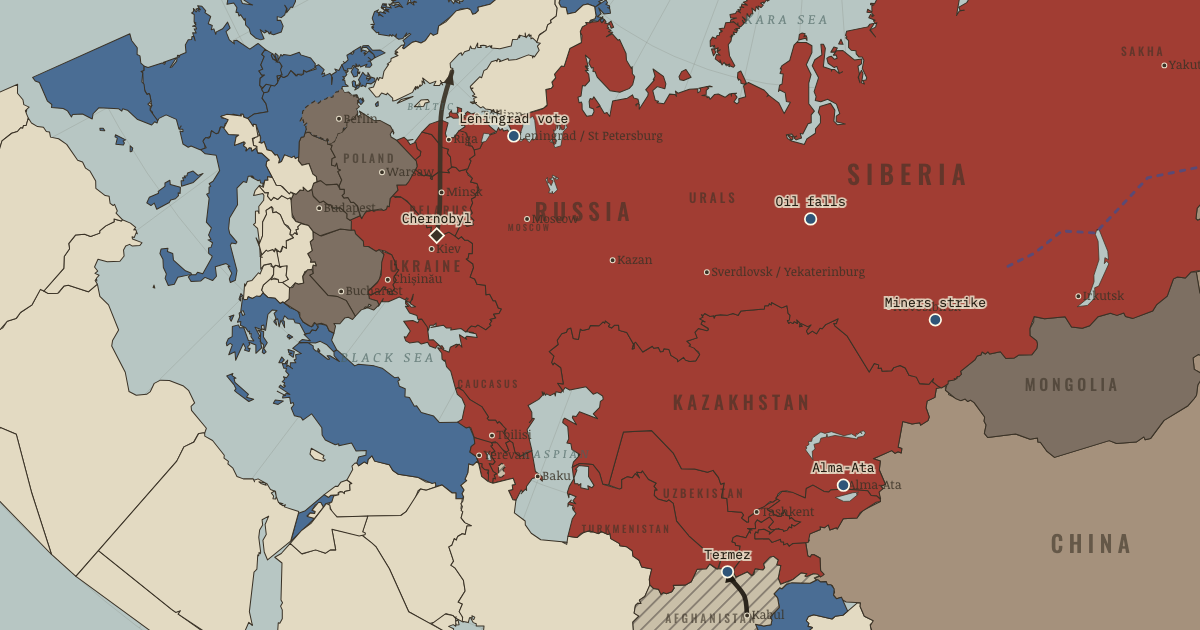
The map above is the world of The Soviet Union, February 1988 — Karabakh votes to secede.
Part of IB History: Meiji Japan and post-Soviet Russia →
BRIEF EXPLANATION — THE ESSENTIAL ARGUMENT
Mikhail Gorbachev, chosen in March 1985 at the age of 54 as general secretary of the Communist Party, the post that made him the Soviet Union’s leader, set out to save Soviet socialism by making it work, and the order in which he changed things decided its fate. He began with “acceleration”, meaning more investment and more discipline, and with a campaign against alcohol that cut the state’s vodka revenue just as world oil prices fell by more than half in 1985–86. The budget slid into deficit, with the state spending far more than it collected, and the gap was covered by printing money. The explosion at Chernobyl in April 1986, which officials concealed for two days, convinced him that secrecy was itself a danger. He answered with glasnost, or “openness”, which allowed newspapers to report failures and historians to discuss the crimes of the past, much as a company in trouble might finally open its accounts to show where the money is going.
Perestroika, or “restructuring”, then changed the rules of the economy without replacing its foundations, like rebuilding a house while still living in it. The Law on State Enterprise of 1987 let factories set their own wages and sell part of their output, while most prices stayed fixed by the state, so wages rose faster than the supply of goods and the shortages it was meant to cure grew worse. Political reform went further and faster. In March 1989 voters chose among rival candidates for a new parliament, the Congress of People’s Deputies, for the first time since 1917, and senior party officials lost, most strikingly in Leningrad. That summer hundreds of thousands of coal miners went on strike, and in February the last troops had left Afghanistan across the bridge at Termez. Gorbachev had dismantled the tools that made the old system work, central commands, censorship and fear, before building the ones meant to replace them.
The full story
Gorbachev’s early reforms tried to make the old system run faster, and they collided with an economic shock. As general secretary, the party’s leader and so the country’s, he promised “acceleration” through investment in machine-building and tighter discipline, and in May 1985 he launched a campaign against drinking that cut vodka production and raised prices. Alcohol taxes had been one of the budget’s largest sources of income, and the campaign removed tens of billions of roubles over three years while moonshine replaced state vodka. At the same moment world oil prices fell from about 27 dollars a barrel in 1985 to around 14 in 1986, cutting the export earnings on which grain imports depended. The government covered the gap by printing money, and by 1989 the budget deficit, the gap between spending and revenue, reached about a tenth of national output by Western estimates. In December 1986 the replacement of Kazakhstan’s Kazakh party chief by a Russian outsider brought students onto the streets of Alma-Ata. A reformer who needed money and calm began his work with neither.
Chernobyl turned glasnost, “openness” about the system’s failures, from a slogan into a policy, because it showed how secrecy could endanger the state itself. Reactor No. 4 at Chernobyl exploded on 26 April 1986; the town of Pripyat was evacuated the next day, but the world learned of the accident only when Swedish monitors detected radiation, carried north-west by the wind along the path of the arrow on the map. Thirty-one people died within months, more than 100,000 were evacuated that year, and estimates of later cancer deaths range from about 4,000 to tens of thousands. Gorbachev concluded that a system unable to tell the truth to itself could not be reformed, and from 1987 censorship loosened quickly. Newspapers exposed corruption, banned books were published, and the press reopened Stalin’s crimes. Openness was meant to mobilise public support for reform, and it also showed millions of people how badly the system had served them.
Perestroika, the “restructuring” of the economy, loosened the plan without creating a market, and political reform then removed the party’s power to command. The Law on State Enterprise, passed in 1987 and in force from 1988, let firms keep profits, set wages and sell output beyond state orders, and a law of 1988 allowed cooperatives, small businesses owned by their members, private firms in all but name. Because prices remained fixed, extra wages chased the same goods, shops emptied and regions began hoarding supplies. In 1988 Gorbachev turned to politics to break resistance in the party apparatus, the full-time officials who ran the party, and in March 1989 voters chose among rival candidates for a new parliament, the Congress of People’s Deputies, for the first time since 1917. In Leningrad the regional party chief lost although no one stood against him, and in Moscow the dismissed reformer Boris Yeltsin won almost 90% of the vote. In July 1989 miners in the Kuzbass, the Donbas and Vorkuta struck over soap, food and pay. The party could no longer rule by command, and nothing had yet taken its place.
DEEP EXPLANATION — EVIDENCE & INTERPRETATION
Did Gorbachev get the order wrong?
Comparisons with China dominate this debate. After 1978 Deng Xiaoping freed farmers and small businesses first, kept the party’s political monopoly, and in June 1989 used the army to crush protest in Tiananmen Square. Minxin Pei and others have argued that the Soviet Union did the reverse, opening politics before the economy had been fixed, and lost control as a result. Archie Brown replies that Gorbachev turned to political reform because the party apparatus and the economic ministries were blocking economic change, so elections were a way to outflank them. Chris Miller’s history of Soviet economic policy adds that powerful lobbies, the military-industrial complex, the farm sector and the factory directors, defeated every attempt to cut subsidies or free prices, and that Gorbachev lacked China’s vast low-wage peasantry, which made Deng’s path easier. Most historians now see the sequence as a forced choice: Gorbachev could not reform the economy without breaking the apparatus, and breaking the apparatus removed the means of reforming the economy in an orderly way.
Chernobyl and the politics of openness
Serhii Plokhy’s history of the accident shows a system whose instinct was to hide bad news: local officials delayed evacuating Pripyat, Moscow announced the accident only after Sweden asked questions, and May Day parades went ahead in Kiev under radioactive skies. Gorbachev himself later wrote that Chernobyl may have done more than perestroika to bring down the Soviet Union, because it destroyed trust in official information. The human toll of the accident remains contested. A 2005 assessment by the World Health Organisation and other United Nations agencies estimated up to about 4,000 eventual deaths among the most heavily exposed groups, while other studies that model the effects of low doses across Europe arrive at tens of thousands, and Ukrainian and Belarusian estimates are higher still. The gap arises because small increases in cancer among millions of people cannot be measured directly and must be calculated from uncertain assumptions. Politically, the disaster made glasnost necessary, and glasnost made the system answer for its record.
How the Law on State Enterprise deepened shortages
The enterprise law illustrates a danger that economists call partial reform. Under the old plan, wages and output were both controlled from above, so the amount of money people earned roughly matched the goods available at fixed prices. The 1987 law freed firms to pay higher wages and bonuses and to sell some output at prices they negotiated, while state banks kept lending and most consumer prices stayed frozen. Money incomes rose quickly, the goods behind them did not, and the difference piled up as savings that could not be spent, a “monetary overhang” estimated at hundreds of billions of roubles by 1990. Cooperatives, often attached to state firms, bought scarce goods at state prices and resold them at higher ones, which looked to many citizens like legalised theft. By 1989 sugar and soap were rationed in many regions and republics were restricting exports of food to one another. Half a plan and half a market proved worse than either, and the shortages discredited the very idea of reform.
Key places on the map
On this day
Why it happened
A generational change at the top. Between November 1982 and March 1985 three general secretaries died in office, and the old guard finally gave way to a younger man who had risen through regional party work in Stavropol and agriculture. Gorbachev and his allies, including Alexander Yakovlev and Eduard Shevardnadze, had seen the West and believed the system could be renewed. The decline described in chapter 7 had created the demand for reform; the deaths of the old leaders created the opportunity.
Falling oil prices and the vodka campaign emptied the budget. The two largest sources of state income besides enterprise profits were alcohol taxes at home and oil and gas sales abroad. Gorbachev’s temperance campaign cut the first, and the collapse of world oil prices in 1985–86 cut the second. With the war in Afghanistan, the Chernobyl clean-up and an investment drive also to be paid for, the government printed money, and the resulting excess of cash over goods undermined every later reform.
Chernobyl discredited secrecy. The accident exposed incompetence and lies at every level, from the plant’s managers to the ministries in Moscow. It persuaded Gorbachev that problems hidden from the leadership could not be fixed, and it gave reformers an argument against the censors. Glasnost became the tool he used to expose opponents of reform, and it soon escaped his control as citizens used it to criticise the party itself.
The apparatus resisted economic reform. Ministries and regional party bosses had built their careers on the plan, and they diluted every measure that threatened their control over resources. By 1988 Gorbachev had concluded that only political competition would force them to change. The 19th Party Conference in June–July 1988 approved contested elections to a new parliament, moving the struggle for reform from the party’s offices to the voting booth.
THE TURNING POINT
The elections of 26 March 1989. These elections are the hinge because they created a source of authority outside the party. For the first time since 1917 most voters had a choice of candidates, and in Leningrad and other cities they used it to reject senior party officials, while Boris Yeltsin won Moscow with almost 90% of the vote. When the Congress of People’s Deputies, a new 2,250-member parliament, met in May, millions watched its debates on television, including Andrei Sakharov’s attack on the party’s monopoly. From now on power could be claimed through votes, and leaders of the republics would soon claim it in the name of their own peoples.
What it changed
An elected opposition gained a national stage. Inside the new Congress, Yeltsin, Sakharov and several hundred allies formed the Inter-Regional Group of deputies, the first organised opposition since the 1920s. In March 1990 the Congress abolished the article of the constitution that guaranteed the party’s leading role. Elections to the republics’ parliaments that spring brought nationalist and democratic movements to power in the Baltic states, Russia and elsewhere.
Shortages turned into a crisis of supply. By 1989–90 the state could no longer deliver basic goods, rationing spread, and regions and republics hoarded food and raw materials. The money overhang and empty shops that perestroika left behind became the starting point for the price liberalisation of January 1992. Any successor government would inherit an economy with too much money and too few goods.
National movements found their voice. Glasnost allowed the peoples of the Union to speak about their own grievances. In February 1988 the Armenian-majority region of Nagorno-Karabakh, hatched on the map, voted to leave Azerbaijan, and that year popular fronts formed in Estonia, Latvia and Lithuania. Reform from the centre was producing demands for freedom from the centre.
DISCUSSION QUESTION — Should Gorbachev be judged a failure for losing the system he set out to save, or credited for ending it without a major war?
Judged by his own goals, Gorbachev failed: he wanted a reformed, more productive socialism within a renewed Union, and by 1991 the economy was in free fall and the Union had dissolved. His economic measures, from the vodka campaign to the enterprise law, made shortages and deficits worse. Yet historians such as Archie Brown and William Taubman stress that he refused to use mass force to keep power at home or in Eastern Europe, accepted competitive elections and ended the Cold War. The episodes of violence in Tbilisi in 1989 and Vilnius in 1991 show both that force was used and that it was not pursued to the end. A strong answer separates intention from outcome and economics from politics, and weighs what alternative leaders might realistically have done. Many conclude that he was a failed economic reformer and a remarkable political one. The transferable lesson is that a leader’s refusal to use force can decide the character of a transition as much as any policy.
An interesting fact
The anti-alcohol campaign was so unpopular that people nicknamed Gorbachev the “mineral secretary” instead of the general secretary. Yet the campaign had a measurable effect on health: deaths from heart disease, accidents and alcohol poisoning fell, and male life expectancy in Russia rose to about 65 years in 1987, its highest level in the whole Soviet period. When the campaign was abandoned and drinking returned, life expectancy began to fall again, and the collapse that followed in the 1990s was partly a delayed bill for the lives the campaign had briefly saved.
Related
THE FREE PRINTABLE STUDY GUIDE
Join the Dispatch — a short welcome series, then a letter when a new atlas opens — and the printable study guide for Remaking the State is yours now, free.
NO TRACKING · YOUR ADDRESS IS USED FOR THE DISPATCH AND NOTHING ELSE · UNSUBSCRIBE ANYTIME