Age of Revolutions · JUL 1789
Could Louis XVI have saved the French monarchy?
The seminar question: “Could Louis XVI have saved the monarchy — and if so, when was the last exit?”
France entered 1789 with an insolvent state: war debt consumed revenue, the privileged resisted equal taxes and poor harvests raised bread prices. The Estates-General became a National Assembly, crowds stormed the Bastille on 14 July 1789 and privileges were abolished; the king’s flight to Varennes in 1791 deepened distrust.
Chapter 3 is part of membership. WW2 is free — every chapter. Try chapters 1–2 of any 2 other atlases (3 with a free account). Opening a new atlas uses one of them. Membership opens all 21 — Join.
Free printable Age of Revolutions study guide, sent by email ↓
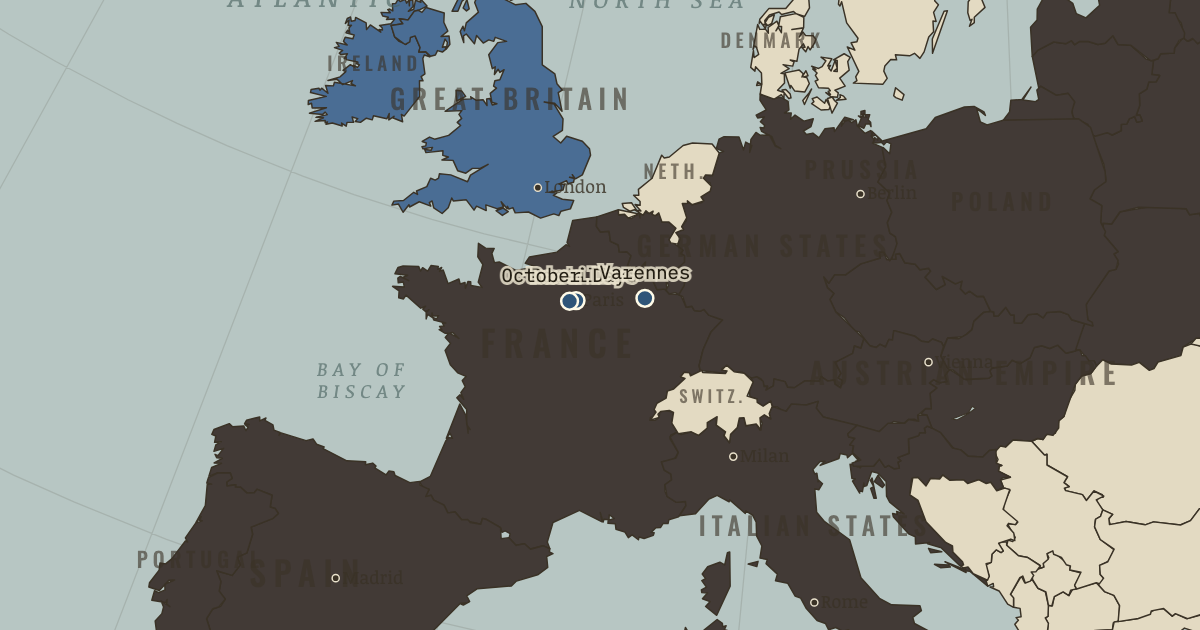
France’s government could not reliably tax the wealth it governed. Interest on war debt consumed much of the budget, while noble and Church privileges limited reform. The 1788 harvest failure raised bread prices just as the state sought new revenue. Louis XVI summoned the Estates-General, which had not met since 1614. Elections and written grievance lists gave millions of people a language and process for national change.
The short answer
- The bill for two empires’ wars. France fought Britain for a century and paid for America’s liberty last; unlike Britain, it had no parliament to legitimize taxes and no Bank of England to cheapen credit. Compare the mechanism of Chapter 1 — war → debt → taxation → representation crisis — now running at ten times the scale. The Estates-General was France’s version of “no taxation without representation,” summoned by the crown itself.
- Privilege without function. The nobility had traded political power (lost to Versailles) for tax exemption and honors — privileges increasingly impossible to justify to lawyers, merchants and philosophes who paid for the state but had no say in it. The Enlightenment did not cause the deficit; it made the deficit legible as injustice.
- Bread at fourteen sous. The 1788 hail and drought made 1789 the hungriest year in a generation. Ideas chose the targets, hunger supplied the crowds — the Bastille fell in the same week bread prices peaked. Most revolutions need both a philosophy and a bad harvest.
- The American precedent. French officers (Lafayette above all) came home from America having seen rights written down and armies of citizens win. The Declaration of 1789 was drafted with Jefferson consulting in Paris. Revolutions are contagious by correspondence.
THE TURNING POINT
The Bastille, 14 July 1789. Militarily trivial — seven prisoners, a hundred dead. Politically absolute: the king’s soldiers would not fire on Paris, and everyone saw it. Power had visibly moved from the crown to the street, and Louis’s appearance at the Hôtel de Ville in the tricolor cockade ratified it. The turn is not the fortress falling; it is the discovery that the old regime’s force was a bluff.
What it changed
Sovereignty changes its address. “The principle of all sovereignty resides essentially in the nation” — Article 3. Once stated, no throne in Europe is safe from the question, which is why every throne in Europe will eventually go to war with it.
The Church becomes a battlefield. Confiscating Church lands to back a new paper currency, then demanding clergy swear loyalty to the state, split every village in France in two. The counter-revolution of Chapter 4 — the Vendée above all — is born at the parish altar, not in émigré salons.
Varennes kills the middle ground. After the flight, republicanism moves from fringe to program; after the Brunswick Manifesto threatens Paris with “exemplary vengeance,” the crowd storms the Tuileries (10 August 1792) and the monarchy falls. Foreign threats radicalize revolutions — file the pattern.
Rights heard across the water. In Saint-Domingue, free men of color petition for the Rights of Man within months; the enslaved draw their own conclusions by 1791. Paris will spend a decade deciding whether its universal words were meant universally.
The full answer, argued
The monarchy had several exits, but each required surrendering privilege and building trust earlier. Fiscal equality in 1787–88 might have reduced the need for the Estates-General. Honest acceptance of the National Assembly in 1789 could have supported constitutional monarchy. Varennes was the last practical exit because the flight supplied visible evidence of bad faith. After that, war and royal vetoes confirmed suspicion. The monarchy was not doomed from the start; repeated resistance narrowed its choices until compromise no longer looked credible.
An interesting fact
The fallen Bastille had a brisk afterlife as merchandise: the contractor who demolished it, Pierre-François Palloy, had its stones carved into scale models of the fortress and dispatched one to each of the eighty-three new départements — revolution as souvenir, within the year. The prison’s great key traveled further still: Lafayette shipped it to George Washington in 1790 as “a tribute … from a missionary of liberty to its patriarch,” and it hangs at Mount Vernon to this day.
This is the study layer of French Revolution, chapter 3 of The Age of Revolutions, 1775–1848; the full index of the atlas is here.
Related questions
THE FREE PRINTABLE STUDY GUIDE
Join the Dispatch — a short welcome series, then a letter when a new atlas opens — and the printable study guide for The Age of Revolutions is yours now, free.
NO TRACKING · YOUR ADDRESS IS USED FOR THE DISPATCH AND NOTHING ELSE · UNSUBSCRIBE ANYTIME