Age of Revolutions · JAN 1804
Why is Haiti’s revolution the test of universal rights?
The seminar question: “The American, French and Haitian revolutions all claimed universal rights. Why is only Haiti’s treated as the test case?”
In Saint-Domingue, the world’s richest plantation colony, the enslaved outnumbered the free about ten to one and rose in 1791. Toussaint Louverture built an emancipated but still French order. Napoleon’s 1802 expedition captured him but was destroyed by Dessalines’ resistance and yellow fever; Haiti became independent in 1804.
Chapter 5 is part of membership. WW2 is free — every chapter. Try chapters 1–2 of any 2 other atlases (3 with a free account). Opening a new atlas uses one of them. Membership opens all 21 — Join.
Free printable Age of Revolutions study guide, sent by email ↓
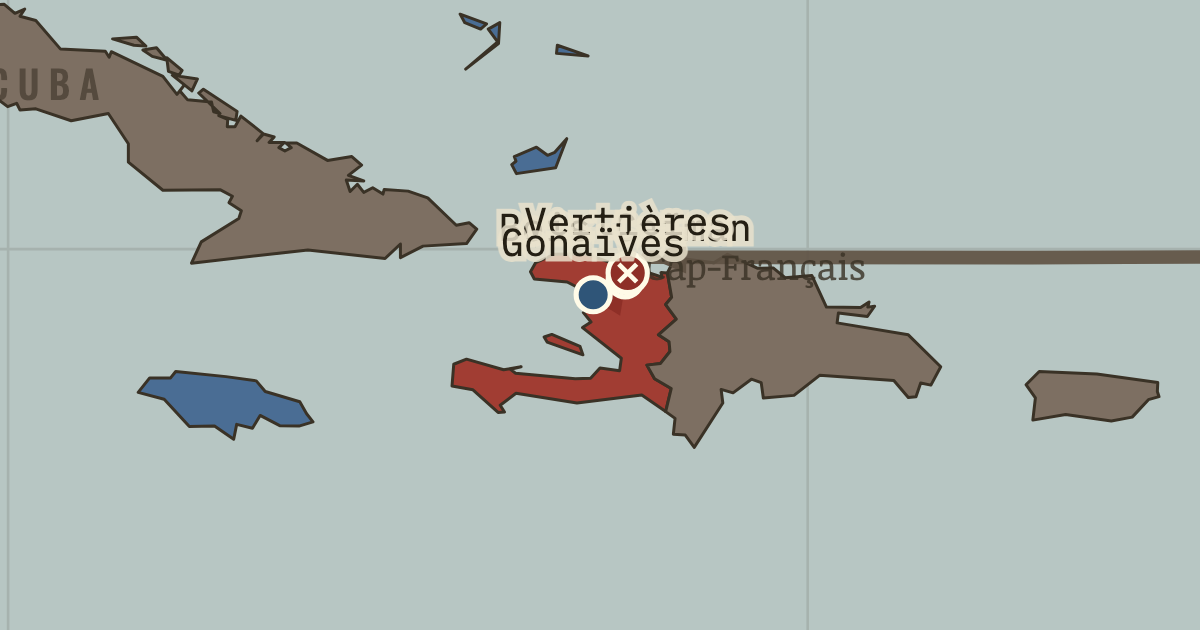
Saint-Domingue produced extraordinary sugar and coffee wealth through a labor regime with extreme mortality. The French Revolution split planters, poorer whites and free people of color over citizenship and authority. Enslaved organizers used that division. The August 1791 rising spread across the northern plain and made plantation rule impossible to restore without a major war.
The short answer
- The most concentrated tyranny produced the most total revolution. Saint-Domingue’s regime was demographically unlike North America’s: enslaved people outnumbered the free ten to one, most remembered African freedom, and plantation mortality made accommodation meaningless. Where the American revolution could compromise with slavery and the French could equivocate, here the question admitted no middle answer — which is why only here was it answered completely.
- A three-cornered opening. The Revolution split the colony’s masters — royalist planters, republican small whites, free people of color demanding citizenship — into open war with each other by 1791. The enslaved majority rose through the crack. Rule one of servile war, known since Sparta: the enslaved rise when the armed class divides.
- Emancipation as war policy, then as faith. Republican commissioner Sonthonax freed the north in 1793 to save it from Britain and Spain; Paris ratified in 1794; Toussaint then made the French Republic’s own principle the non-negotiable core of his state. When Napoleon revoked the principle, he converted an ambivalent colony into a nation with nothing to lose.
- The fever line. European armies in the Caribbean died of yellow fever at rates no strategy could absorb — Britain lost ~45,000 dead in the islands in the 1790s, Leclerc’s force upward of 40,000. Dessalines’ strategy explicitly counted on “the rainy season and its fevers.” Disease environments are combatants; ignore them and every colonial campaign in this atlas becomes unreadable.
THE TURNING POINT
Vertières, 18 November 1803. The only decisive battle in this atlas fought by former slaves against the army of the power that had freed and then re-enslaved them. Capois-la-Mort’s column, shot down four times, re-formed four times; Rochambeau evacuated Cap-Français within days. Beyond the island, the consequence was continental: with Saint-Domingue lost, Napoleon’s American empire had no anchor, and he had already sold Louisiana to the United States (April 1803) — doubling the republic of Chapter 2 as a side-effect of a revolution it refused to recognize.
What it changed
Quarantined for the crime of succeeding. The US embargoes trade (1806); France demands, at gunboat-point in 1825, an “indemnity” of 150 million francs — compensation to the enslavers, paid by the formerly enslaved — a debt not fully discharged until 1947. Haiti’s poverty is routinely cited without its invoice. Name the mechanism: the age’s powers made an example of the one revolution that took their own principles literally.
Terror in the master class, hope in the quarters. From Virginia to Brazil, planters tightened codes and censored news of Haiti; from Gabriel’s conspiracy (1800) to the German Coast rising (1811), the enslaved cited it anyway. Both reactions confirm what everyone understood: the thing was possible now.
The republic that armed the Liberators. In 1816, President Pétion gave the defeated Bolívar ships, muskets, printing press and men — on one condition: abolish slavery where you win. Bolívar’s emancipation decrees trace directly to that bargain. Haiti, unrecognized, was the age’s quiet arsenal of liberation.
The empire pivots east. “Damn sugar, damn coffee, damn colonies,” Napoleon reportedly said — and turned from the Atlantic to Europe. The army lost before Vertières was an army unavailable at Austerlitz’s price point; the American empire abandoned here funds the European one of the next chapter.
The full answer, argued
Haiti is the hardest test because applying universal freedom there destroyed the plantation property on which French wealth and white power depended. American leaders protected slavery; French governments abolished it under pressure and Napoleon restored it where possible. Haiti made emancipation the condition of national survival. The other revolutions still changed political rights, but their universal claims were least convincing where they imposed the greatest material cost. Haiti paid that cost and was then isolated by states afraid of its example.
An interesting fact
Boarding the ship that took him to France, Toussaint Louverture left a warning his captors recorded: “In overthrowing me, you have cut down in Saint-Domingue only the trunk of the tree of liberty. It will spring back from the roots, for they are numerous and deep.” He died on 7 April 1803, of pneumonia in an unheated cell at the Fort de Joux, nine hundred metres up in the Jura mountains — a prison chosen to be as far from the sea, and from Saint-Domingue, as France could contrive. Vertières proved him right seven months later.
This is the study layer of Haitian Revolution, chapter 5 of The Age of Revolutions, 1775–1848; the full index of the atlas is here.
Related questions
THE FREE PRINTABLE STUDY GUIDE
Join the Dispatch — a short welcome series, then a letter when a new atlas opens — and the printable study guide for The Age of Revolutions is yours now, free.
NO TRACKING · YOUR ADDRESS IS USED FOR THE DISPATCH AND NOTHING ELSE · UNSUBSCRIBE ANYTIME