Age of Revolutions · JUN 1810
Why could Napoleon beat Europe’s armies but not Spain?
The seminar question: “Why could Napoleon beat every army in Europe but not Spain?”
To enforce the Continental System, French troops crossed Spain toward Portugal in 1807, and Napoleon made his brother Joseph king of Spain. Madrid rose on 2 May 1808, a French corps surrendered at Bailén in July, and Spanish juntas, guerrillas and Wellington’s sea-supplied army pinned down hundreds of thousands of troops.
Chapter 7 is part of membership. WW2 is free — every chapter. Try chapters 1–2 of any 2 other atlases (3 with a free account). Opening a new atlas uses one of them. Membership opens all 21 — Join.
Free printable Age of Revolutions study guide, sent by email ↓
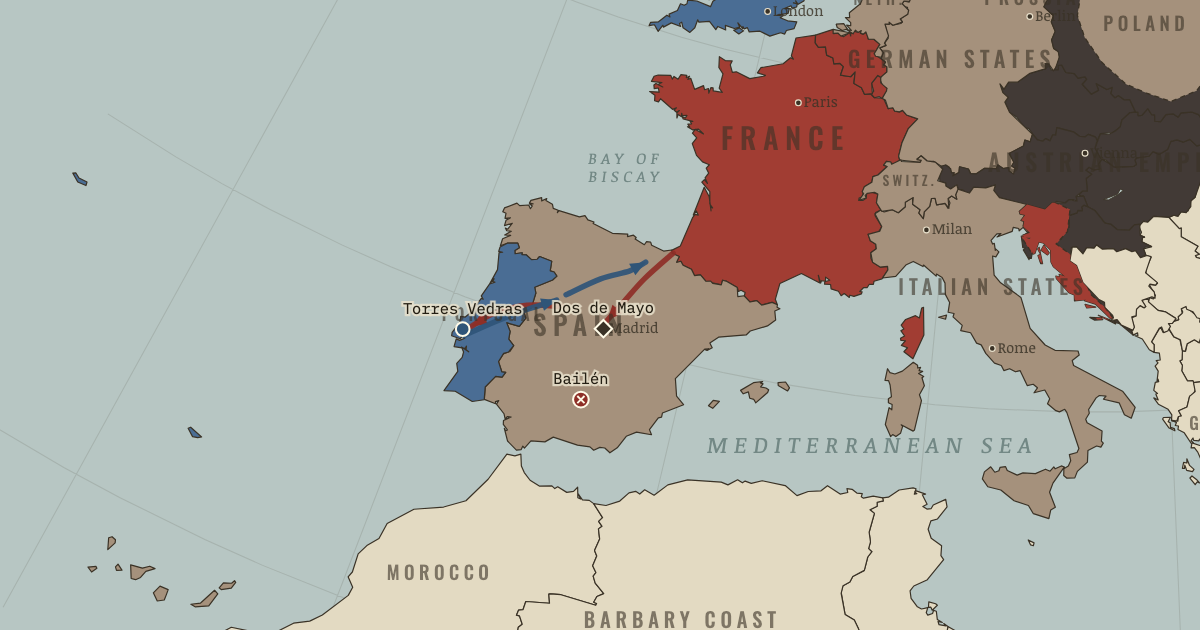
Napoleon could not invade Britain after Trafalgar, so he tried instead to close continental markets to British goods. Portugal refused to comply, so French troops crossed Spain in 1807, and Napoleon then forced the Spanish royal family to abdicate and installed his brother Joseph Bonaparte. Madrid rose on 2 May 1808 and was answered with severe reprisals. Local juntas, or emergency councils, then claimed authority in the absent king’s name.
The short answer
- Economic war without an exit. The Continental System hurt Britain (exports slumped, 1808 and 1811-12 were crisis years) but hurt the continent more — and made smuggling a patriotic industry from Lisbon to Riga. Its fatal property: it worked only if total, so every leak (Portugal, the Papal states, eventually Russia) demanded another occupation. A weapon that obliges you to conquer your own allies is pointed at yourself.
- Bayonne: legitimacy fumbled. In Italy or the Rhineland, French rule replaced foreign or feudal rulers and could pose as liberation. In Spain, Napoleon stole the crown of an intact, pious, proud nation by trickery at a conference table. The regime he installed was born illegitimate to every social class at once — and no battlefield victory converts illegitimacy into consent. He later called the Spanish affair the knot that strangled him.
- Insurgency plus sea power. Neither alone sufficed: guerrillas couldn’t take fortresses, Wellington couldn’t hold Spain against 250,000 men. Together — insurgents denying the French their intelligence and forage, the navy feeding Lisbon and Cádiz indefinitely — they created a war the Empire could neither win nor afford to leave. It is the age’s textbook on asymmetric alliance, still on the syllabus.
THE TURNING POINT
Bailén, 19 July 1808. Eighteen thousand imperial troops — admittedly second-line — surrender to Spanish regulars and levies in the Andalusian heat. Materially recoverable; symbolically fatal: the first capitulation of a Napoleonic army in the open field, gazetted in every capital in Europe. Austria began rearming within weeks (the 1809 war), and every conquered people recalibrated what was possible. Aura is a military asset with a single failure mode — Bailén was the crack, and Napoleon had to pour ever more real force in to cover what reputation had carried before.
What it changed
The veteran drain. Iberia became the Empire’s permanent second front: the men and horses lost there were precisely the professionals missing from the 1812 army, which had to be filled with allied conscripts of doubtful loyalty. Chapter 8’s catastrophe is partly a Spanish invoice.
Nationalism changes sides. Spain proved that the French formula — a people fighting as a nation — worked against France. Prussia’s reformers (Stein, Scharnhorst) rebuilt their state and army on the lesson; the wars of 1813 will be fought by nations, not dynasties, on both sides. The Revolution’s deepest export defeats its exporter.
Cádiz writes the liberal script. The 1812 Constitution — sovereignty of the nation, but a Catholic monarchy — becomes the template for Mediterranean and Latin American liberalism for thirty years; “liberal” itself enters the world’s vocabulary as a Spanish word. When Ferdinand returns and tears it up (1814), he creates the exact grievance the revolutions of 1820 will detonate on.
An empire decapitated across the ocean. With Spain’s king in French custody and its government a besieged junta, Spanish America’s cities face a legal void: to whom is loyalty owed? Their answer — juntas of their own, “conserving” sovereignty — is the door to independence, whatever its authors intend.
The full answer, argued
Napoleon’s system was designed to destroy a main army and dictate peace to a government. Spain denied that ending. Juntas survived occupation, guerrillas made dispersed control expensive and Wellington’s sea-supplied army prevented France from concentrating safely. Terrain and poor forage added cost, while Bayonne denied the regime legitimacy from the start. Napoleon kept winning battles, but no victory removed all three sources of resistance. His strength could seize capitals; it could not create consent or a final negotiating partner.
An interesting fact
Goya watched the war he painted, but his two great canvases of the Madrid rising — the Second of May and the firing squad of the Third of May — were made six years afterward, in 1814, when he petitioned the restored government for funds to “perpetuate by means of his brush the most notable and heroic actions of our glorious insurrection.” His private ledger of the war, the eighty-two etchings of The Disasters of War, he never dared publish; they first appeared in 1863, thirty-five years after his death.
This is the study layer of Peninsular War, chapter 7 of The Age of Revolutions, 1775–1848; the full index of the atlas is here.
Related questions
THE FREE PRINTABLE STUDY GUIDE
Join the Dispatch — a short welcome series, then a letter when a new atlas opens — and the printable study guide for The Age of Revolutions is yours now, free.
NO TRACKING · YOUR ADDRESS IS USED FOR THE DISPATCH AND NOTHING ELSE · UNSUBSCRIBE ANYTIME