Age of Revolutions · JUL 1807
Was Napoleon the Revolution’s heir or its gravedigger?
Napoleon inherited armies transformed by the Revolution and added fast concentration and unified command, winning from Italy in 1796 to Austerlitz in 1805. Taking power in the coup of 18 Brumaire in 1799, he issued the Civil Code while suppressing political liberty and restoring colonial slavery; Tilsit in 1807 marked his peak.
Chapter 6 is part of membership. WW2 is free — every chapter. Try chapters 1–2 of any 2 other atlases (3 with a free account). Opening a new atlas uses one of them. Membership opens all 21 — Join.
Free printable Age of Revolutions study guide, sent by email ↓
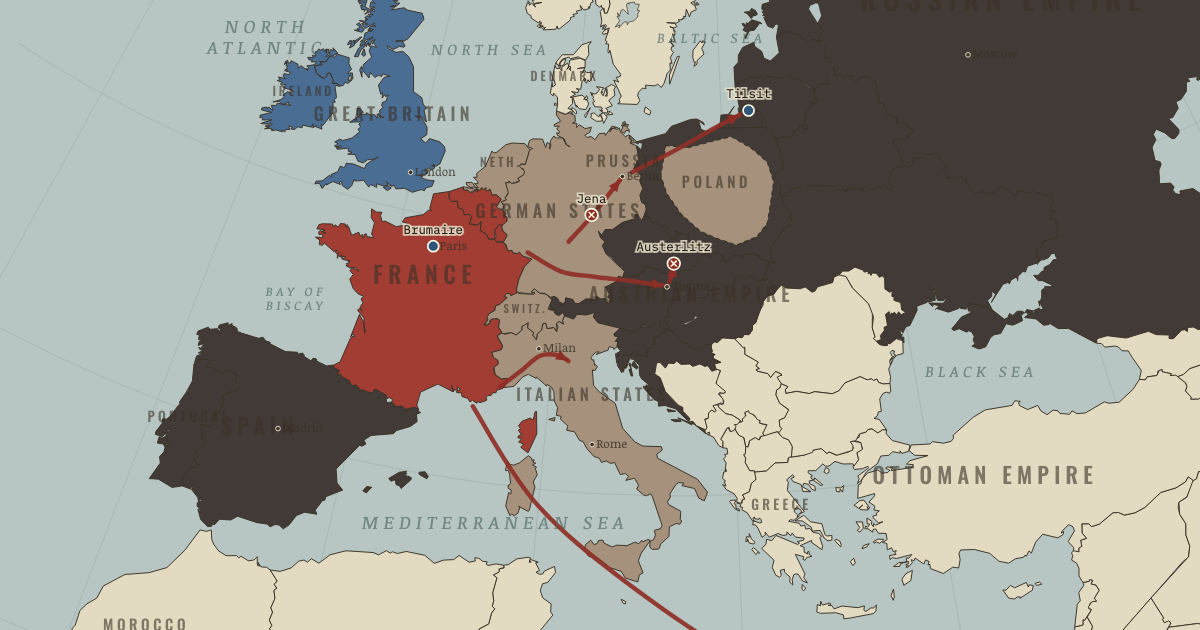
Napoleon’s rise can be read as a single campaign that began in Italy in 1796, where he used speed to separate enemy armies and defeat them in turn. His Egyptian expedition of 1798 showed both the reach and the limit of that method, since victory near the Pyramids was followed by strategic isolation once Nelson destroyed the French fleet. Returning to France, Napoleon helped overthrow the Directory in the coup of 18 Brumaire in 1799 and took power himself.
The short answer
- The Revolution built the weapon; he aimed it. Mass conscription, promotion by merit, armies that marched on requisition instead of magazines, divisions and corps that moved independently and concentrated to strike — all of it existed by 1794 (Chapter 4). Napoleon added operational genius and absolute unity of command. Old-regime armies — enlisted serfs, aristocratic officers, wagon-bound logistics — faced a system a generation ahead; Jena is what the gap looks like.
- France’s enemies fought retail. Austria, Prussia and Russia distrusted each other almost as much as France — Prussia sat out 1805, Austria sat out 1806-7, and each made separate peace when beaten. Napoleon defeated a coalition that never once fielded its full weight simultaneously. Remember this when it finally does (Chapter 9).
- Order as a product. After a decade of revolution, France wanted its gains guaranteed — land transfers, legal equality, careers — without further chaos. Brumaire succeeded because the Republic’s owners (peasant landholders, army, bourgeoisie) accepted a guarantor. Authoritarianism rarely sells tyranny; it sells the securing of a revolution’s winnings.
- Trafalgar closed the sea. The same fortnight as Ulm, Nelson destroyed the Franco-Spanish fleet (21 Oct 1805). After that no invasion of Britain was possible — so every victory had to be won on land against enemies Britain could always re-subsidize. Sea power set the terms: continental hegemony or nothing.
THE TURNING POINT
Austerlitz, 2 December 1805. The perfect battle, chosen deliberately: he abandoned the dominant Pratzen Heights to invite attack on his weakened right, then took the emptied center and rolled the allied army up. 27,000 allied casualties to 9,000 French; Austria signed within the month; Pitt looked at the map of Europe and said to “roll it up — it will not be wanted these ten years.” The turn cuts both ways: Austerlitz made the Empire — and made Napoleon incapable of believing any future problem lacked a battlefield solution. Spain and Russia will test that belief.
What it changed
Germany simplified, and awakened. From ~300 statelets to ~40; the Rhine Confederation gets the Code, secularized lands, modern administration — and French garrisons and conscription. Efficiency at bayonet-point plants exactly the national resentment that will fill Leipzig’s ranks in 1813. Fichte lectures in occupied Berlin on “the German nation”: the exported revolution is manufacturing its own gravedigger.
The Continental System declared. Unable to invade Britain, Napoleon decrees Europe closed to British trade (Berlin, 1806). Economic war requires sealing every coastline — a logic that will drag him into Portugal, Spain and finally Russia. The next chapter is this decree playing out.
Poland: hope on a leash. The Duchy of Warsaw (watch the tan patch on the Vistula) resurrects a Polish state eleven years after the final partition — and 100,000 Poles will fight for Napoleon in return. Vienna will erase it again in 1815; the loyalty and the betrayal both echo for a century.
The full answer, argued
He was both in different dimensions. The Civil Code, legal equality for men, careers open to talent and destruction of feudal privilege preserved the Revolution’s social settlement. Censorship, police rule, plebiscitary control, empire and restored colonial slavery destroyed much of its political liberty and universal promise. Calling him only heir ignores repression; calling him only gravedigger ignores durable reforms. He secured selected revolutionary gains by placing them under authoritarian administration.
An interesting fact
Napoleon shipped 167 scholars to Egypt alongside the soldiers — engineers, chemists, naturalists, artists — and their work outlasted his: the Description de l’Égypte, twenty-three volumes published over two decades, effectively founded Egyptology. Their greatest find they lost. The Rosetta Stone, dug up by soldiers strengthening a fort in 1799, passed to Britain with the capitulation of 1801 — yet it was a Frenchman, Champollion, who finally cracked the hieroglyphs in 1822, working from ink rubbings and copies.
This is the study layer of Rise of Napoleon, chapter 6 of The Age of Revolutions, 1775–1848; the full index of the atlas is here.
Related questions
THE FREE PRINTABLE STUDY GUIDE
Join the Dispatch — a short welcome series, then a letter when a new atlas opens — and the printable study guide for The Age of Revolutions is yours now, free.
NO TRACKING · YOUR ADDRESS IS USED FOR THE DISPATCH AND NOTHING ELSE · UNSUBSCRIBE ANYTIME