Age of Revolutions · SEP 1783
Could Britain have won the American Revolutionary War?
The seminar question: “Britain had the world’s best navy, deepest purse and most professional army. Make the case that it could never have won.”
The American Revolutionary War began at Lexington and Concord on 19 April 1775. The rebels needed only to keep an army and coalition alive; Burgoyne’s surrender at Saratoga in 1777 brought France in openly, and French troops and de Grasse’s fleet enabled the Yorktown trap in 1781. The 1783 peace recognized a new republic.
WW2 is free — every chapter. Try chapters 1–2 of any 2 other atlases (3 with a free account). Opening a new atlas uses one of them. Membership opens all 21 — Join.
Free printable Age of Revolutions study guide, sent by email ↓
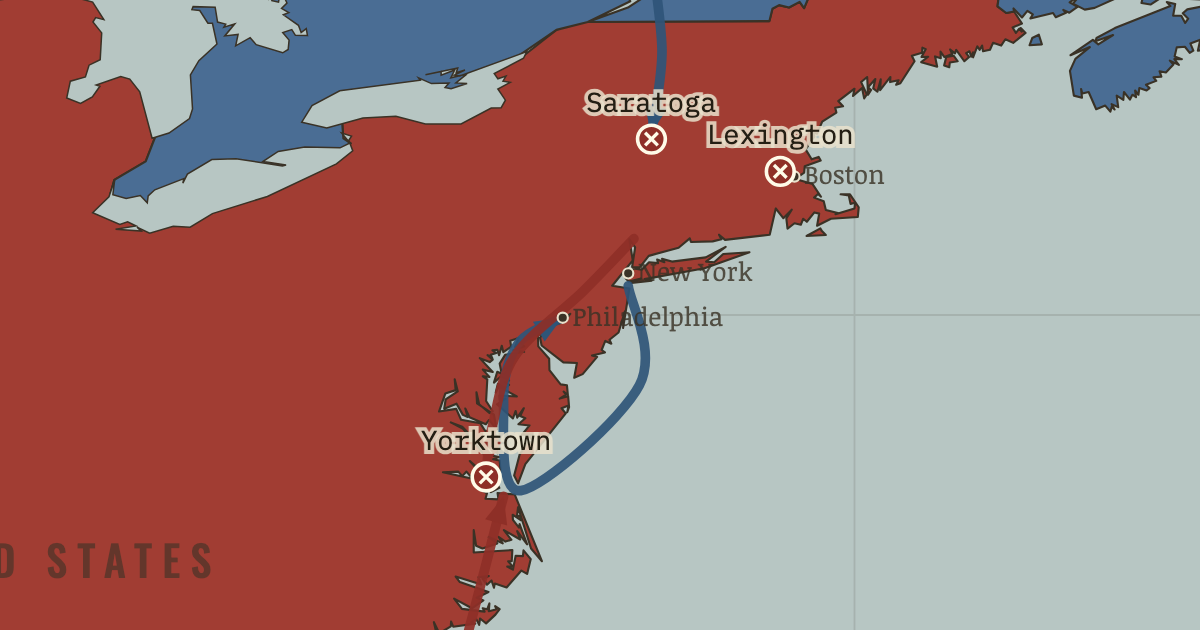
The fighting opened around Boston and immediately revealed the pattern that would decide the war. British troops sent to seize colonial military stores met local militia at Lexington and Concord on 19 April 1775 and suffered heavily on their retreat. Washington’s problem followed directly, because Britain could capture cities while the Continental Army could not risk destruction in one decisive battle, so keeping that army in existence was what kept Congress and foreign hopes alive.
The short answer
- Distance as a weapon. Britain had to project force 3,000 miles by sail — three months for an order and its answer. The rebels didn’t need to win; they needed to not lose long enough for London’s will and credit to crack. Insurgencies against distant powers keep rediscovering this arithmetic.
- Saratoga and the French wager. Vergennes had smuggled arms to the rebels from 1776 (most of the gunpowder at Saratoga was French). Open alliance in February 1778 brought a fleet, an army, and — decisively — a global war that stretched Britain past breaking. Revenge for 1763 was the motive; the 1.3 billion livres it cost will be the Bastille’s down payment.
- A militia society. The colonies had armed, self-governing local institutions a century old. Britain could take any city (and did — New York, Philadelphia, Charleston) yet control nothing beyond musket range of its garrisons. Political infrastructure, not marksmanship, made the rebellion unkillable.
THE TURNING POINT
Saratoga, 17 October 1777. A plan drawn in London — three columns converging on Albany — dissolved in American woods: Howe went to Philadelphia instead, and Burgoyne, cut off, surrendered 5,800 men. The battlefield mattered less than the news of it in Paris: within four months France signed the alliance. The hinge of the war was the moment it stopped being one war and became Britain against a world coalition.
What it changed
A constitution that exports. The state constitutions, then the federal one of 1787 — written, ratified, amendable — turn Enlightenment theory into working precedent. Every revolutionary from Paris to Caracas will carry the American example, agreeing or arguing with it.
What was not revolutionized. Half a million people remain enslaved; the Constitution counts them as three-fifths and shields the slave trade for twenty years. Northern states begin gradual abolition, and tens of thousands of Black Loyalists leave with the British — having judged, reasonably, that liberty wore a red coat. The revolution’s greatest word and greatest silence share one document.
The losers of the peace. Native nations — most of whom had fought with Britain precisely to stop settler expansion — appear nowhere in the Treaty of Paris, which hands their lands to the republic on paper. The frontier wars that follow are the revolution’s longest, least-remembered consequence.
France wins the war and loses the treasury. Glorious, victorious, and broke: the war costs France ~1.3 billion livres, all borrowed. Interest now devours half the royal budget. The road from Yorktown runs straight to the Estates-General.
The full answer, argued
Britain could have defeated the Continental Army, especially in 1776, so victory was not impossible. The harder task was restoring durable control over self-governing communities across a large coast. After France entered, Britain also had to defend more valuable positions worldwide. City occupation addressed the field army but not the political network supporting rebellion. The war became unwinnable at acceptable cost when local resistance, Atlantic distance and global coalition pressure operated together.
An interesting fact
The Revolution’s deadliest ground was not a battlefield but an anchorage: more Americans died aboard Britain’s prison hulks in New York’s Wallabout Bay — perhaps 11,000, though estimates run higher — than were killed in every battle of the war combined, roughly 6,800. Survivors of the worst ship, the Jersey, called her “Hell afloat.” The bones of the dead kept washing out of the Brooklyn shoreline for decades, until a crypt at Fort Greene finally gathered them in 1908.
This is the study layer of American Revolutionary War, chapter 2 of The Age of Revolutions, 1775–1848; the full index of the atlas is here.
Related questions
THE FREE PRINTABLE STUDY GUIDE
Join the Dispatch — a short welcome series, then a letter when a new atlas opens — and the printable study guide for The Age of Revolutions is yours now, free.
NO TRACKING · YOUR ADDRESS IS USED FOR THE DISPATCH AND NOTHING ELSE · UNSUBSCRIBE ANYTIME