Chinese Revolution · 1926
Could the First United Front have survived beyond 1927?
The seminar question: “Could the First United Front have held — or was the 1927 rupture written into its founding documents?”
With Soviet aid, Sun Yat-sen rebuilt the Nationalist Party, and the Whampoa Academy, founded in 1924, trained officers loyal to party and doctrine, with Communists inside the First United Front. The Northern Expedition of 1926 won the south by early 1927 as warlord units defected.
Chapter 4 is part of membership. WW2 is free — every chapter. Try chapters 1–2 of any 2 other atlases (3 with a free account). Opening a new atlas uses one of them. Membership opens all 21 — Join.
Free printable Chinese Revolution study guide, sent by email ↓
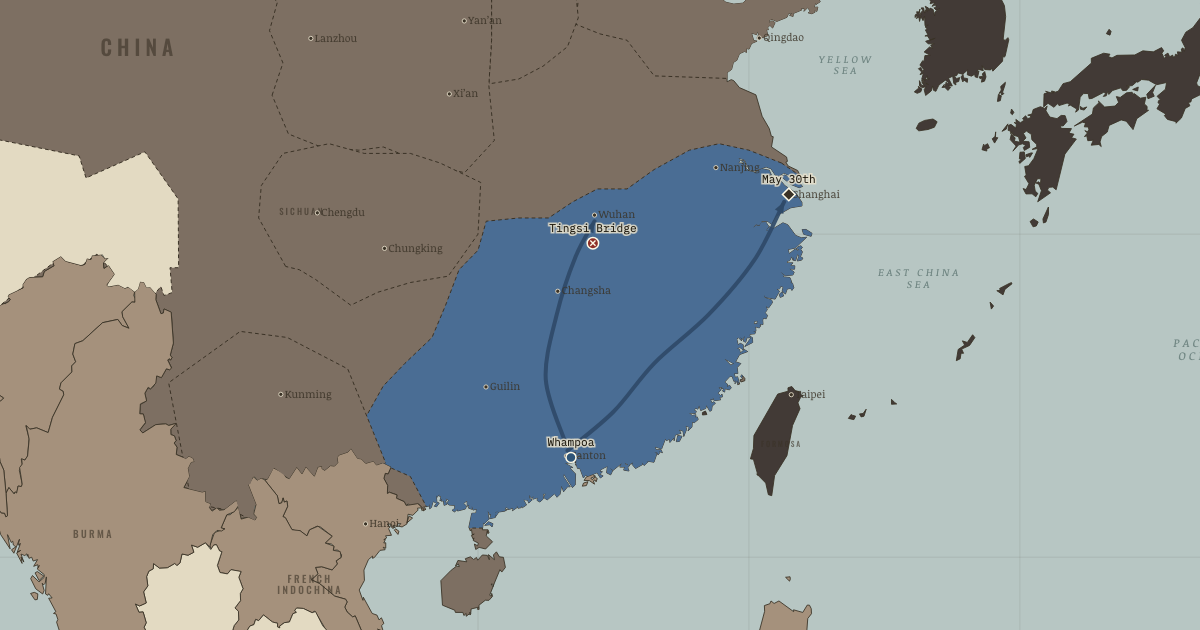
A party-army fuses military command with a political organization, a doctrine and a system of discipline. By the mid-1920s the blue in the south was being turned into exactly that kind of machine. In 1923 Sun Yat-sen struck his bargain with Moscow, which sent money, rifles and, more important than either, organizers led by Michael Borodin. Borodin rebuilt the Nationalist Party as a Leninist pyramid of cells and committees, with the tiny CCP folded inside it. On an island below Canton the alliance founded what China had never possessed, an officer academy whose cadets swore loyalty to a party and a doctrine rather than to a paymaster (the ● at Whampoa). Its commandant was a sharp, austere soldier named Chiang Kai-shek, and its political department was run by a polished young Communist named Zhou Enlai. Nearly every commander of every war left in this atlas, on both sides, passed through Whampoa’s first classes. Then, in May 1925, British-officered police fired into a Shanghai crowd (the ◆ on the Bund), and the empire-wide strike wave that followed handed Canton a mass movement to lead.
The short answer
- The Soviet package: party, army, mass line. What Moscow exported was not Marxism (Borodin was under orders to keep the revolution “national”) but Leninist technique: a party organized in cells, an army with political commissars, agitation as a weapon system. Sun took the deal after every Western power had declined him. The transfer worked frighteningly well — well enough that both of its Chinese students would spend 1927–49 using it against each other.
- Nationalism with an address. May 30th, 1925, converted diffuse resentment into a movement with a target (the treaty system) and a headquarters (Canton). The Hong Kong–Canton strike and boycott that followed lasted sixteen months and mobilized hundreds of thousands — proof that the new politics could discipline a mass public. The Northern Expedition marched into that prepared emotional country. Its slogans (“down with the unequal treaties,” “down with the warlords”) required no explanation anywhere in China.
- The warlords could not combine. The cliques’ system, built on capturing rather than destroying each other, had no mechanism for facing an ideological enemy: Wu Peifu and Sun Chuanfang fought the NRA separately and fell separately, while Zhang Zuolin husbanded Manchuria. Fifteen years of treating armies as businesses had produced soldiers with no reason to die for their employers — the NRA’s defection rate is the warlord balance sheet coming due.
- Whampoa as the multiplier. A few thousand cadets should not conquer half a country, but Whampoa produced something warlord China lacked entirely: junior officers who led from the front and units that did not dissolve under fire. The academy’s casualty rates in the Eastern Expeditions and the march north were extraordinary. So was the loyalty it created — to the party in theory, and in practice, fatefully, to its commandant.
THE TURNING POINT
Whampoa, June 1924. Choose the founding over any battle: Tingsi Bridge was won by the kind of army Whampoa existed to create, and the campaign was won by dozens of Tingsi Bridges. The academy is the hinge because it settled HOW modern Chinese power would be organized — a party-army, indoctrinated, commissar-supervised. Both regimes of the next sixty years are its graduates. When you cannot find the turning point on a battlefield, look for the institution that made the battlefields redundant.
What it changed
Two victors inside one victory. By spring 1927 the United Front holds the Yangtze. It has become two rival governments (Wuhan’s left KMT with the Communists. Chiang with the army and, soon, Shanghai’s bankers). United fronts are marriages of schedule: each partner intended to discard the other after victory, and victory has arrived.
The peasant association explosion. In Hunan the associations the expedition licensed claim millions of members and begin settling scores with landlords ahead of any party decision — Mao’s 1927 “Hunan Report” reads the violence as the revolution’s real engine. It terrifies the NRA’s officer corps, whose families own the land in question: the class question will split the front before the year is out.
The powers pick a Chinese partner. Nanking’s foreign gunboats and Shanghai’s Settlement barbed wire (1927) mark the treaty powers’ alarm. But London and Washington are already concluding that a Chiang-led order beats endless disorder, and begin the slow trade of treaty privileges for stability. The revolution is splitting into a wing the world can do business with and a wing it cannot.
The full answer, argued
Structurally it looks doomed: the Comintern’s own instructions described the KMT alliance as a temporary vehicle the CCP would eventually capture, and Chiang’s faction reciprocated the intention. Two Leninist parties sharing one army is a succession crisis with a flag. But contingency deserves its due — Sun’s early death in March 1925 removed the one figure both wings obeyed. Chiang’s March 1926 Zhongshan gunboat coup, which clipped Communist influence a full year before the purge, went unanswered by a Moscow distracted by the Stalin–Trotsky fight (China policy was a weapon in that quarrel, and Stalin ordered the CCP to stay in an alliance he could not afford to see fail). A fair verdict: rupture was overdetermined, but its timing, violence and victor were not — a Wuhan-led front surviving into 1928, or a purge before the expedition rather than after, were live possibilities with very different maps attached. Distinguish the doomed from the merely unstable. The difference is where statesmanship lives.
An interesting fact
The Northern Expedition’s commanders became a reunion in both later Chinas. Whampoa’s first classes and staff supplied not only Chiang’s marshals but five of the ten Marshals of the People’s Liberation Army created in 1955 — Xu Xiangqian of the first class, Lin Biao of the fourth, and Ye Jianying, Nie Rongzhen and Chen Yi from the academy’s staff and political departments. The men who destroyed Chiang’s armies in 1948–49 had learned their trade in his academy, under Zhou Enlai’s political department — the civil war was, among other things, Whampoa’s faculty meeting resumed by other means.
This is the study layer of Northern Expedition and United Front, chapter 4 of China in Revolution, 1911–1949; the full index of the atlas is here.
Related questions
THE FREE PRINTABLE STUDY GUIDE
Join the Dispatch — a short welcome series, then a letter when a new atlas opens — and the printable study guide for China in Revolution is yours now, free.
NO TRACKING · YOUR ADDRESS IS USED FOR THE DISPATCH AND NOTHING ELSE · UNSUBSCRIBE ANYTIME