Chinese Revolution · 1935
How much of the Long March’s importance is myth?
The seminar question: “How much of the Long March’s significance is myth-making — and does the myth-making diminish or constitute its importance?”
The Long March of 1934–35 began as a forced escape from the collapsing Jiangxi Soviet. The column lost perhaps half its strength at the Xiang River, Mao joined the military leadership at Zunyi in January 1935, and survivors reached Shaanxi in 1935 after crossing snow mountains and grasslands.
Chapter 7 is part of membership. WW2 is free — every chapter. Try chapters 1–2 of any 2 other atlases (3 with a free account). Opening a new atlas uses one of them. Membership opens all 21 — Join.
Free printable Chinese Revolution study guide, sent by email ↓
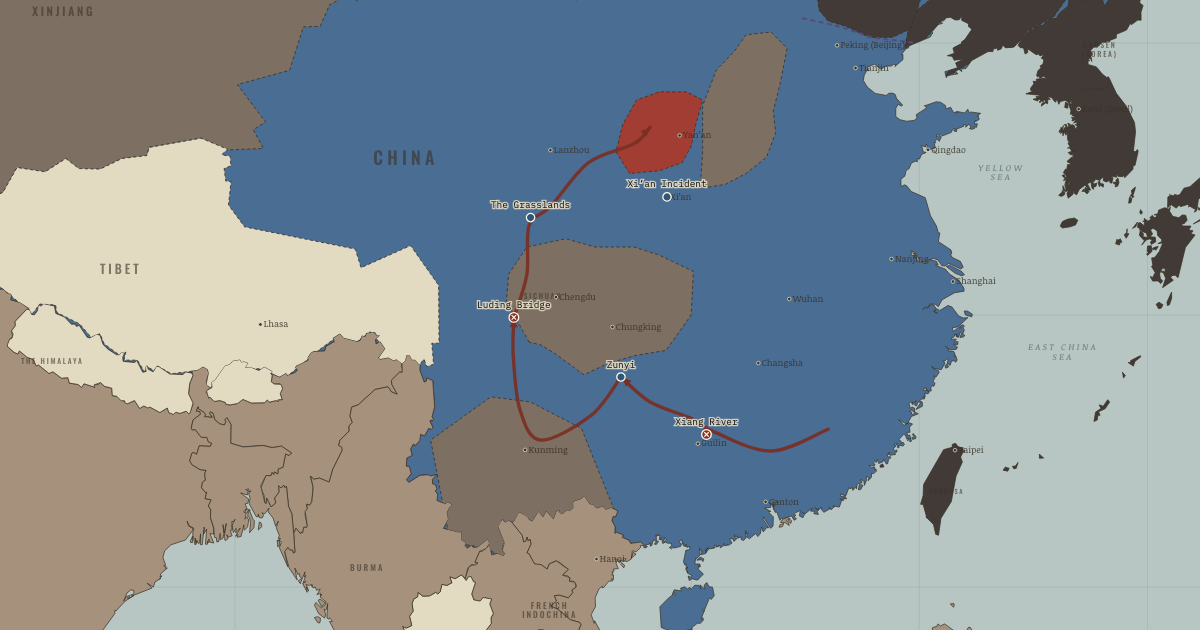
The Long March was a sequence of retreats and regroupings that was later shaped into a founding story, and the three red arrows on the map trace one continuous line some 9,000 kilometers long. The chapter exists because, between October 1934 and October 1935, the Communist revolution held no territory at all. The column that broke out of Jiangxi was a state in motion, 86,000 people hauling archives, treasury and machine tools. It moved like one too, in a slow box that the pursuit caught at the Xiang River (the ✕). Four days of crossing under fire cost perhaps half the column, dead, drowned or deserted. Disaster then did what disaster does inside a Leninist party, which is to discredit the incumbents. At Zunyi in January 1935 (the ●), in a merchant’s upstairs room, the surviving leadership turned on the Comintern-backed commanders, and Mao Zedong, sidelined for two years, joined the military leadership. The march changed character at once, with feints, doubling-back and split columns, and the fourfold crossing of the Chishui left the pursuit’s maps a mess of contradictory arrows.
The short answer
- Breakout was forced, direction was chosen. Leaving Jiangxi was arithmetic (Chapter 6), but everything after was decision: west along the watersheds because the pursuit and the warlord armies were thinnest there. North from Zunyi because “north to fight Japan” converted retreat into a claim on nationalism — strategy and propaganda in one compass bearing. Shaanxi was not the destination until late. The march discovered its endpoint en route, which is worth remembering when it is narrated as destiny.
- Zunyi: defeat reorganizes power. The conference worked because the Xiang River had made the old line indefensible and because the Comintern’s radio link was down — Moscow could not veto. Mao’s ascent was neither complete (he shared command. His supremacy took years and rectification campaigns to finish) nor inevitable. It was the promotion of the man whose methods had won the campaigns the leadership had lost by abandoning. Institutions that can change command after failure survive. The KMT’s wars will offer the counterexample.
- Warlord geography as corridor. The route ran deliberately through provinces (Guizhou, Yunnan, Sichuan’s edges) whose warlords feared Chiang’s pursuing armies as much as the Reds — several fought just hard enough to usher the column out, unwilling to let central troops “assist” them into subjugation. The fracture painted in Chapter 3 became the Long March’s escape lane: the CCP was saved, in part, by the incoherence of its enemies’ coalition.
- Survival as selection. What arrived in Shaanxi was not a defeated army but a distilled one: the survivors were disproportionately young, hardened cadres bound by an experience no one else shared — the future elite of party and army for fifty years (of the marchers, a striking share of the PRC’s first leadership). Catastrophe functioned as a loyalty filter no recruitment drive could have designed.
THE TURNING POINT
Zunyi, 15–17 January 1935. The march’s military escapes — Luding, the Grasslands — saved bodies. Zunyi decided what the bodies would be for. It ended imported strategy as the party’s operating system, promoted the commander the next fourteen years would vindicate, and established the precedent (defeat is examined, leadership is accountable to results) that distinguished the CCP’s wars from its rival’s. Revolutions hinge on conferences more often than on bridges — the bridges just photograph better.
What it changed
Yan’an becomes the laboratory. In the loess country the party builds the model it will scale after 1945: rent reduction rather than terror, village elections it can steer, army units that farm, cadres schooled (and purged) in rectification. Edgar Snow’s 1936 visit exports the legend. The base the legend advertises is the small red zone your map keeps through 1947.
The united front against Japan. Xi’an suspends the civil war on terms nobody trusts: the Red Army renumbers itself the Eighth Route Army under nominal Nationalist command. Both parties prepare for the war after the war. Chiang, released, becomes the symbol of national resistance. Eight months later, at Marco Polo Bridge, the resistance begins.
The myth becomes an instrument. The Long March is retold — beginning with the party’s own 1930s collections — as founding epic: proof that the party could not be killed. The myth recruited students in 1937 and legitimated leadership in 1949. Its inflation (and the fate of teller-of-inconvenient-versions) is part of the same story. States are built of such stories. Historians are allowed to check the mileage.
The full answer, argued
Audit the ledger honestly. The traditional 25,000 li (12,500 km) is an overstatement — two British writers who walked the route in 2002–03 measured roughly half that. Luding Bridge’s twenty-two heroes grew in the telling (survivors’ accounts differ on the fire and the defenders). And the march was, by any military accounting, a catastrophic defeat: nine-tenths of the force lost. Yet the exaggerations were doing historical work in real time — “the Red Army cannot be destroyed” recruited the students of 1936–37, awed the war correspondents, and disciplined the party’s own memory. Mao called the march a manifesto and a seeding-machine, which was a claim about the future that the future then honored. The mature position is neither debunking nor reverence: the Long March matters because a movement reduced to a few percent of itself retained the cadre, doctrine and story from which a state could be regrown. The story was one of the assets. For any regime you study, list the founding myth among its instruments of rule, then check its arithmetic separately.
An interesting fact
About thirty women made the First Front Army’s march from Jiangxi, selected largely for political rank and physical endurance; they included Mao’s pregnant wife He Zizhen, who gave birth on the route and left the infant with a peasant family, as marchers’ children almost always were — the column could carry printing presses but not cries in the night. Several of the thirty later held senior rank in the People’s Republic, among them Kang Keqing, Zhu De’s wife, who had marched as a soldier with a rifle. The march’s demography is its own document: a revolution young enough that its long march was made by people mostly in their teens and twenties, led by men barely past forty.
This is the study layer of Long March, chapter 7 of China in Revolution, 1911–1949; the full index of the atlas is here.
Related questions
THE FREE PRINTABLE STUDY GUIDE
Join the Dispatch — a short welcome series, then a letter when a new atlas opens — and the printable study guide for China in Revolution is yours now, free.
NO TRACKING · YOUR ADDRESS IS USED FOR THE DISPATCH AND NOTHING ELSE · UNSUBSCRIBE ANYTIME