Chinese Revolution · 1934
Did the Jiangxi Soviet rule by land reform or by coercion?
The seminar question: “Did the Jiangxi Soviet win its peasants by land reform — or hold them by coercion? What would evidence for each look like?”
In 1931 Japan’s Kwantung Army staged the Mukden Incident and seized Manchuria, while the Communists governed a rural soviet at Ruijin through land reform, courts and currency. The Nationalists’ fifth encirclement campaign used blockhouses and blockade, and after defeat at Guangchang in 1934 the Communists broke out.
Chapter 6 is part of membership. WW2 is free — every chapter. Try chapters 1–2 of any 2 other atlases (3 with a free account). Opening a new atlas uses one of them. Membership opens all 21 — Join.
Free printable Chinese Revolution study guide, sent by email ↓
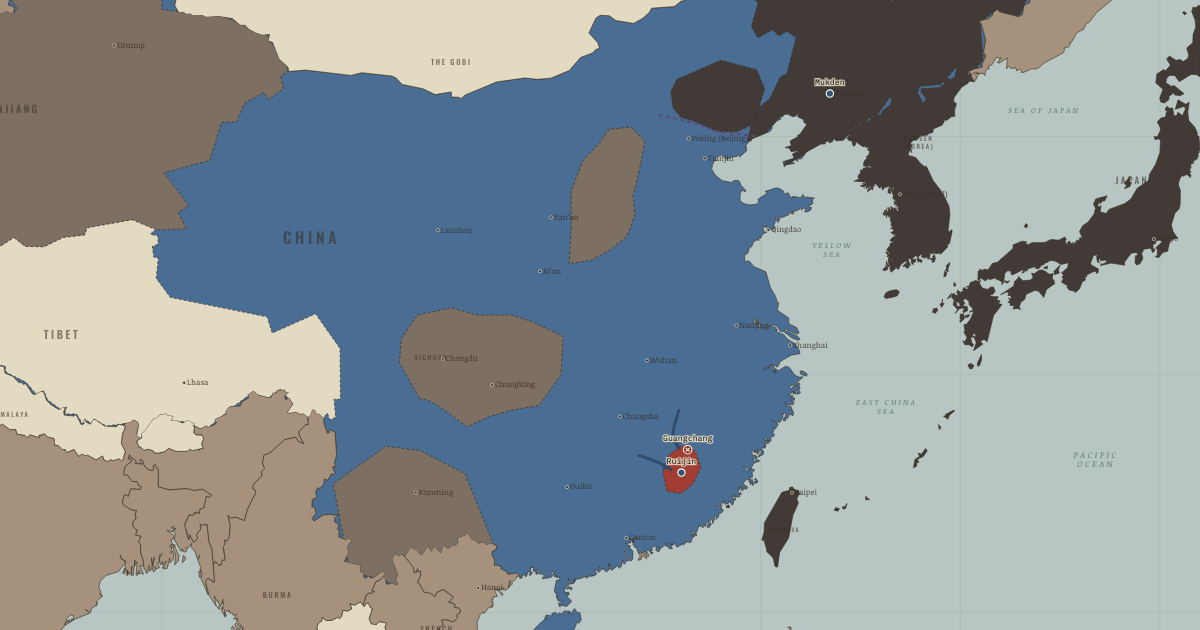
An encirclement campaign works by isolating a base, cutting its supplies and destroying it from the outside inward. Within fourteen months two rival states were proclaimed against Nanjing, and the map now carries both. Consider the northeast first. On 18 September 1931 Kwantung Army officers bombed their own railway outside Mukden (the ● there), blamed China, and overran Manchuria in five months. They acted against Tokyo’s instructions and to loud Japanese public applause. In March 1932 the conquest was dressed up as “Manchukuo,” with the last Qing emperor Puyi installed as its puppet. In 1933 Jehol was annexed, and the Tanggu Truce, the dashed line along the Great Wall, demilitarized everything north of Peking as a concession by another name. Chiang, then mid-campaign against the Communists, ordered non-resistance and appealed to the League of Nations, whose commission duly reported the truth and changed nothing. The charcoal here records the world’s security system failing its first great test, eight years before Europe’s.
The short answer
- Manchuria: an army making foreign policy. The Kwantung Army acted because it could: Huanggutun had proven field officers faced no consequences. The Depression had gutted civilian government prestige in Tokyo. And Manchuria held the coal, iron and “lifeline” mythology of army planning. The conspirators (Ishiwara above all) expected — correctly — that success would be ratified. The deeper cause was constitutional: an army answerable to the throne alone, in a state where no one else could say no.
- Non-resistance as a considered bet. Chiang’s “first internal pacification, then external resistance” was strategically argued, not only craven: China in 1931 had no navy, no air force to speak of, and armies that Japan had smashed in days whenever tested. Fighting then, he judged, meant losing everything. Buying time meant Germany-trained divisions, a currency, roads. The bet’s cost was paid in legitimacy — every year of non-resistance recruited for his critics, and eventually his own generals (Chapter 7’s Xi’an) called it in.
- Land revolution as state-building. The soviet grew because it solved, locally and violently, rural China’s central problem: rent, debt and taxes that took half or more of a poor family’s crop. Redistribution bought the loyalty of the many with the property of the few, and conscription rode on gratitude and terror together. Note the design: the CCP was no longer organizing workers against employers but governing peasants against landlords — the strategic discovery of the entire revolution.
- The Comintern line meets Chinese terrain. The soviet’s Moscow-backed leadership (the “28 Bolsheviks,” and the Comintern adviser Otto Braun) treated the base as a state to be defended at its borders — regular warfare, fixed lines. Mao’s mobile doctrine, which had beaten four campaigns, was set aside in 1932–33 with his sidelining. Against blockhouses, regular defense meant attrition China’s smaller army could only lose. Doctrine imported without terrain attached: the mistake Zunyi will spend Chapter 7 correcting.
THE TURNING POINT
Guangchang, April 1934. Mukden changed the world more, but within this chapter’s war the hinge is Guangchang: the battle that proved the Fifth Encirclement could not be out-fought by the methods the leadership insisted on, and therefore forced the breakout. Every consequence cascades from it — the Long March, Zunyi, Mao’s ascent, Yan’an. When a system fails, the pivotal moment is usually not the catastrophe but the demonstration that made the catastrophe unavoidable.
What it changed
The breakout becomes the Long March. What leaves Ruijin in October 1934 is a moving state — printing presses, archives, an arsenal on carrying poles — headed for a defeat at the Xiang River that will kill half of it and discredit the leadership that ordered the column to march as a convoy. The road to Zunyi begins at Guangchang.
Manchukuo industrializes for the next war. Japan pours investment into Manchuria — railways, the Shōwa steel works, whole planned cities — building the industrial base from which it will invade China proper in 1937 and which, captured in 1945, will arm the Communists in 1946–48. The same factories serve three different wars in this atlas.
The League’s failure is filed for reference. Japan walks out of Geneva in 1933 and keeps Manchukuo. The powers accept it in practice. Mussolini and Hitler both read the file. For IB purposes this is the cleanest early case study of collective security’s core defect: it asked status-quo powers to pay real costs for abstract rules, and they declined.
The full answer, argued
The land-reform reading has strong support: recruitment soared where redistribution ran deepest, and Nationalist restoration of landlords behind the advancing blockhouses re-taught the difference village by village. But the coercion evidence is not deniable: the Futian purge killed thousands of Red Army men as “AB League” infiltrators on confessions extracted by torture. Grain levies and conscription in the blockaded years grew as heavy as any warlord’s. And flight from the soviet rose as the ring closed. The methodological point is the valuable one: both readings draw on sources with agendas — party memoirs sanctify, Nationalist reports demonize, and the soviet’s own archives record what cadres wished to report. Chen Yung-fa and others have shown consent and coercion were not alternatives but instruments used together, in proportions that shifted with military pressure. Write that sentence into any essay on revolutionary support: mass support is rarely a fact about hearts. It is a fact about options.
An interesting fact
The Chinese Soviet Republic behaved like a state to a degree that still surprises: it issued its own silver coins and banknotes (the “National Bank” was run out of a courtyard by Mao’s economist Lin Boqu with a staff counted on two hands), sold state bonds, and legislated. Its 1931 marriage regulations were among the most radical on earth — marriage by mutual consent, divorce on demand by either party, a ban on bride-prices — and were enforced enough to be complained about, especially by soldiers’ families. However short its life, the Ruijin state was the CCP’s dress rehearsal in currency, taxation and family law for governing a fifth of humanity.
This is the study layer of Jiangxi Soviet and the encirclements, chapter 6 of China in Revolution, 1911–1949; the full index of the atlas is here.
Related questions
THE FREE PRINTABLE STUDY GUIDE
Join the Dispatch — a short welcome series, then a letter when a new atlas opens — and the printable study guide for China in Revolution is yours now, free.
NO TRACKING · YOUR ADDRESS IS USED FOR THE DISPATCH AND NOTHING ELSE · UNSUBSCRIBE ANYTIME